




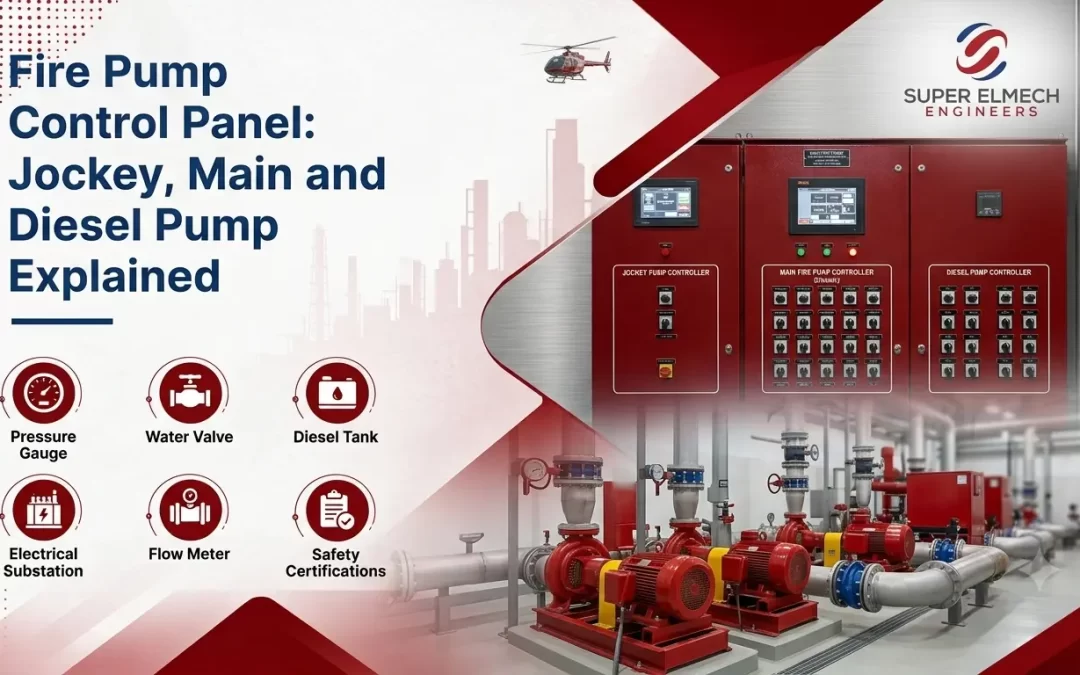
A guide to the operation, components, technical requirements, testing and selection of jockey, main electric and diesel fire pump control panels.
Fire protection systems are critical in commercial, factory, warehouse, hospital, hotel, and industrial facilities. An effective system will consist of hydrants, sprinklers and water tanks but also a well designed fire pump control panel.
The fire pump control panel will control, monitor and manage the operation of the jockey pump, main electric pump and diesel engine standby pump in-line with the approved fire protection design.
Each pump will have a different role to play. The jockey pump will maintain pressure in the pipeline, the main fire pump will provide the flow rate to fight a fire and the diesel pump will provide an alternate pumping solution.
Having an understanding of how these pumps operate will help the builder, electrical contractor, MEP consultant, fire safety professional or facilities manager choose the correct fire pump control panel.
In this guide we will explain how the fire pump control panel operates, what components are included, how it operates in automatic mode, technical requirements, testing and maintenance.
Table of Contents
What Is a Fire Pump Control Panel?
Why Is a Fire Pump Control Panel Important?
Understanding the Three Main Fire Pumps
How Does a Jockey, Main and Diesel Pump System Work?
Automatic and Manual Operating Modes
Important Components of a Fire Pump Control Panel
Electrical and Technical Requirements
Difference Between Jockey, Main and Diesel Pumps
Applications of Fire Pump Control Panels
Important Standards and Design Considerations
Testing and Maintenance
How to Select the Right Fire Pump Control Panel
Why Consider Super Elmech Engineers?
Frequently Asked Questions
What Is A Fire Pump Control Panel?
Conclusion
What Is The Main Role Of A Fire Pump Control Panel?
To help ensure the fire fighting pump system is responding correctly to low pressures.
It will help the operator to understand if the pump is available, in operation, any electrical issues etc.
With the correct engineering a fire pump control panel will;
Provide automatic starting of pumps in line with approved settings
Manual operation of pumps
Indications of pump operation & faults
Coordinate electric and diesel pumping
Electrical control and protection
Remote indication
Why Is A Fire Pump Control Panel Important?
A fire pump system needs to be ready to provide water to the fire fighting network. A control panel will help this by controlling the electrical operations.
Automatic Start
The pressure switches will monitor the pressure in the fire fighting system. If the pressure falls below the set point the relevant controller will receive an input to start the pump.
The pressure is dependent upon the approved system design.
Multiple Pumps
Commercial and industrial systems can have multiple pumps each with varying capacities.
The control panel will help this by coordinating the jockey, main and standby pump in line with the approved sequence.
Indications
The panel can provide;
Supply available
Pump running
Pump failure
Auto/Manual
Phase failure
Low pressure
Diesel failure
Battery charger failure
Common Alarm
The final indications should be confirmed from the project drawings.
Reliable Operation
Having the correct panel, wiring, components and undertaking regular testing will ensure the fire fighting pump is ready.
Understanding The Three Types Of Fire Pumps
There are three common types of fire pumps within a fire protection system. The jockey pump, main fire pump and diesel standby pump.
Whilst they are part of the same system they will have different roles.
Jockey Pump – Maintain Pressure In Pipeline
A jockey pump is a small capacity pump that will help maintain the pressure in the fire fighting water system.
Small pressure drops can occur due to slight leakage, valve movement or other causes. The jockey pump will make up for this without the main fire pump coming into operation.
Operation
The fire fighting system will be at the designed pressure.
- Small pressure drop.
- Jockey pump pressure switch will detect pressure drop.
- Jockey pump will start automatically.
- Water will be supplied to make up for pressure.
- Jockey pump will stop automatically once set pressure is met.
Features Of A Jockey Pump Control
The jockey pump control can include;
Automatic start/stop
Manual start/stop
Pressure switch
Motor starter
Overload protection
Pump running indication
Trip/fault indication
The jockey pump should not be used instead of the main fire pump during a large fire fighting requirement.
Why Is A Jockey Pump Required?
If the pressure maintenance system isn’t chosen correctly the main fire pump could be switched on unnecessarily due to small pressure drops. The jockey pump will help ensure the system is kept under pressure and reduce the unnecessary operation of the larger pump.
Main Fire Pump – Provide Water For Fire Fighting
The main fire pump will be the main pump to provide the required flow and pressure to the fire fighting system.
It can be powered by an electric motor depending on the approved system design.
If pressure drops below the jockey pump operation level the main fire pump will receive a start signal.
Operation
Generally a main fire pump will operate in the following way;
- Large pressure drop.
- Main pump pressure switch will detect the set pressure.
- Main pump controller will receive a start signal.
- Main electric fire pump will start.
- Water will be supplied to the hydrant or sprinkler system.
Pump will show running and relevant fault.
If the fire pump is designed for automatic starting then generally it will run until manually stopped by authorised personnel.
Main Fire Pump Control Features
The main pump controller can include;
Supply switching
Motor starter
Automatic & manual operation
Pressure switch input
Pump running indication
Electrical fault indication
Ammeter & Voltmeter (if required)
Phase indication
Start/Stop push button
Remote status contacts (if required)
The starter and protection should be chosen according to the pump motor, electrical system and fire pump requirements.
Diesel Fire Pump – Standby Pump
A diesel engine driven fire pump will often be installed as a standby pump if the approved fire protection system requires an alternate pump.
Instead of using an electric motor it utilises a diesel engine.
This can provide an alternate pump if the electric pump isn’t available or pressure continues to drop in accordance with the approved sequence.
Operation
The fire protection system will detect a pressure drop.
- Main pump will be called to start in accordance with the approved sequence.
If the standby pump requirement is met the diesel pump controller will receive a start signal.
- Diesel engine start system will operate using the specific battery system.
- Diesel engine will drive the fire pump.
Controller will provide relevant indications for the engine and pump.
The exact start will depend on the approved system design. A diesel pump should not be described as starting when there is no electricity. It will depend on the pressure and pump availability.
Diesel Fire Pump Controller Features
The diesel fire pump controller can include;
Automatic & manual start
Specific start batteries
Battery charger
Engine start
Engine running
Low oil pressure
High engine temperature
Engine overspeed (if available)
Battery & charger faults
Common alarm
Remote monitoring contacts (if required)
The diesel controller will generally be a separate control panel containing engine specific controls. It should be designed in accordance with the approved project requirements and interfaced with the main pump.
How The Jockey, Main & Diesel Pump Operates
The three pumps will work together to ensure the fire fighting system is under pressure and providing the correct pumping capability. The example below is a simple example showing automatic operation. The pressure, pump priority and interlocks should be approved for the installation.
Pump Operation
- Pressure is at normal level.
- Small pressure drop due to minor leakage or losses.
- Jockey pump will automatically start to make up pressure.
Pressure continues to drop.
Main fire pump will start once pressure drops to the set level.
If the approved system logic requires the diesel standby pump to start then it will start once pressure has dropped to the set level.
Pump will provide indications for pump running, faults and other requirements.
[Note: This is just an example for educational purposes. The approved control schematic from the project should be used.]
Pump Example
System Status
Pump Action
Pressure is normal
- Pumps are in a ready state.
Small pressure loss
- Jockey pump will start.
Pressure made up.
- Jockey pump stops.
- More pressure loss.
Main fire pump will start.
Pressure drops to set standby level.
Diesel fire pump will start.
Fire pump is running.
Status & alarms monitored.
Don’t use generic pressure levels. The pressure level should be identified from the system design and approved drawings.
Automatic & Manual Mode
A fire pump control panel can offer automatic and manual mode.
Automatic Mode
In automatic mode the pump controller will respond to the pressure switch or approved start signal.
When the set start level is met the correct pump will start.
Manual Mode
Manual mode will allow authorised personnel to manually start the pump via the push buttons or controls on the panel.
This is generally used for testing, checking and maintenance.
Why Are These Modes Important?
Automatic mode ensures the system will respond as intended when pressure drops.
Manual mode allows technicians and facilities to undertake approved testing and maintenance.
The control panel should have clear indications on whether it’s in automatic or manual mode to let the responsible operator know.
Key Components
The components will depend on the number of pumps, motor ratings, control strategy and project requirements.
Supply Switchgear
This will provide the electrical supply to the relevant pump controls. The rating should be chosen according to the electrical design and available fault level.
Motor Starters
These will control the starting of electrically powered pumps. The start method can be DOL, star delta or another approved method depending on the motor and project.
Contactors & Relays
These will provide switching and control relays for the controls.
Pressure Switches
This will detect changes in pressure within the pipeline. Different pressure settings can be used for each pump.
Indication Lights
These will help to identify if there is a supply, pump running, mode or fault.
Diesel Engine Battery Charger
The diesel pump start system will need a suitable battery system. The controller should provide indication for the battery and charger.
Alarm & Remote Monitoring
Depending on the project requirements the panel can provide audible alarms, visual indications and potential free contacts for remote monitoring or building management systems.
Electrical & Technical Requirements
Before manufacturing the fire pump control panel the manufacturer should look at the approved drawings and pump details.
Important information to note;
Pump motors
Diesel engine
Voltage & frequency
Start method
Fault level available
Pressure switch settings
Pump sequence
Alarms & indications required
Cable entries & terminations
Enclosure & installation
Remote monitoring
Why Is It Important To Know The Motor Rating?
The motor rating will determine the switching equipment required, cable sizes and electrical design.
If the wrong starter/switch is chosen it can affect the performance and reliability.
Why Is A Separate Control Required For The Diesel Pump?
The diesel engine will require specific start, battery, charging and engine monitoring requirements. The controller should be designed around the data from the engine manufacturer and approved fire pump system.
Difference Between Pumps
Jockey Pump
Main Fire Pump
Diesel Fire Pump
Main Role
Maintain pressure in pipeline
Provide water for fighting fire
Alternate pumping
Driven By
Usually Electric Motor
Electric Motor or as designed
Diesel Engine
Capacity
Small compared to main pump
Designed fire duty
As per standby duty
Start Signal
Small pressure drop
More pressure drop
Approved standby
Typical Operation
Automatic start/stop
Automatic start, manual stop as per design
Automatic start & controlled shutdown
Control
Jockey Pump Controller
Main Pump Controller
Diesel Engine Controller
Applications
Fire pump control panels can be used in many different buildings and industrial environments.
Commercial Buildings
Offices and business complexes will require fire fighting systems to be designed according to the occupancy, building height and approved fire safety system.
Shopping Malls
Shopping malls can be multi-storey with basements, food courts and service areas. The pump control system needs to be coordinated with the complete hydrant and sprinkler system.
Hospitals & Hotels
Careful coordination of fire safety is required due to the occupancy.
Industrial Plants
Factories and industrial plants can have specialised fire risks, machinery and storage areas. The pump system should be chosen according to the relevant fire protection design.
Warehouses
Warehouses may require specific sprinkler, hydrant and water supply systems depending on what is stored.
Important Standards & Design Considerations
The fire pump installation should be designed and checked in accordance with Indian Standards, National Building Code, local fire service requirements and project requirements.
IS 15301 – Installation & Maintenance Of Fire Fighting Pumps
IS 15301:2003 is an Indian Standard for the installation and maintenance of fire fighting pumps.
It contains definitions of important terminology such as jockey pump, fire pump, standby pump, pump panel & pressure switch.
It also contains pump house designs, pump control panels, installation and maintenance.
National Building Code – Part 4
Part 4 of the NBC contains fire and life safety requirements. The relevant requirements should be checked according to the building occupancy, height, risk and approved fire protection design.
NFPA 20 & Project Requirements
Some projects may require NFPA 20 or additional requirements from consultants, insurance companies or project authorities.
Not all projects will follow the same standards. Check what edition is required and what the scope is before manufacturing the panel.
Testing & Maintenance
Regular testing is important to ensure the pump system is working.
Electrical Panel Checks
- Visual checks on the enclosure.
- Check electrical connections.
- Check wiring & terminal markings.
- Check indication lights.
- Check control circuits.
- Check relevant alarm signals.
- Check automatic & manual operation.
Jockey Pump
- Check the jockey pump starts and stops at the approved pressure levels and makes up the required pressure.
Main Fire Pump
- Test in accordance with the approved maintenance requirements. Check automatic start, pump operation and indications.
Diesel Pump
- Check the diesel engine batteries, charging system, fuel, engine indications and automatic start.
The maintenance should be carried out in accordance with the relevant standard, approved project requirements and equipment manufacturers instructions.
IS 15301:2003 contains daily and weekly maintenance requirements for the fire fighting pumps. The responsible team for the facilities should check the relevant standard and current project requirements.
How To Choose The Correct Fire Pump Control Panel
A suitable fire pump control panel should be chosen and can be done so by carrying out some technical research.
Consider;
Pump Configuration – Confirm how many jockey, main and standby pumps there are.
Motors & Engines – Provide full motor ratings and diesel engine details.
Control Sequence – Provide approved pressure settings and pump operation.
Components – Check what switching, starters, relays & controls are required.
Monitoring – Confirm what alarms, indications and remote contacts are required.
Panel Design – Check what material the enclosure is made from, where it needs to be installed and the IP requirements.
Testing – Confirm what checks & testing are required before dispatch.
Technical Support – Check what drawing approvals, installation coordination and after sales support is required.
A fire pump control panel should be designed for the actual fire pump system.
Why Choose Super Elmech Engineers?
Super Elmech Engineers provide electrical panel engineering & manufacturing solutions for commercial & industrial applications.
We have a dedicated page on our website for Fire Fighting Panels. This page contains information on automatic & manual operation and controlling the main, standby and jockey pump.
Our website contains information on how we can engineer, fabricate, assemble, test and support your panel.
Share the approved fire protection drawings, pump schedule, motor ratings, diesel engine details, electrical information and required operation with us.
Explore the company’s related pages:
- Fire Fighting Panels
- Testing and Support
- Motor Control Centre Panels
- About Super Elmech Engineers
- Contact Super Elmech
Frequently Asked Questions
What is a fire pump control panel?
A fire pump control panel is an electrical control assembly used to operate and monitor firefighting pumps. It manages pump starting, operating indications and associated control functions according to the approved system design.
What is the function of a jockey pump?
A jockey pump maintains pressure in the firefighting pipeline. It starts when a minor pressure drop occurs and stops after the required pressure is restored.
What is the function of the main fire pump?
The main fire pump supplies the required firefighting water flow and pressure to the hydrant or sprinkler network when the system experiences a significant pressure drop.
Why is a diesel fire pump used?
A diesel fire pump provides an alternative pumping source where the approved fire protection design requires a diesel engine-driven standby pump. It can operate independently of the electric motor driving the main pump.
Does the diesel fire pump start only during a power failure?
Not necessarily. The diesel pump’s starting conditions depend on the approved pressure settings, standby logic and project control sequence. It may be called to operate when the specified standby condition occurs.
What is the difference between a jockey pump and a main fire pump?
A jockey pump maintains pipeline pressure and handles minor pressure losses. A main fire pump supplies the larger water flow required for firefighting.
Can all three pumps be controlled from one panel?
The system may use an integrated control assembly or separate controllers. The arrangement depends on applicable requirements, project specifications and the approved control design. Diesel engine controls may require a dedicated controller.
What is automatic mode in a fire pump control panel?
Automatic mode allows the controller to start the designated pump when the configured pressure or other approved starting condition is detected.
Which standard covers the installation and maintenance of firefighting pumps in India?
IS 15301:2003 is the Indian Standard titled Installation and Maintenance of Fire Fighting Pumps – Code of Practice. Other standards and local requirements may also apply.
What information is needed for a fire pump control panel quotation?
Provide the pump schedule, motor ratings, diesel engine details, electrical supply, pressure settings, control sequence, alarm requirements, drawings and project specifications.
Conclusion
A fire pump control panel plays an important role in managing the firefighting water supply system of commercial buildings and industrial facilities.
The jockey pump maintains pipeline pressure, the main fire pump supplies the required firefighting water flow, and the diesel-driven pump provides an alternative pumping arrangement where specified.
All three pumps must work according to a properly engineered control sequence. Correct pressure settings, suitable electrical components, dedicated diesel engine controls, reliable indications and regular testing are important considerations.
Before selecting a fire pump control panel, review the approved fire protection scheme, pump ratings, electrical requirements, operating sequence and applicable standards.
For project-specific fire fighting panel requirements, contact Super Elmech Engineers and share your technical drawings and pump details for discussion.
Explore Fire Fighting Panel Solutions: Super Elmech Engineers | Contact the Team