




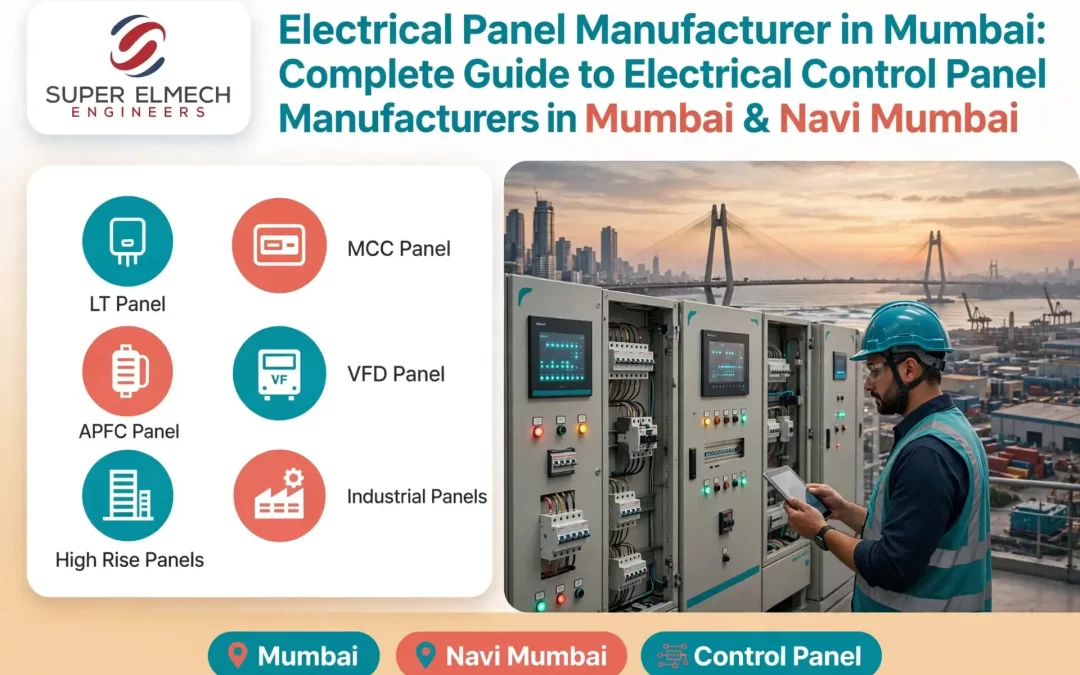
Mumbai is one of India’s important commercial and industrial centres, with manufacturing units, warehouses, commercial buildings, infrastructure projects, data facilities and process industries requiring dependable electrical distribution and control systems. Selecting the right electrical panel manufacturer in Mumbai is therefore an important decision for electrical contractors, consultants, EPC companies, factory owners, builders and industrial purchase teams.
An electrical panel is not simply a metal enclosure containing circuit breakers. It is an engineered assembly designed to distribute electrical power, control equipment, protect circuits and support safe operation. The panel must be selected according to the connected load, fault level, operating environment, protection requirements, installation space and future expansion plans.
Buyers searching for electrical control panel manufacturers in Navi Mumbai or control panel manufacturers in Mumbai should compare technical capability, drawings, component selection, manufacturing quality, testing records, documentation and after-sales support—not only the quoted price.
This guide explains the major types of electrical panels, what to check before placing an order, how to evaluate a manufacturer and how to shortlist a suitable supplier for projects in Mumbai and Navi Mumbai.
Table of Contents
- What Does an Electrical Panel Manufacturer Do?
- Types of Electrical Panels Used in Industrial Projects
- Electrical Control Panel Manufacturers in Mumbai and Navi Mumbai
- How to Choose the Best Electrical Panel Manufacturer in Mumbai
- Important Technical Specifications Before Ordering
- Why Panel Testing and Documentation Matter
- PLC Panel Manufacturer in Mumbai: What Buyers Should Check
- Electrical Panel Price: What Affects the Cost?
- Why Consider an Experienced Electrical Panel Manufacturer in India?
- About Super Elmech Engineers Pvt. Ltd.
- Frequently Asked Questions
- Conclusion
What Does an Electrical Panel Manufacturer Do?
An electrical panel manufacturer designs and assembles electrical distribution, protection and control systems according to the requirements of a particular installation.
The manufacturing process generally starts with understanding the electrical load and project specifications. Engineers prepare the required electrical drawings, select suitable components, design the enclosure and busbar arrangement, complete assembly and wiring, and conduct applicable inspections and tests.
A professional manufacturer may support the buyer through several stages:
- Understanding the project load and application.
- Reviewing the single-line diagram (SLD).
- Preparing general arrangement (GA) and control drawings.
- Selecting circuit breakers, contactors, relays and other components.
- Designing busbars, cable compartments and internal segregation.
- Fabricating and finishing the panel enclosure.
- Completing electrical assembly and wiring.
- Conducting applicable inspection and testing.
- Providing drawings, test records and dispatch documentation.
Why is manufacturer selection important?
Incorrect component selection, inadequate short-circuit withstand capability, poor wiring practices or unsuitable enclosure protection can create operational and safety risks.
A suitable manufacturer should understand the actual operating conditions rather than simply offering a standard panel against a generic enquiry.
Types of Electrical Panels Used in Industrial Projects
Different projects require different electrical panels. Before contacting electrical panel manufacturers in Mumbai, identify the panel type and its intended function.
1. Power Control Centre (PCC) Panel
A PCC panel is primarily used for receiving and distributing electrical power to downstream feeders or distribution systems.
Typical applications include:
- Manufacturing plants
- Industrial facilities
- Commercial buildings
- Infrastructure projects
- Utility and service installations
PCC panel design depends on incoming supply, connected load, fault level, outgoing feeder requirements, protection coordination and future expansion.
Learn more about Power Control Centre (PCC) Panels.
2. Motor Control Centre (MCC) Panel
An MCC panel controls and distributes power to multiple motors used in industrial processes.
Common applications include:
- Pumps and pumping stations
- Compressors
- Conveyors
- HVAC systems
- Manufacturing machinery
- Water and wastewater treatment plants
An MCC may include motor feeders using DOL starters, star-delta starters, soft starters or VFDs, depending on the motor and process requirements.
The selection should consider motor rating, starting current, duty cycle, control philosophy and protection requirements.
Explore Motor Control Centre (MCC) Panels.
3. Automatic Power Factor Control (APFC) Panel
An APFC panel automatically switches capacitor steps to maintain the required power factor according to the changing electrical load.
It may help industrial facilities manage reactive power demand and reduce avoidable power-factor-related charges, subject to the applicable electricity tariff and installation conditions.
Before selecting an APFC panel, check:
- Existing power factor and load profile
- Required compensation in kVAr
- Harmonic levels
- Capacitor duty and switching arrangement
- Reactor requirements, where applicable
- Ventilation and operating temperature
Explore Automatic Power Factor Control (APFC) Panels.
4. PLC Control Panel
A PLC panel is used for programmable automation and process control. It receives signals from field devices, processes programmed logic and operates connected equipment through suitable control interfaces.
Typical applications include:
- Automated production lines
- Pump automation
- Material handling systems
- Process industries
- Water treatment plants
- Machine control systems
A PLC panel may include a PLC CPU, digital and analogue I/O modules, power supplies, relays, communication equipment, terminal blocks and an HMI interface, depending on the project.
5. VFD Panel
A Variable Frequency Drive panel controls motor speed by adjusting the frequency and voltage supplied to a compatible motor.
It is commonly used where the process requires variable speed, controlled acceleration or improved operational flexibility.
Applications include pumps, fans, blowers, conveyors and selected process machinery.
Explore Variable Frequency Drive (VFD) Panels.
6. AMF Panel
An Automatic Mains Failure panel monitors the mains supply and manages the transfer sequence between the normal supply and a standby generator, according to the approved control arrangement.
It is used in facilities where standby power is important, such as commercial buildings, industrial sites and essential services.
Explore Auto Mains Failure (AMF) Panels.
Electrical Control Panel Manufacturers in Mumbai and Navi Mumbai
Mumbai and the surrounding industrial belt have diverse electrical panel requirements. A buyer may be sourcing a distribution panel for a commercial property, a motor control panel for a factory or a PLC automation panel for a process installation.
When comparing electrical control panel manufacturers in Navi Mumbai, consider the exact project location, installation environment and service requirements.
Areas and industrial locations to consider
Depending on the project, buyers may evaluate suppliers for installations in:
- Navi Mumbai: Industrial and commercial facilities across the wider Navi Mumbai region.
- Turbhe and TTC Industrial Area: Manufacturing, engineering and industrial applications.
- Rabale and Mahape: Industrial units, technology facilities and commercial infrastructure.
- Taloja: Process, chemical and manufacturing applications.
- Thane and Wagle Estate: Industrial and commercial installations.
- Andheri and MIDC areas: Manufacturing, engineering and commercial facilities.
- Bhiwandi: Warehousing, logistics and industrial infrastructure.
- Panvel: Industrial, infrastructure and commercial projects.
The location of a supplier is only one part of the decision. A manufacturer outside Mumbai may also be considered if its technical capability, delivery plan, documentation, installation coordination and service arrangements meet the project requirements.
Local manufacturer or manufacturer from another city?
| Evaluation factor | Local Mumbai/Navi Mumbai supplier | Manufacturer from another city |
|---|---|---|
| Site coordination | May be easier for nearby projects | Requires planned coordination |
| Factory inspection | Depends on factory location and access | Requires travel or agreed inspection arrangements |
| Transport | May offer shorter local delivery routes | Freight and transit planning required |
| Technical capability | Must be verified individually | Must be verified individually |
| After-sales support | Confirm response time and service scope | Confirm local support and service arrangements |
| Project suitability | Depends on design and execution capability | Depends on design and execution capability |
Do not assume that a nearby supplier is automatically the best option. Technical suitability and documented quality should remain the primary selection criteria.
How to Choose the Best Electrical Panel Manufacturer in Mumbai
The phrase “best electrical panel manufacturer in Mumbai” is searched by buyers who want a reliable supplier. However, the best manufacturer for one project may not be suitable for another.
Use the following checklist before finalising a purchase.
1. Check relevant manufacturing experience
Ask whether the manufacturer has handled projects similar to yours. A company experienced in industrial MCC panels may have a different project portfolio from a supplier focused mainly on small commercial distribution boards.
Request relevant project references, product photographs and technical details where available.
2. Review design and engineering capability
A manufacturer should be able to understand the electrical requirements and prepare project-specific drawings.
Ask for:
- Single-line diagram (SLD)
- General arrangement drawing
- Power and control schematics
- Bill of materials
- Busbar arrangement
- Cable entry and termination details
- Protection and interlocking philosophy
Drawings should be reviewed and approved by the responsible project engineer before manufacturing.
3. Verify component selection
Ask for the make, model and ratings of important electrical components.
Depending on the design, these may include:
- ACBs and MCCBs
- MCBs and isolators
- Contactors and overload relays
- Protection relays
- CTs and metering equipment
- PLCs and HMIs
- VFDs and soft starters
- Capacitors and reactors
Component selection must match the electrical design, operating conditions and required protection.
4. Examine enclosure and fabrication quality
A panel enclosure should be suitable for its installation environment.
Check the following:
- Sheet thickness and mechanical construction
- Surface preparation and paint finish
- Door alignment and locking arrangement
- Gland plate and cable entry design
- Internal wiring identification
- Busbar support and insulation
- Ventilation and heat dissipation
- Required IP protection
For outdoor, dusty, humid or corrosive environments, discuss the appropriate enclosure design with the manufacturer.
5. Ask about testing and inspection
Do not finalise a panel only on the basis of a quotation or product photograph.
Ask for the applicable inspection and testing plan, routine verification records and any project-specific test requirements.
A useful starting point is to review the manufacturer’s testing process and understand which tests will be performed on the actual supplied assembly.
6. Confirm delivery and after-sales support
Before issuing a purchase order, clarify:
- Manufacturing lead time
- Inspection and approval stages
- Packing and transportation
- Installation responsibilities
- Commissioning support
- Warranty terms
- Spare parts availability
- Service response arrangements
These points should be recorded in the purchase order or agreed project documents.
Important Technical Specifications Before Ordering an Electrical Panel
A detailed technical enquiry helps manufacturers prepare a more accurate proposal and reduces avoidable revisions.
| Parameter | Information to provide |
|---|---|
| Panel type | PCC, MCC, APFC, PLC, VFD, AMF or other |
| System voltage | Nominal operating voltage |
| Phase and frequency | Single-phase/three-phase and frequency |
| Rated current | Required incomer and feeder current |
| Short-circuit level | Available fault level or specified withstand rating |
| Incomer details | Source, breaker type and rating |
| Outgoing feeders | Quantity, load and protection requirements |
| Busbar details | Material, rating and configuration |
| Enclosure | Indoor/outdoor and required IP rating |
| Installation | Floor-mounted, wall-mounted or other |
| Cable entry | Top, bottom or specified arrangement |
| Control supply | Required AC/DC control voltage |
| Environment | Ambient temperature, dust, humidity and corrosive exposure |
| Documentation | SLD, GA, schematics, BOM and test records |
Which standard should buyers discuss with the manufacturer?
For low-voltage switchgear and controlgear assemblies, buyers commonly refer to the relevant parts of the IS/IEC 61439 series, as applicable to the assembly and project specification.
The exact standard, design verification evidence and routine verification requirements should be confirmed for the panel being ordered. A generic statement such as “IEC standard panel” is not a substitute for reviewing the applicable technical documents.
Buyers should also check applicable BIS requirements for the specific electrical equipment and components. BIS publishes information on relevant standards and product-specific certification requirements. Compliance obligations depend on the product category and current regulations.
Why Panel Testing and Documentation Matter
Testing helps verify that the assembled panel meets the applicable project and technical requirements.
Depending on the design, specification and inspection plan, checks may include:
- Visual and mechanical inspection
- Wiring and connection verification
- Protective circuit continuity checks
- Insulation resistance measurement
- Dielectric or high-voltage testing, where applicable
- Functional operation checks
- Interlock verification
- Metering and control circuit checks
- Applicable primary or secondary current injection tests
Not every test applies to every panel. The manufacturer and buyer should agree on the test scope before production.
Documents to request before dispatch
A buyer may request the following documents, as applicable:
- Approved GA and SLD drawings
- Control and power schematics
- Bill of materials
- Component datasheets
- Applicable test reports
- Inspection records
- Operation and maintenance documents
- Warranty information
- Panel identification and rating details
If a supplier claims that a panel is CPRI tested or type tested, ask for the actual report or certificate and verify its scope. Confirm the manufacturer, assembly configuration, ratings and test conditions. Do not assume that a report for one design automatically covers every panel configuration.
PLC Panel Manufacturer in Mumbai: What Buyers Should Check
Industrial automation projects need more than a PLC installed inside an enclosure. The complete control panel must be designed around the process, field instruments, communication requirements and operating philosophy.
Before selecting a PLC panel manufacturer in Mumbai, discuss the following points.
PLC hardware and I/O planning
The PLC should have sufficient input and output capacity for the current project and any planned expansion. Confirm whether digital, analogue, high-speed or specialised modules are required.
HMI and communication
Depending on the application, the control system may require an HMI, remote I/O, Ethernet communication, Modbus, Profinet or another protocol. Compatibility must be confirmed between the PLC, drives, instruments and supervisory systems.
Control philosophy and safety
The manufacturer should understand:
- Auto/manual operation
- Start/stop sequence
- Emergency stop requirements
- Permissives and interlocks
- Alarm handling
- Fault reset logic
- Communication failure response
- Equipment protection requirements
The final logic and safety design must be reviewed by the responsible automation and electrical engineering teams.
Testing before commissioning
Ask whether the project includes point-to-point checks, I/O simulation, sequence testing, communication checks and factory acceptance testing (FAT), where specified.
A documented test plan can reduce commissioning issues at the site.
Electrical Panel Price: What Affects the Cost?
There is no reliable single price for every electrical panel. The cost depends on the technical scope and the components selected.
Important cost factors include:
- Panel type and application
- Current and voltage ratings
- Short-circuit withstand requirements
- Number and rating of feeders
- Breaker and switchgear make
- Busbar material and size
- Enclosure dimensions and construction
- IP protection and internal segregation
- PLC, HMI, VFD or automation scope
- Testing and certification requirements
- Documentation and inspection requirements
- Transportation, installation and commissioning
How to compare quotations correctly
Do not compare two quotations only by their final amount. Check whether both suppliers have quoted the same technical scope.
A lower quotation may exclude important components, testing, documentation or site support. Ask each supplier to provide a clear technical offer and a deviation list.
Why Consider an Experienced Electrical Panel Manufacturer in India?
Some industrial buyers search for electrical panel manufacturers in India rather than limiting their search to one city. This can help them compare engineering capabilities, manufacturing facilities and project experience across different regions.
A manufacturer from another city may be suitable when it can demonstrate:
- Relevant panel manufacturing experience
- Engineering and drawing capability
- Suitable fabrication and assembly infrastructure
- Component traceability
- Defined testing procedures
- Project documentation
- Clear delivery commitments
- Practical after-sales support
For Mumbai and Navi Mumbai projects, confirm transport arrangements, site coordination and service responsibilities before placing an order.
About Super Elmech Engineers Pvt. Ltd.
Super Elmech Engineers Pvt. Ltd. is an electrical control and distribution panel manufacturer based in Gurugram, Haryana, India. The company describes its work in industrial and commercial electrical panel solutions and provides engineering support that includes AutoCAD GA drawings, single-line diagrams and control drawings.
Its published product range includes:
- Power Control Centre (PCC) Panels
- Motor Control Centre (MCC) Panels
- APFC Panels
- VFD Panels
- AMF Panels
- Water Treatment Plant (WTP) Panels
The company also describes its manufacturing and inspection process, including panel fabrication, painting, assembly and applicable electrical testing.
For buyers comparing electrical panel manufacturers in India, Super Elmech can be included in the technical evaluation where its product range and project capabilities match the requirement. Since its manufacturing facility is in Gurugram, Mumbai and Navi Mumbai buyers should confirm project feasibility, transportation, delivery timelines and service arrangements directly.
Discuss your project requirements with Super Elmech Engineers Pvt. Ltd.
- Website: https://www.superelmech.com/
- Phone: +91 (124) 646 0877
- Phone: +91 9811129576
- Location: A-1/11, Sheetla Colony, Sayyad Marg, Gurugram, Haryana, India
- Contact the company
When sending an enquiry, share your panel type, SLD, load details, technical specifications, project location and expected delivery schedule.
Frequently Asked Questions
1. How do I choose an electrical panel manufacturer in Mumbai?
Compare the manufacturer’s engineering capability, relevant project experience, component selection, fabrication quality, applicable testing, documentation, delivery plan and after-sales support. Ask for a technical offer against your project specifications.
2. What is the difference between an electrical panel and a control panel?
An electrical panel is a broad term that may include power distribution, protection and control assemblies. A control panel generally focuses on controlling machines, motors or processes through electrical or automation components. The exact function depends on its design.
3. Which electrical panels are commonly used in factories?
Factories commonly use PCC, MCC, APFC, PLC, VFD and distribution panels. The required combination depends on the plant’s electrical load, machinery, automation level and distribution architecture.
4. How can I find electrical panel manufacturers near me?
Search using your exact area or industrial location, such as Navi Mumbai, Turbhe, Rabale, Mahape, Taloja or Thane. Shortlist suppliers and verify their factory location, product capability, project references and service coverage.
5. What details are needed to get an electrical panel quotation?
Share the panel type, voltage, current rating, load list, SLD, fault level, number of feeders, component preferences, enclosure requirements, installation environment and project location.
6. What is a PLC panel used for?
A PLC panel is used to automate machines and industrial processes. It receives input signals, executes programmed logic and controls connected equipment through suitable output devices and communication systems.
7. What is the difference between PCC and MCC panels?
A PCC panel primarily distributes electrical power to downstream feeders. An MCC panel is designed to control and distribute power to multiple motors. Some installations use both panels as part of the same electrical distribution system.
8. Does Super Elmech manufacture electrical panels in Mumbai?
Super Elmech’s published manufacturing location is Gurugram, Haryana. Buyers in Mumbai or Navi Mumbai should contact the company to confirm whether the required panel, delivery schedule, transportation and service arrangements are feasible for their project.
9. What documents should I request from an electrical panel manufacturer?
Request approved drawings, bill of materials, component details, applicable test records, inspection documents, operating instructions and warranty information. The exact document list depends on the purchase specification.
10. How do I verify a CPRI-tested electrical panel claim?
Ask for the relevant CPRI report or certificate and verify the manufacturer, tested assembly, ratings, configuration, applicable standard and scope. A claim should be supported by documents relevant to the panel being supplied.
Conclusion
Selecting the right electrical panel manufacturer in Mumbai requires a technical evaluation, not just a price comparison. Whether your requirement is a PCC, MCC, APFC, PLC, VFD or AMF panel, begin with a clear load schedule and project specification.
Compare electrical control panel manufacturers in Mumbai and Navi Mumbai on design capability, component quality, fabrication, testing, documentation, delivery and after-sales support. If you are also evaluating electrical panel manufacturers in India, include manufacturers from other regions only after confirming their ability to meet your project and service requirements.
For industrial buyers, a well-engineered and properly verified panel can support reliable power distribution, equipment protection and efficient plant operation over its service life.