




Introduction
Having a reliable source of power is very important for industries, hospitals, commercial buildings, manufacturing and infrastructure. In some cases, having just one Diesel Generator (DG) set will not provide enough load so multiple generators can be used.
However, connecting multiple generators into one electrical busbar can be quite complex. The electrical parameters need to be matched correctly before closing circuit breakers. This is known as generator synchronization.
A generator synchronization panel is an electrical control panel. It allows for the synchronization of two or more generator sets, controlling the paralleling process. The panel will also monitor key electrical parameters.
Understanding the function and components within a generator synchronization panel will help purchasers within industry.
Within this guide, we will look at how the generator synchronization panel works, the key components, a Single Line Diagram and the factors to consider when purchasing a synchronization panel manufacturer in India.
Table of Contents
What Is a Synchronizing Panel for a Generator?
Why Is a DG Synchronizing Panel Required?
Working Principle of a Generator Synchronizing Panel
Essential Conditions for Generator Synchronization
Main Synchronizing Panel Components
Synchronizing Panel Wiring Diagram and Single Line Diagram
Automatic vs Manual Synchronizing Panel
Functions of an Automatic Synchronizing Panel
DG Synchronizing Panel Specifications
Synchronizing Panel Price: What Affects the Cost?
Synchronizing Panel Applications
Difference Between AMF Panel and Synchronizing Panel
How to Select a Synchronizing Panel Manufacturer
Frequently Asked Questions
Conclusion
What Is a Synchronizing Panel for a Generator?
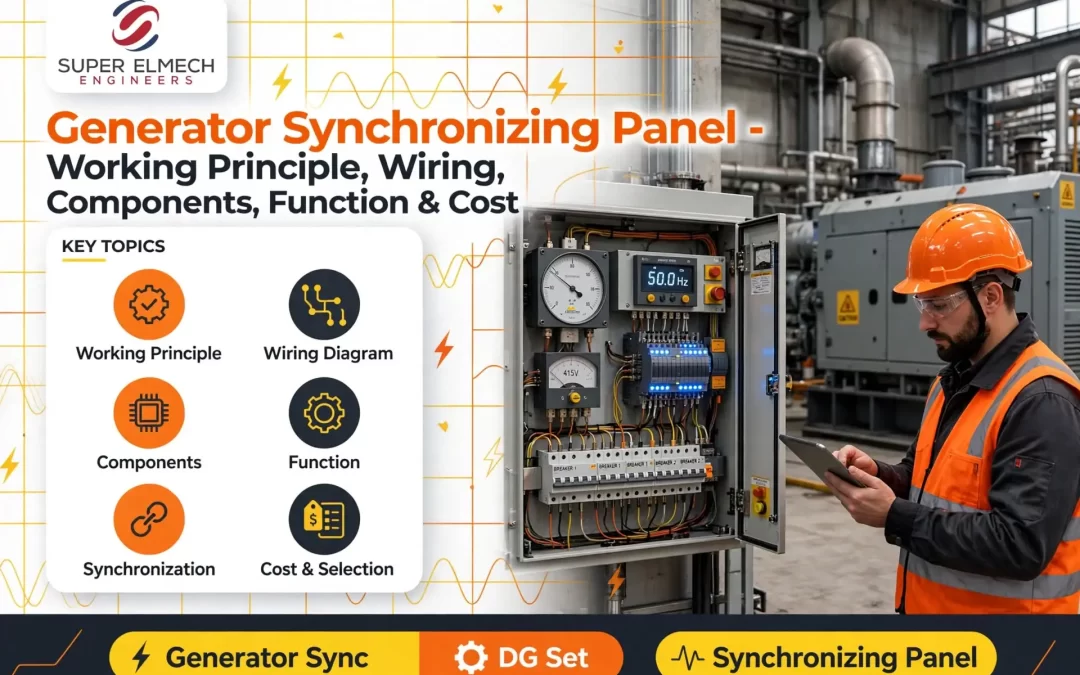
A generator synchronizing panel (also known as a DG synchronizing panel, genset synchronizing panel or generator paralleling panel) is an electrical control panel to allow multiple generators to be run in parallel.
The panel will check that the incoming generator has the correct voltage, frequency, phase sequence and phase angle within the defined synchronization parameters.
Once the correct conditions have been met, the synchronization panel will allow the circuit breaker of the generator to be closed and generators can be used to supply a common electrical load.
For example if there are three DG sets within an industrial facility:
DG Set 1 – 500kVA
DG Set 2 – 500kVA
DG Set 3 – 500kVA
A correctly designed control panel can allow extra generators to be brought online during peak loads and taken offline when loads drop.
This helps the facility manage fluctuating loads effectively.
Note – The actual power available will depend on generator ratings, power factor, conditions, load and Approved System Design. Simply adding up the kVA ratings will not guarantee the total amount of load can be supplied.
Why is a DG Synchronizing Panel Required?
A synchronization panel is useful if you need to run multiple generators.
The main reasons for using a DG synchronization panel are:
Parallel Control of Multiple DG Sets
Multiple sets of generators can be controlled via the control panel and connected to a common busbar.
Load Sharing
If generators are running in parallel, then you can control the share of real and reactive power.
Having the correct amount of load sharing between generators will stop one being overloaded while another does not reach its intended loading.
Automatic Control of Generators
An automatic synchronization panel can start, synchronize and connect extra generators.
Better Generator Utilisation
Only the correct amount of DG sets will be run using a load management system.
Protection
The protection will monitor electrical and operational parameters. Depending on the design of the panel alarms, trips or isolation of the generator can be generated.
Monitoring
The status of the generators can be monitored by operators. Voltage, Current, Frequency, Power and Alarms can be viewed. This can be done via a common panel or HMI.
Working Principle
The generator synchronization panel works by checking that the incoming generator has the correct electrical parameters compared to the live busbar.
The incoming generator will be brought into synchronism before the circuit breaker is closed.
The steps involved with an automatic generator synchronization are:
Generator Start
When load demand increases or the generator is started by an operator. The control panel will start the chosen generator.
The generator controller will check the start-up parameters and confirm it is ready to run.
Voltage and Frequency Check
The voltage from the incoming generator and live busbar are sent to the synchronization controller.
The voltage magnitude and frequency are checked.
Speed and Voltage Adjustment
If available on the generator and controller, the synchronization controller will send commands to the governor or engine control to change the speed. It may also communicate with the Automatic Voltage Regulator (AVR) to change the voltage.
The aim is to ensure that the incoming generator has the correct electrical parameters within the defined synchronization parameters.
Phase Angle Check
The synchronization controller will constantly check the phase angle between the incoming generator and busbar.
The synchronization controller will ensure the circuit breaker is closed at the right time.
Circuit Breaker Closed
Once all of the correct conditions have been met, the synchronization controller will allow the circuit breaker to be closed by the synchronism check protection logic.
The incoming generator will now be connected to the common busbar.
Load Sharing
Once the generators are synchronized, the load sharing will ensure correct real and reactive power from the generators.
Real power sharing will typically be controlled by governor or engine control. Reactive power sharing will be controlled by excitation and AVR.
Monitoring
The panel will continue to monitor the generators. If any issues occur, the protection will react according to the Approved Protection Philosophy.
Key Conditions for Synchronization
Before two generators are run in parallel, certain conditions must be met.
Parameter
Reason
Voltage Magnitude
Ensure the voltage from the incoming generator is within acceptable tolerance.
Frequency
Ensure the frequency between the generator and busbar are similar.
Phase Sequence
Ensure the phase sequence is the same.
Phase Angle
Ensure the voltage waveform is in line with the defined closing tolerance.
Number of Phases
Ensure the systems are compatible with either 3 phase or otherwise.
Voltage Matching
The incoming generator should have a similar voltage to the busbar. If the voltage is too different it could cause unwanted currents.
Frequency Matching
The incoming generator should have a similar frequency to the running system. The frequency tolerance will depend on the equipment and project requirements.
Phase Sequence Matching
The phase sequence should be the same. For example both systems would have R-Y-B. Having the wrong phase sequence could cause big issues.
Phase Angle Matching
The phase angle should be within the defined synchronization tolerance.
This is important because if the generator circuit breaker is closed without the incoming generator being in sync, it could cause high stresses. This can damage generators, coupling equipment and switchgear.
The synchronization tolerances should be defined by qualified electrical engineers and will depend on the generator specifications, protection, control equipment and project requirements.
Key Components of a Synchronizing Panel
The synchronization panel will contain a variety of components. The design will depend on the number of generators, generator capacity, control and application.
Synchronizing Controller
Checks the incoming generator parameters against the busbar. If automatic, controls the synchronization and may send commands to change speed and voltage.
PLC (Programmable Logic Controller)
The PLC can be used to control the sequence of generators, logic, interlocking, alarms and other control devices.
Not all synchronization panels will require a PLC. Some functions can be built into the generator controller.
Generator Circuit Breaker
Connects/disconnects the generator from the common busbar.
Selection of circuit breaker will depend on generator current, voltage, short circuit, protection and switching requirements.
Synchronism Check Relay
Also known as ANSI Device 25. This will check the synchronization conditions and allow the circuit breaker to be closed if the defined conditions are met.
Automatic Voltage Regulator (AVR)
Controls the excitation of the generator.
Voltage can be controlled via the AVR interface.
Governor / Speed Control Interface
Controls the speed of the engine. During synchronization, the control system may interact with the governor to change the generator frequency.
Load Sharing Controller
Controls the real and reactive power sharing between the generators.
This will depend on the generator controllers, communication and control.
Protection Relays
Depending on the design of the panel, the protection may include:
Reverse Power Protection
Overvoltage Protection
Undervoltage Protection
Overfrequency Protection
Underfrequency Protection
Overcurrent Protection
Earthing Protection
Differential Protection
Protection relating to generator and circuit breaker failure.
Protection should be defined by a protection study for the project.
Measuring Devices
Digital Voltmeters
Ammeters
Frequency Meters
Multi-function Power Meters
kW & kVAR Indication
Power Factor Meters
Energy Meters
HMI & Indication
Provides an interface for operators to view generator status, select modes and view alarms.
May include indicator lamps, selector switches, push buttons and emergency.
Wiring & Single Line Diagram
The wiring diagram shows how the electrical, control, measuring and protection circuits are connected.
The Single Line Diagram (SLD) shows a simplified layout of the power.
Typical DG Synchronizing Panel Single Line Diagram
Below shows a simple conceptual diagram of 3 generators:
DG SET – 1
Generator CB-1
DG SET – 2
Generator CB-2
COMMON BUSBAR
Generator CB-3
DG SET – 3
MAIN PCC / MDB
DISTRIBUTION
LOADS
Note – This is a simple concept diagram to show how the power is flowing. A full electrical drawing will include individual generator incomers, bus couplers, bus section breakers, utility incomers, metering CTs/PTs, protection relays, interlocking and auxiliary supplies.
What is Included in a Wiring Diagram?
A wiring diagram can include a variety of information depending on the project.
Generator voltage sensing connections.
Busbar voltage sensing connections.
CT Connections.
PT Connections (if applicable).
Synchronizing controller inputs/outputs.
Governor & AVR control.
Generator CB close/open.
Auxiliary contacts from circuit breaker.
Protection relay connections.
PLC, HMI & Communication connections.
DC control supply and auxiliary.
Interlocking.
Synchronizing Panel Circuit Diagram PDF
If you are trying to find a generator synchronization panel circuit diagram PDF, you need to understand that a generic circuit diagram may not be suitable for your generator or site.
The correct drawing package should be designed using information from the generator manufacturer, circuit breakers, controller manuals, protection requirements and electrical design.
You should never use a random wiring diagram from the internet to connect generator circuit breakers or override the synchronism check protection.
Automatic & Manual Synchronizing Panel
A synchronization panel can be designed to be manual, automatic or a combination.
Parameter
Manual Synchronizing
Automatic Synchronizing
Operation
Operator manually performs synchronization.
Controlled by the controller.
Monitoring
Meters & Synchroscope.
Electronic controller with monitoring.
Speed Control
Controlled by operator or separately.
Automatic if available.
Voltage Control
Controlled by operator or separately.
Automatic if available.
Circuit Breaker Close
Controlled by operator with correct supervision.
Automatically closes.
Operator Involvement
More involvement.
Less involvement.
Typical Application
Smaller or manually controlled systems.
Industrial & multiple generator systems.
Manual Synchronizing Panel
During manual synchronization, the operator will monitor the incoming generator parameters using meters, such as voltmeters, frequency meters and a synchroscope.
They will then change the speed and voltage of the generator and follow the correct procedure to close the circuit breaker.
This requires trained personnel and correct synchronism check protection.
Automatic Synchronizing Panel
The automatic synchronization panel will use an electronic synchronization controller. This will compare the incoming generator parameters to the live busbar.
If available, the controller will change the speed and voltage using the relevant interface. Once the correct conditions have been met, the circuit breaker will be closed.
Automatic systems are typically used when there are multiple DG sets or fluctuating loads.
Functions of an Automatic Synchronizing Panel
The automatic synchronization panel can have various functions depending on the project.
Automatic Synchronization
Matches the incoming generator electrical parameters to those of the live busbar.
Load Sharing
Controls real and reactive power sharing between the generators.
Generator Sequence
Starts/stops generators based on programmed logic and load demand.
Automatic Load Management
Can bring extra generators online when the connected load increases. Can also take generators offline when demand drops. Minimum loading and limits will apply.
Circuit Breaker Control & Interlocking
Controls circuit breaker open/close based on circuit breaker status and electrical interlocking.
Alarms & Faults
Provides indication of unusual voltage, frequency, protection, communications and other defined conditions.
AMF Integration
If required, the synchronization system can be integrated with automatic mains failure (AMF). This will control the utility incomer.
However, the utility needs to be paralleled using the correct approved method. This ensures the correct protection, synchronism check and permission to run. A DG synchronization panel will not automatically mean the system is suitable to run in parallel with the grid.
DG Synchronizing Panel Specifications
The DG synchronization panel should be designed based on the complete generator and electrical distribution.
When requesting a quotation, you should consider:
Parameter
Information to Confirm
Number of DG Sets
2,3,4 or more.
Generator Capacity
kVA & kW rating of generator.
Voltage
e.g. 415V or project specific.
Frequency
50Hz or project specific.
Phase
3 phase or project specific.
Synchronization
Manual, automatic or combination.
Control
PLC, dedicated synchronization controller or integrated generator controllers.
Load Sharing
Real & reactive power sharing.
Circuit Breaker
Type, rating, breaking capacity and mechanism.
Protection
Protection functions for generators & busbars.
Communication
Modbus, CAN or other compatible. If required.
HMI
Local display requirements.
Enclosure
Indoors/outdoors & IP requirements.
Drawings
SLD, GA, control wiring & terminal.
Standards to Consider
Depending on the equipment, installation and project, the following standards may be applicable.
ISO 8528-4 – Controlgear and switchgear for generating sets driven by reciprocating internal combustion engines. Includes information about paralleling and synchronization.
IEC 61439 – May be applicable for low voltage switchgear and controlgear assemblies.
The project engineer should confirm which editions, parts, statutory requirements and verification requirements apply.
Factors Influencing Cost of Synchronizing Panel
One of the most common searches is for synchronizing panel cost or DG synchronizing panel cost.
As the panel is engineered based on the generator capacity, number of generators, control and protection requirements there is no standard cost.
Factors to consider when receiving a quotation are:
Number of Generators
A panel for 2 DG sets will typically be different to 4 or 6 generators.
Extra generators may require more control interfaces, sensing, circuit breakers and protection.
Generator Capacity
Generator kVA rating will impact current values, circuit breaker selection, busbar size etc.
Controller & PLC
The brand, communication, load sharing and automation can all have a large effect on the project cost.
Circuit Breaker Rating
Type, rating, breaking capacity and mechanism.
Protection
Number and type will depend on generator rating, system and protection.
HMI & Communication
Remote monitoring, SCADA, data logging and communication can increase the engineering and hardware requirements.
Enclosure
Material, size, IP rating, segregation and installation will effect the quotation.
Testing & Drawings
Inspection, functionality, drawings, documentation and commissioning on site.
Tip – Rather than just comparing synchronizing panel costs, compare the full supply, controller, protection, circuit breaker brand, testing documentation, warranty and commissioning.
Applications
Synchronizing panels are used in facilities where multiple generators need to be run.
Manufacturing Industries
Factories with large machinery, production lines, compressors and process equipment may require generators to be controlled.
Hospitals
Hospitals will often have critical loads and may have multiple sets of generators.
Commercial Buildings
Large commercial complexes, hotels & offices may require generators to be run in parallel.
Data Centres
Data centres have strict power requirements. The generator and distribution must be designed to suit the redundancy and operational philosophy of the facility.
Infrastructure
Infrastructure facilities, industrial parks and large construction projects may require multiple generators.
Water & Wastewater Treatment Plants
Pumps, blowers, motors and process equipment can cause fluctuating loads so may require generators to be controlled.
Difference Between AMF Panel and Synchronizing Panel
AMF and synchronizing panels are related to generator control, but their primary functions are different.
| Feature | AMF Panel | Synchronizing Panel |
|---|---|---|
| Main purpose | Automatic changeover between mains and generator supply | Parallel operation of multiple generators or compatible sources |
| Typical configuration | Mains and DG | Two or more DG sets, or other approved parallel sources |
| Main operation | Starts generator and transfers load according to configured logic | Matches electrical parameters and coordinates breaker closing |
| Load sharing | Not its primary function | Can be included |
| Synchronization | Not normally required for basic open-transition changeover | Essential before parallel connection |
| Typical application | Backup power for buildings and smaller facilities | Industrial plants and multi-generator installations |
An AMF panel generally monitors mains supply and initiates generator operation when a mains failure occurs.
A synchronizing panel is designed to connect compatible generators in parallel after checking synchronization conditions.
Some projects integrate AMF and synchronization functions into a common control arrangement. The exact design depends on the power system.
How to Select a Synchronizing Panel Manufacturer
Choosing the right synchronizing panel manufacturer is important because the panel must work reliably with the generator sets, switchgear, control system and electrical distribution network.
Consider these factors before finalising an order.
1. Technical Design Capability
Check whether the manufacturer can develop project-specific single-line diagrams, general arrangement drawings, control schematics and interlocking logic.
2. Generator Compatibility
The manufacturer should understand the generator controllers, AVR, governor interfaces and communication requirements of the selected DG sets.
3. Protection and Interlocking
Confirm that the proposed panel includes the required synchronism-check function, breaker interlocking and protection philosophy.
4. Quality of Components
Review the make and ratings of controllers, PLCs, circuit breakers, relays, meters, terminal blocks and other components.
5. Testing Facilities
Ask about inspection and testing procedures, including functional checks, wiring verification, relay testing and other tests specified for the project.
6. Documentation
A professional panel supplier should provide relevant technical drawings, component details, test records and operating documentation.
7. After-Sales Support
Check the availability of technical assistance, commissioning support, troubleshooting and spare parts.
8. Experience with Industrial Applications
Ask for relevant project references and examples of similar generator synchronizing or load-sharing systems.
Why Consider Super Elmech Engineers Pvt Ltd?
Super Elmech Engineers Pvt Ltd is an electrical panel manufacturer based in Gurugram, Haryana, India.
The company provides PLC-based synchronization panels designed for applications where multiple diesel generators need to operate together.
According to the company’s product information, its DG synchronization panels use PLC-based control to coordinate generator operation according to changing load requirements.
The system can be configured to bring additional generators online when demand increases and disconnect generators when demand reduces, subject to the project’s control logic and generator operating limits.
For buyers evaluating a DG synchronizing panel, the important step is to discuss the generator configuration, load requirements, control interfaces and protection requirements before finalising the design.
Explore the company’s PLC Based Synchronization Panels for more information.
You can also explore related electrical panel solutions:
For a project-specific enquiry, contact Super Elmech Engineers Pvt Ltd.
Company: Super Elmech Engineers Pvt Ltd
Address: A-1/11, Sheetla Colony, Sayyad Marg, Gurugram, Haryana, India
Phone: +91 (124) 646 0877
Mobile: +91 9811129576
Email: [email protected]
Website: https://www.superelmech.com/
Frequently Asked Questions
1. What is a synchronizing panel for a generator?
A synchronizing panel is an electrical control panel that checks and matches the electrical parameters of an incoming generator with an existing busbar before connecting it in parallel. It can also coordinate load sharing and generator operation.
2. What is the main function of a DG synchronizing panel?
Its main function is to synchronize multiple DG sets and manage their parallel operation. Depending on the design, it can also provide load sharing, generator sequencing, breaker control, protection and monitoring.
3. What are the main components of a synchronizing panel?
Common components include a synchronizing controller, PLC or generator controllers, generator circuit breakers, synchronism-check relay, protection relays, voltage and current sensing circuits, meters, HMI and control power supply.
4. What are the conditions required for generator synchronization?
The main conditions include compatible phase configuration, identical phase sequence, closely matched voltage magnitude, closely matched frequency and an acceptable phase angle difference at the time of breaker closing.
5. What is the difference between an automatic and manual synchronizing panel?
A manual system relies on an operator to observe electrical parameters and perform the synchronization procedure. An automatic system uses a synchronizing controller to coordinate parameter adjustment and breaker closing within configured limits.
6. What is a synchronizing panel single-line diagram?
A synchronizing panel single-line diagram is a simplified drawing showing the main power connections between generators, generator circuit breakers, the common busbar and the outgoing distribution system.
7. What is the difference between an AMF panel and a synchronizing panel?
An AMF panel primarily manages automatic generator starting and mains-to-generator changeover. A synchronizing panel manages the matching and parallel connection of multiple generators or other compatible power sources.
8. What is the price of a DG synchronizing panel?
The price depends on generator capacity, number of DG sets, controller selection, circuit breakers, protection devices, load-sharing requirements, enclosure, communication features and testing scope. A project-specific quotation is required for accurate pricing.
9. Can two different-capacity generators operate in parallel?
Yes, generators of different ratings can be designed to operate in parallel when they are electrically compatible and supported by suitable control, protection and load-sharing arrangements. Their operating limits and load-sharing strategy must be properly engineered.
10. Which industries use generator synchronizing panels?
Industries using synchronizing panels include manufacturing plants, hospitals, data centres, commercial buildings, infrastructure facilities, water treatment plants and other sites requiring multiple generators.
11. What is a genset synchronizing panel?
A genset synchronizing panel is another name for a generator synchronization panel. It coordinates the connection and parallel operation of generator sets by monitoring their electrical parameters.
12. Which manufacturer should I contact for a generator synchronizing panel in India?
Select a manufacturer that can understand your generator configuration, prepare project-specific drawings, provide suitable control and protection equipment, and support testing and commissioning. Super Elmech Engineers Pvt Ltd, based in Gurugram, provides PLC-based DG synchronization panel solutions.
Conclusion
A synchronizing panel for generator is an important part of electrical power management wherever multiple generator sets need to operate in parallel.
It helps match generator voltage, frequency, phase sequence and phase angle before breaker closing. Depending on the design, it can also coordinate active and reactive load sharing, generator sequencing, protection, monitoring and automatic operation.
Before purchasing a DG synchronizing panel, evaluate the number and capacity of generators, controller compatibility, circuit breaker ratings, protection requirements, wiring arrangement, communication features and testing scope.
A properly engineered system can help improve generator utilisation, support changing electrical loads and provide coordinated power management for industrial and commercial facilities.
For a project-specific DG synchronizing panel requirement, connect with Super Elmech Engineers Pvt Ltd to discuss your generator configuration and electrical control requirements.