




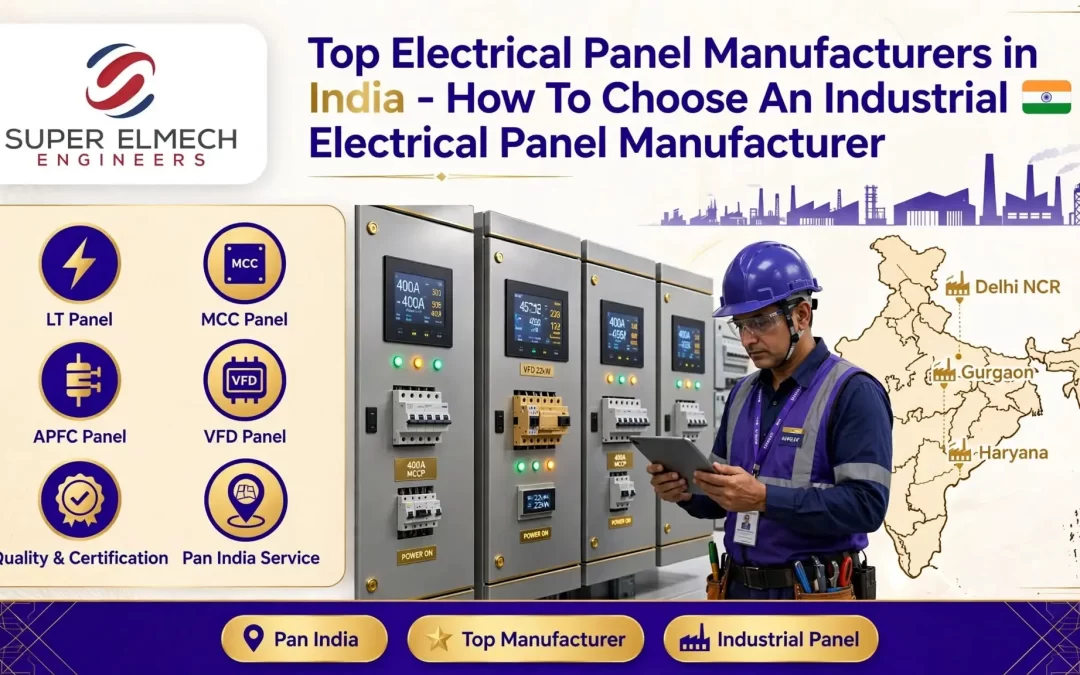
As the industrial sector in India continues to expand, there is a high demand for electrical panel manufacturing to provide safe and efficient electrical distribution, automation, and management systems. With most facilities needing reliable electrical distribution, it is important to choose the right electrical panel manufacturer for your industrial project.
When looking for top electrical panel manufacturers in India, it is important to look at more than just the price. Factors such as manufacturing experience, engineering expertise, quality components, testing, customisation, safety features, and aftercare will all affect the long-term performance of electrical panels.
Having an experienced industrial electrical panel manufacturer will mean they understand that each project will have different requirements. This can include Motor Control Centre (MCC), Power Control Centre (PCC) panels, lighting distribution, and automatic systems.
This guide looks at what types of industrial electrical panels are available, the key factors to consider when choosing an electrical panel manufacturer, what testing is required, and how you can find the right electrical panel manufacturing partner in India.
Table of Contents
1. What Is an Electrical Panel?
2. Why Electrical Panels Are Important for Industries
3. Top Electrical Panel Manufacturers in India
4. Types of Industrial Electrical Panels
5. How to Choose an Industrial Electrical Panel Manufacturer
6. Why Design and Engineering Matters
7. CPRI Testing
8. Industries That Require Industrial Electrical Panels
9. Factors That Affect Electrical Panel Prices in India
10. Why Choose Super Elmech Engineers Pvt. Ltd?
11. Frequently Asked Questions (FAQ)
12. Conclusion
What Is an Electrical Panel?
An electrical panel is a collection of electrical components used to provide a central point for receiving, distributing, controlling, and protecting electrical power.
Typically, electrical panels will include circuit breakers, busbars, contactors, relays, meters, protection, control, and other electrical components. Electrical panels help manage the flow of electrical power from a main source to various machines, equipment, and electrical circuits, while incorporating proper circuit protection.
Electrical panels are engineered and designed to match the load, conditions, voltage, fault levels, environment, and any project-specific requirements.
Main Functions of an Electrical Panel
- Distribution – Provides safe and structured distribution of electrical power across circuits.
- Protection – Helps isolate faulty circuits using the correct protective devices.
- Motor Control – Controls the start, stop, and speed operations of industrial motors.
- Monitoring – Provides real-time electrical data and load parameters.
- Automation – Provides process automation using control devices, PLCs, and relays.
- Safety – Provides a structured, grounded enclosure for electrical equipment and operator safety.
Why Electrical Panels Are Important for Industries
Having a reliable electrical supply is key for industrial facilities. If there are issues with your electrical distribution system, this can cause disruption to production, impact machinery, and increase maintenance costs. Using a well-designed electrical panel helps overcome these issues:
- Reliable Power Distribution – Provides consistent distribution of electrical power to production machines, pumps, motors, lighting, HVAC, and other electrical equipment.
- Protects Machinery – Using the right circuit breakers, overload relays, and protective gear helps safeguard expensive electrical equipment.
- Better Control – Control panels provide a centralised way to control motors, pumps, and automated equipment.
- Improved Power Management – Provides continuous monitoring of electrical parameters, helping improve power factor correction and efficiency.
- Easier Maintenance – A well-designed panel features structured wiring, clear identification of components, and accessible layouts for easier maintenance.
Top Electrical Panel Manufacturers in India
India has many well-known companies in this sector, ranging from large multinational electrical technology conglomerates and switchgear brands to specialised custom panel manufacturers.
Major Electrical & Switchgear Companies in India
| Company | General Focus |
| Schneider Electric India | Provides energy management, switchgear, and electrical distribution. |
| Siemens Limited | Provides automation, switchgear, and power distribution. |
| ABB India | Provides electrification, automation, and electrical technology. |
| Larsen & Toubro (L&T) | Provides electrical engineering and power distribution. |
| Legrand India | Provides electrical infrastructure and distribution. |
| Havells India | Provides electrical products and distribution systems. |
| C&S Electric | Provides electrical equipment and switchgear. |
| Eaton | Provides electrical power management and protection. |
Note: This is a representative list of well-known companies within the industry and is not ranked by revenue. Each supplier offers different product lines and capabilities, so it is important to compare options against your project requirements.
Specialised Panel Manufacturers
Alongside large electrical brands, there are also specialised electrical panel manufacturers in India. These manufacturers provide project-specific engineering, bespoke manufacturing, industrial control, and custom power distribution panels. They are ideal if you need:
- Customised PCC / MCC panels
- Industrial motor control panels
- APFC and power factor correction panels
- AMF and auto changeover panels
- PLC automation panels
- Load sharing and synchronisation panels
- Lighting distribution and feeder pillar panels
When choosing an electrical panel supplier for your industrial project, the largest brand is not always the best fit. It is important to choose a manufacturer who can deliver on your exact technical specifications, build quality, documentation, and after-sales service.
Types of Industrial Electrical Panels
Depending on your facility’s application and load profile, you will need different types of electrical panels:
1. Power Control Centre (PCC) Panel
Used for the central distribution of electrical power within industrial and commercial applications, providing electrical power from a main supply (transformer or generator) to downstream distribution systems.
Common Applications:
- Manufacturing facilities
- Commercial buildings
- Heavy industrial facilities
- Large infrastructure
- Utility distribution
2. Motor Control Centre (MCC) Panel
Used to control and protect multiple electric motors from a central location. Typically includes motor starters, contactors, overload protection, control circuits, and metering equipment.
Common Applications:
- Pumping stations
- Steel plants
- Automotive industries
- Water treatment plants
- Process manufacturing
3. Automatic Power Factor Control (APFC) Panel
Provides automatic power factor correction by switching between capacitor banks depending on the real-time electrical load. When designed and installed correctly, it maintains the desired power factor and avoids utility penalties.
Key Benefits:
- Provides automatic switching between capacitor banks
- Helps maintain target power factor
- Reduces reactive power demand from the grid supply
- Improves overall efficiency of electrical systems
4. Auto Mains Failure (AMF) Panel
Monitors the main grid power supply and automatically manages the switching between mains and backup diesel generators based on pre-set control settings. Widely used in facilities where uninterrupted backup power is essential.
5. PLC Control Panel
Uses Programmable Logic Controllers (PLCs) to automate industrial processes. It integrates and controls sensors, motors, valves, pumps, and automated production lines with high precision.
6. Variable Frequency Drive (VFD) Panel
Controls the speed and torque of an electric motor by varying the frequency and voltage supplied to it within drive limitations. Used in applications where variable speed and energy savings are required, such as pumps, HVAC fans, conveyors, and industrial machinery.
7. Feeder Pillar Panel
Designed for outdoor electrical distribution, providing safe power distribution to multiple outgoing circuits. Commonly used in urban infrastructure, street lighting, industrial parks, and outdoor distribution networks.
How to Choose an Industrial Electrical Panel Manufacturer
When evaluating an electrical panel manufacturer, it is vital to assess their technical capabilities alongside commercial terms. Consider the following eight criteria when shortlisting suppliers:
1. Proven Industry Experience
Ensure that the manufacturer has proven experience in building the specific panels you need. Ask how many similar installations they have completed, which industries they serve, and whether they have handled comparable fault levels and electrical loads.
2. Certifications and Type Testing
Request relevant certifications and verify that they can provide both independent type testing reports and factory routine testing. Do not assume that because a manufacturer is ISO certified, all of their panel designs have undergone independent type testing.
3. Engineering & Documentation Capabilities
A reputable manufacturer should be able to interpret complex electrical schematics and produce comprehensive project documentation, including:
- Single Line Diagrams (SLD)
- General Arrangement (GA) drawings
- Control circuit schematics
- Detailed Bill of Materials (BOM)
- Component technical specifications
- Factory Acceptance Test (FAT) reports
4. Quality of Switchgear & Components
Internal components directly determine the reliability and lifespan of the panel. Ensure that circuit breakers, contactors, relays, busbars, meters, and wiring accessories are sourced from reputable, approved brands suited to your duty cycle.
5. Customisation Flexibility
Every industrial installation has unique space and operational constraints. Ensure the manufacturer can deliver bespoke panels—tailoring enclosure sizing, component layout, busbar ratings, control logic, cable entry points (top/bottom), and IP protection ratings to match approved specifications.
6. In-House & Third-Party Testing
Confirm that the manufacturer conducts rigorous routine testing (insulation resistance, high-voltage dielectric test, functional wiring checks). If your project mandates third-party witnessing or independent lab testing, verify their testing procedures and partner laboratories upfront.
7. Aftercare & Technical Support
Because electrical panels are long-term capital assets, evaluate their post-delivery support—including installation supervision, on-site commissioning, fault troubleshooting, preventive maintenance, and spare parts availability.
8. Overall Lifecycle Value
The lowest initial quote is rarely the most economical over a 15-to-20-year lifecycle. Compare technical specifications, switchgear make, copper/aluminium busbar sizing, engineering documentation, testing standards, warranty coverage, delivery lead times, and service responsiveness.
Why Design and Engineering Matters
A reliable electrical panel starts with thorough electrical and mechanical engineering. Before fabrication begins, the engineering team must analyse the connected load, incoming supply characteristics, outgoing feeder requirements, prospective short-circuit fault levels, ambient operating environment, and project specifications.
Key Design Considerations
- Electrical Load – Calculate connected load and maximum demand load to size breakers and feeders accurately.
- Busbars – Determine busbar material (electrolytic copper or aluminium), cross-section, temperature rise limits, and short-circuit withstand rating.
- Protection – Select properly coordinated protection devices (ACB, MCCB, MCB, relays) for fault discrimination.
- Enclosure – Ensure the sheet-metal enclosure suits the installation site, operator access, and required Ingress Protection (IP) rating.
- Cabling – Provide adequate cable entry glands, termination space, busbar clearance, routing, and ferrule identification.
- Thermal Management – Account for internal heat dissipation from switchgear and drives using proper ventilation, louvers, or cooling fans.
A disciplined engineering workflow prevents assembly errors, reduces thermal hotspots, and ensures long-term operational safety.
CPRI Testing
CPRI (Central Power Research Institute) testing is a critical benchmark when procuring industrial electrical panels in India. If your project requires independent type testing for safety and short-circuit withstand compliance, CPRI test credentials should be verified carefully.
CPRI is an autonomous Indian testing and research organisation providing accredited high-power and electrical testing services. Buyers should clearly distinguish between independent type testing (performed on a representative assembly), routine testing (performed on every manufactured panel), and company quality certifications (such as ISO).
What to Ask Your Manufacturer About CPRI Testing
- Ask to review the relevant CPRI type test report.
- Verify that the report was issued to the exact manufacturing entity and covers the proposed panel assembly.
- Confirm that the panel was tested at the required current, voltage, and short-circuit fault ratings (e.g., kA rating).
- Check that the testing complies with applicable IEC / IS standards.
- Ensure the structural and busbar design of your proposed panel aligns with the tested configuration.
- Confirm that full routine testing will also be performed and documented for your specific manufactured panel.
| Important Verification Tip Holding a CPRI test report for one specific panel rating or enclosure design does not automatically mean every custom panel configuration manufactured by that supplier is type-tested. Always match the test report parameters to your project specifications. |
Industries That Require Industrial Electrical Panels
Industrial electrical panels are foundational across virtually every modern sector:
| Industry Sector | Typical Panels Used |
| Automotive | MCC, PCC, and PLC automation panels |
| Steel & Metal | Heavy-duty motor control and power distribution panels |
| Pharmaceutical | Cleanroom distribution and process control panels |
| Water Treatment | Pump control, VFD, and PLC panels |
| Commercial | PCC, AMF, and lighting distribution panels |
| Hospitals & Healthcare | Critical power distribution, synchronisation, and backup AMF panels |
| Textile | MCC, APFC, and VFD panels |
| Infrastructure | Outdoor feeder pillars and main distribution panels |
| General Manufacturing | PCC, MCC, and APFC panels |
Exact panel construction, IP rating, and compartmentalisation depend on the facility’s electrical design, connected machinery, and environmental conditions.
Factors That Affect Electrical Panel Prices in India
The cost of industrial electrical panels in India varies significantly depending on application, technical specifications, and manufacturing standards. Because industrial panels are engineered to order, there is no fixed off-the-shelf price.
1. Panel Type & Complexity
A standard wall-mounted lighting distribution board costs substantially less than a multi-tier, compartmentalised PCC or withdrawable MCC panel.
2. Electrical Ratings & Busbar Specs
System voltage, rated current (Amperes), short-circuit fault withstand levels (kA), and busbar material (electrolytic copper vs. aluminium) heavily influence material costs.
3. Switchgear & Component Brands
The make, breaking capacity, and release type (thermal-magnetic vs. microprocessor) of ACBs, MCCBs, contactors, relays, and digital meters impact pricing.
4. Enclosure Fabrication & IP Rating
CRCA sheet steel thickness (e.g., 1.6mm to 2.0mm+), modular structure, powder-coating finish, busbar sleeving, and higher IP ratings (IP54, IP55, IP65) add to fabrication cost.
5. Automation & Communication Integration
Integrating PLCs, HMIs, VFDs, soft starters, SCADA communication protocols, and smart energy monitoring increases hardware and engineering costs.
6. Testing, Inspection & Documentation
Third-party inspections, specialised testing, detailed AutoCAD engineering packages, and project-specific documentation affect overall project pricing.
| Procurement Tip Always request an itemised technical quotation specifying switchgear makes, busbar material and cross-section, sheet thickness, IP rating, and included testing so you can compare vendor quotes on an equal basis. |
Why Choose Super Elmech Engineers Pvt. Ltd?
Super Elmech Engineers Pvt. Ltd. is an established electrical control and distribution panel manufacturer based in Gurugram, Haryana, with extensive experience delivering electrical panel engineering and manufacturing for industrial, commercial, and infrastructure projects.
Comprehensive Product Portfolio
Super Elmech Engineers Pvt. Ltd. designs and manufactures a wide range of low-voltage electrical panels, including:
- Power Control Centre (PCC) Panels
- Motor Control Centre (MCC) Panels
- Automatic Power Factor Control (APFC) Panels
- Auto Mains Failure (AMF) Panels
- Outdoor Feeder Pillars
- Lighting Distribution Panels
- Meter Boards
- Control Desks
- Custom Industrial Power Distribution Systems
Engineering and Manufacturing Capabilities
Their in-house capabilities cover end-to-end AutoCAD electrical design, General Arrangement (GA) drawings, Single Line Diagrams (SLDs), control schematics, project planning, component procurement, and precision fabrication.
Operating from their manufacturing facility in Gurugram, they manufacture electrical panels rated up to 6000A. Clients can consult directly with their engineering team to confirm exact current ratings, busbar sizing, and technical specifications for any project.
CPRI Testing & Quality Assurance
Super Elmech Engineers Pvt. Ltd. provides CPRI-tested panel solutions. When initiating a new project, clients can request the relevant CPRI test reports to verify that the proposed panel design meets required fault levels and technical specifications.
Proven Track Record & Client Experience
Their portfolio includes successful executions and testimonials from prominent organisations such as Indian Oil Corporation Limited (IOCL), Sunbeam Auto, and other leading industrial enterprises. Prospective buyers are encouraged to request project references and technical submittals tailored to similar applications. Industrial plant owners.
Electrical contractors.
Builders and infrastructure developers.
Project consultants.
Procurement managers.
Factory maintenance teams.
Electrical engineering companies.
Frequently Asked Questions (FAQ)
Q1. What is the difference between a PCC panel and an MCC panel?
A Power Control Centre (PCC) panel is used for the main distribution and management of bulk electrical power coming from a transformer or generator to various sub-panels. A Motor Control Centre (MCC) panel is specifically designed to control, protect, and monitor multiple electric motors across an industrial facility.
Q2. Why is CPRI testing important when buying an industrial electrical panel?
CPRI testing verifies that an electrical panel assembly can safely withstand specified short-circuit fault currents, temperature rise limits, and dielectric stresses in accordance with IEC/IS standards, ensuring operational safety and regulatory compliance.
Q3. How can I reduce industrial electricity penalties using electrical panels?
Installing a properly sized Automatic Power Factor Control (APFC) panel automatically switches capacitor banks to maintain an optimal power factor (close to unity), reducing reactive power demand and helping avoid utility low-power-factor penalties.
Q4. What documents should I request from an electrical panel manufacturer before production?
Before approving fabrication, you should request the Single Line Diagram (SLD), General Arrangement (GA) layout drawing, control wiring schematics, detailed Bill of Materials (BOM) with switchgear makes, and relevant type test certificates.
Q5. What current ratings can Super Elmech Engineers Pvt. Ltd. manufacture?
Super Elmech Engineers Pvt. Ltd. manufactures customised industrial electrical panels up to 6000A from their facility in Gurugram, Haryana, tailored to project-specific load and fault-level requirements.
Conclusion
Finding the right electrical panel manufacturer in India requires a clear understanding of electrical requirements, manufacturing capabilities, testing procedures and long-term support.
Whether a project needs a PCC panel, MCC panel, APFC panel, AMF panel or a customized industrial control assembly, the manufacturer should be capable of delivering a solution that meets the approved technical specifications.
Do not select a supplier only because of a low quotation or a broad claim of being among the top manufacturers. Evaluate engineering quality, component selection, relevant testing documentation, manufacturing experience and service support.
Super Elmech Engineers Pvt. Ltd. offers electrical control and distribution panel solutions from its Gurugram manufacturing facility. Industrial buyers, consultants and contractors can connect with its team to discuss their requirements and obtain project-specific technical information.
Looking for a dependable industrial electrical panel manufacturer in India? Contact Super Elmech Engineers Pvt. Ltd. to discuss your next electrical panel project.
Website: https://www.superelmech.com/