




Introduction
Industrial automation has become an important part of modern manufacturing. From operating motors and pumps to controlling production lines, conveyors, compressors and water treatment systems, industries need reliable systems that can monitor equipment and execute operations accurately.
One of the most widely used technologies in industrial automation is the Programmable Logic Controller (PLC).
A PLC control panel acts as the central control point for automated machinery and industrial processes. It receives signals from field devices, processes programmed instructions and controls outputs such as motors, contactors, valves, alarms and other equipment.
For manufacturing plants, choosing the right PLC panel is not simply about selecting a controller. Buyers must also consider input/output requirements, electrical protection, communication protocols, programming, panel design, future expansion and maintenance.
This PLC control panel guide explains how a PLC panel works, its full form, important components, programming methods, applications, price factors and how to select a suitable PLC control panel manufacturer in India.
Whether you are researching a PLC control panel for a factory, comparing PLC programming solutions or looking for a PLC control system in Bhavnagar, this guide will help you understand the important technical and purchasing considerations.
Table of Contents
- What Is a PLC Control Panel?
- PLC Panel Full Form and Meaning
- What Is a Programmable Logic Controller?
- How Does a PLC Control Panel Work?
- Main Components of a PLC Panel
- Types of PLC Control Panels
- PLC Programming: Languages and Working
- Allen-Bradley PLC: Features and Applications
- PLC Control Panel Wiring and Design
- PLC Control Panel Price in India
- Industrial Applications of PLC Panels
- PLC Panel vs Conventional Control Panel
- How to Choose a PLC Control Panel Manufacturer
- PLC Control System in Bhavnagar
- Frequently Asked Questions
- Conclusion
What Is a PLC Control Panel?
A PLC control panel is an electrical enclosure containing a programmable logic controller and associated electrical and automation components used to control machinery or industrial processes.
The PLC receives information from field devices such as sensors, limit switches, pressure transmitters and temperature sensors. It processes this information using a user-developed control program and sends commands to output devices.
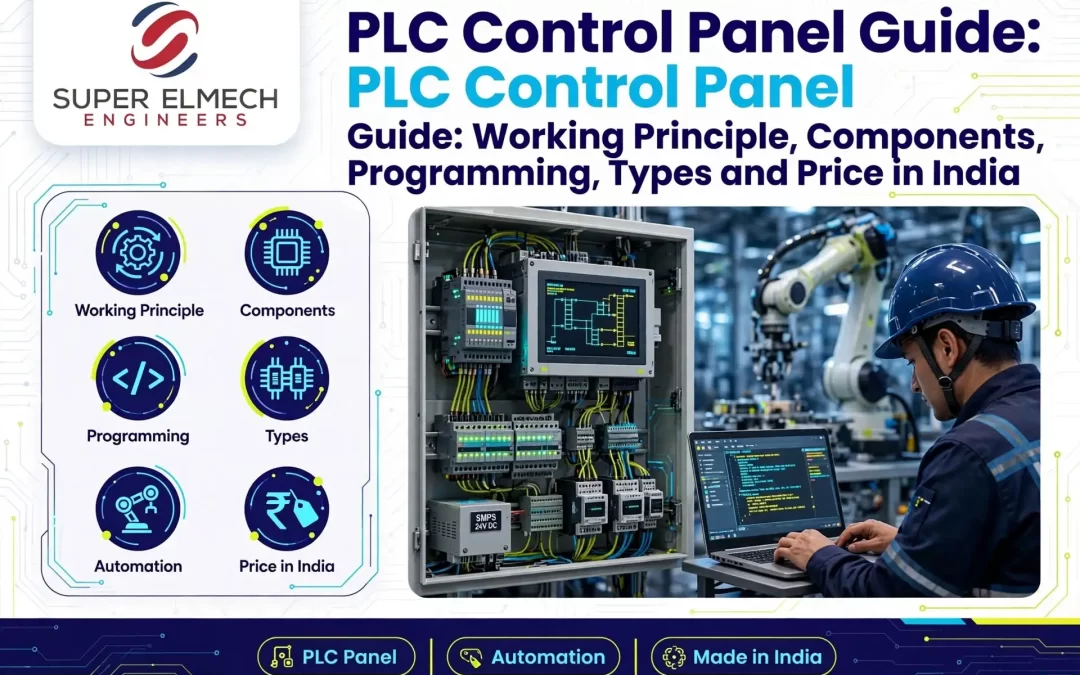
A typical PLC control panel may include:
- Programmable logic controller
- Digital and analog input/output modules
- SMPS power supply
- MCBs and control protection devices
- Relays and contactors
- Terminal blocks
- Communication modules
- Human Machine Interface (HMI)
- Variable Frequency Drive (VFD), where required
- Cooling fan and ventilation accessories
- Control switches and indication lamps
For example, in a water treatment plant, a PLC panel can monitor tank levels, control pumps, operate valves and generate alarms when a process condition falls outside its configured limits.
The exact panel arrangement depends on the process, number of field devices, automation level and project specifications.
PLC Panel Full Form and Meaning
The full form of PLC is Programmable Logic Controller.
A PLC is an industrial computer designed to monitor inputs, execute programmed logic and control outputs.
The term PLC panel refers to the complete electrical control assembly in which the PLC and supporting components are installed.
| Term | Meaning |
|---|---|
| PLC | Programmable Logic Controller |
| PLC Panel | Electrical panel containing PLC and associated control equipment |
| HMI | Human Machine Interface |
| I/O | Input/Output |
| DI | Digital Input |
| DO | Digital Output |
| AI | Analog Input |
| AO | Analog Output |
| SCADA | Supervisory Control and Data Acquisition |
| VFD | Variable Frequency Drive |
| SMPS | Switched Mode Power Supply |
Understanding these terms helps industrial buyers communicate their requirements more clearly when requesting a PLC control panel quotation.
What Is a Programmable Logic Controller?
A Programmable Logic Controller is a rugged industrial controller developed to automate machines, equipment and processes.
Unlike a general-purpose computer, a PLC is designed for industrial control environments. It can receive signals from sensors, execute control logic and operate electrical equipment through its output interfaces.
A PLC generally performs three major functions:
1. Input Processing
The PLC receives information from connected field devices.
Examples include:
- Push buttons
- Limit switches
- Proximity sensors
- Pressure sensors
- Temperature transmitters
- Level switches
- Flow meters
2. Program Execution
The controller executes the stored program according to its operating cycle.
The program may contain logic for motor starting, pump sequencing, temperature control, alarms, interlocking and other automation functions.
3. Output Control
After processing the input information, the PLC updates its outputs.
These outputs may operate:
- Motor contactors
- Control relays
- Solenoid valves
- Alarm indicators
- VFD start commands
- Process control equipment
This process allows industrial equipment to operate according to predefined conditions rather than relying entirely on manual switching.
How Does a PLC Control Panel Work?
The working principle of a PLC control panel is based on receiving signals, processing programmed logic and controlling connected equipment.
Consider an industrial water pumping system.
The PLC panel monitors the water level in a storage tank and controls the pump according to the configured operating sequence.
Step 1: Input Signal Received
A level sensor sends a signal to the PLC when the water level changes.
The signal reaches the appropriate digital or analog input module.
Step 2: PLC Processes the Information
The PLC reads the input and checks the programmed conditions.
For example, the program may specify that a pump should start when the water level falls below a defined threshold.
Step 3: Control Logic Is Executed
The PLC checks additional conditions such as pump availability, overload status, emergency stop status and operating mode.
Step 4: Output Command Is Generated
If all required conditions are satisfied, the PLC activates the relevant output.
The output may operate an interposing relay or a suitable motor control circuit.
Step 5: Pump Starts
The motor starter or VFD receives the required command and operates the pump.
Step 6: Feedback Is Monitored
The PLC receives feedback from auxiliary contacts, sensors or the drive.
If the expected feedback is not received within the configured time, the program may generate an alarm or initiate a defined fault response.
Step 7: Continuous Operation
The PLC repeats this process continuously while the system is running.
This makes it possible to automate repetitive industrial operations and monitor equipment conditions.
Main Components of a PLC Panel
The components used in a PLC control panel depend on the application and the required automation functions.
1. Programmable Logic Controller
The PLC is the main control unit of the panel.
It executes the control program, processes field signals and controls connected output devices.
The controller should be selected according to processing requirements, I/O count, communication needs and future expansion.
2. Input and Output Modules
I/O modules connect the PLC with field devices.
Digital Inputs (DI): Receive ON/OFF signals from push buttons, switches, proximity sensors and similar devices.
Digital Outputs (DO): Provide switching commands to relays, contactors and other compatible devices.
Analog Inputs (AI): Receive continuous signals from instruments such as pressure, temperature and flow transmitters.
Analog Outputs (AO): Provide control signals to compatible devices, including certain VFDs and control valves.
3. SMPS Power Supply
A switched-mode power supply provides the required DC supply for the PLC, sensors and other control equipment.
The power supply rating must account for the connected load and any required design margin.
4. MCB and Electrical Protection
Miniature circuit breakers and other suitable protective devices protect control circuits against specified electrical faults.
Protection selection depends on the circuit characteristics and equipment requirements.
5. Relays and Contactors
Relays provide switching and interface functions between PLC outputs and external control circuits.
Contactors are commonly used to switch motors and other electrical loads within their rated operating conditions.
6. Human Machine Interface (HMI)
An HMI provides a graphical interface between operators and the automation system.
Operators may use it to:
- Start and stop equipment
- View process parameters
- Monitor alarms
- Check equipment status
- Select operating modes
- View operating trends, where supported
7. Communication Modules
Communication modules allow the PLC to exchange data with HMIs, VFDs, SCADA systems, remote I/O and other automation equipment.
The required communication protocol depends on the selected devices and network architecture.
8. Terminal Blocks
Terminal blocks provide organised termination points for field wiring, power connections and control signals.
Correct terminal identification and wiring segregation help simplify inspection and troubleshooting.
9. VFD Integration
A Variable Frequency Drive can be integrated into a PLC control panel when motor speed or process flow needs to be controlled.
The PLC may send start/stop commands and speed references to the VFD, while the drive returns status and fault information.
10. Panel Enclosure and Cooling
The enclosure protects internal equipment from the surrounding environment.
Depending on the installation, the panel may require ventilation, cooling fans, filters or air-conditioning.
The enclosure material, ingress protection rating and thermal design should match the site conditions.
Types of PLC Control Panels
PLC panels are designed according to the type of industrial process and automation requirement.
1. Basic PLC Control Panel
A basic PLC panel is used for straightforward automation tasks involving a limited number of inputs and outputs.
Typical applications include small machines, simple motor sequencing and equipment interlocking.
2. PLC Panel with HMI
This configuration includes a display that allows operators to monitor and interact with the process.
It is suitable for applications where operators need access to equipment status, process values and alarms.
3. PLC and VFD Control Panel
This panel combines PLC-based process control with variable-speed motor operation.
It is commonly used for pumps, blowers, conveyors, fans and other applications requiring controlled motor speed.
4. PLC-Based Pump Control Panel
A PLC pump control panel manages multiple pumps according to pressure, level, flow or other process requirements.
It may include automatic pump alternation, standby pump operation and fault monitoring.
5. PLC-Based Process Control Panel
This type of panel is used for complex processes involving multiple sensors, actuators, control sequences and instrumentation.
Applications include water treatment, chemical processing and manufacturing.
6. PLC-Based Synchronization Panel
A PLC-based synchronization panel coordinates multiple generator sets operating in parallel.
It may manage generator sequencing, synchronization conditions, load sharing and breaker control through suitable controllers and interfaces.
Explore PLC Based Synchronization Panels by Super Elmech.
PLC Programming: Languages and Working
PLC programming defines how the controller should respond to different input conditions and operate connected equipment.
The program is developed according to the machine or process sequence.
A programmer first understands the process requirements, prepares the control philosophy and then develops the PLC logic.
Common PLC Programming Languages
The IEC 61131-3 standard defines programming languages commonly used in programmable controllers.
Ladder Diagram (LD)
Ladder Diagram is a graphical programming language that resembles electrical relay logic.
It is widely used for motor control, interlocking, switching sequences and machine automation.
Function Block Diagram (FBD)
Function Block Diagram represents control functions using interconnected blocks.
It is useful for process control, signal processing and applications involving reusable function blocks.
Structured Text (ST)
Structured Text is a high-level textual programming language.
It is suitable for mathematical operations, data handling, complex conditions and structured control logic.
Sequential Function Chart (SFC)
Sequential Function Chart represents a process as steps and transitions.
It is useful for applications that require clearly defined operating sequences.
Basic PLC Programming Example
Consider a simple motor-starting application.
The operating logic may be:
- The operator presses the START push button.
- The PLC checks whether the STOP and emergency-stop circuits are healthy.
- The PLC checks the overload and other required interlocks.
- If all conditions are satisfied, the PLC issues the motor-start command.
- The motor-running feedback is monitored.
- If an overload or configured fault occurs, the PLC removes the run command and generates an alarm.
This is only a conceptual explanation. Actual safety-related functions must use appropriately designed safety circuits and safety-rated equipment where required. A standard PLC program alone should not be treated as a substitute for a safety system.
Allen-Bradley PLC: Features and Applications
Allen-Bradley is a brand of industrial automation products from Rockwell Automation.
Allen-Bradley PLCs are used in various industrial automation applications, including machine control, manufacturing systems, process automation and equipment monitoring.
Rockwell Automation offers controller families for different application sizes and performance requirements.
Common controller families include:
- Micro800
- CompactLogix
- ControlLogix
- Compact GuardLogix and GuardLogix safety-related platforms
Why Do Industries Consider Allen-Bradley PLCs?
Selection may depend on:
- Required controller performance
- Number of digital and analog I/O points
- Communication requirements
- Programming environment
- Integration with existing equipment
- Network architecture
- Availability of technical support
- Future expansion requirements
The choice between Allen-Bradley and other PLC brands should be based on the actual application, engineering requirements and lifecycle cost.
Important: Allen-Bradley is not automatically the best choice for every project. A suitable controller must be selected after reviewing the process, compatibility and budget.
For product information, refer to the official Rockwell Automation Programmable Controllers range.
PLC Control Panel Wiring and Design
A properly designed PLC panel requires more than mounting a controller inside an electrical enclosure.
The design should consider power distribution, control wiring, signal integrity, heat dissipation, protection and maintenance access.
Important Design Considerations
1. I/O List Preparation
Prepare a complete list of digital and analog signals required from field equipment.
2. Electrical Load Calculation
Calculate the control power requirements for the PLC, HMI, relays, sensors, communication equipment and other devices.
3. Power and Signal Segregation
Separate power wiring from sensitive analog and communication wiring as required by the design.
4. Earthing and Shielding
Provide suitable protective earthing and follow the equipment manufacturer’s recommendations for cable shielding and grounding.
5. Short-Circuit and Overload Protection
Select protective devices according to the connected equipment and applicable electrical design requirements.
6. Panel Layout
Arrange components to allow adequate ventilation, wiring access, identification and maintenance.
7. Communication Architecture
Define how the PLC communicates with HMI, VFDs, SCADA, remote I/O and other equipment.
8. Documentation
A project-specific drawing package may include:
- Single-line diagram, where applicable
- General arrangement drawing
- Power circuit diagram
- Control wiring diagram
- PLC I/O list
- Terminal plan
- Cable schedule
- Bill of materials
- PLC program documentation
A generic PLC wiring diagram should not be used as a direct construction drawing. Final connections must be verified against the actual PLC model, module configuration, equipment manuals and approved project drawings.
PLC Control Panel Price in India
One of the most common commercial searches is PLC control panel price.
There is no fixed price for every PLC panel because the cost depends on the application, controller, I/O configuration, automation complexity and electrical hardware.
The following factors influence the quotation.
1. PLC Brand and Model
Different PLC brands and controller families have different hardware capabilities and price levels.
2. Number of I/O Points
A panel with 16 digital inputs and 8 outputs will have different hardware requirements from a system with hundreds of digital and analog signals.
3. HMI Requirement
The size, features and brand of the HMI influence the total panel cost.
4. VFD and Motor Control Integration
If the project requires VFDs, motor starters, contactors or additional protection devices, the cost will change.
5. Communication and SCADA Integration
Remote I/O, industrial networking, SCADA connectivity and communication gateways may add hardware and engineering costs.
6. Enclosure and Fabrication
Panel dimensions, material, IP rating, internal segregation and cooling arrangements affect fabrication cost.
7. Programming and Engineering
PLC programming, HMI development, process sequencing, commissioning and documentation form an important part of the project cost.
8. Testing and Site Support
Factory testing, functional verification, installation support and commissioning requirements should be included in the quotation scope.
What Information Should You Share for a PLC Panel Quotation?
To receive a meaningful quotation, provide:
- Application or process description
- Number of motors and connected equipment
- Digital and analog I/O list
- PLC brand preference, if any
- HMI requirement
- VFD requirement
- Communication and SCADA requirements
- Supply voltage and control voltage
- Indoor or outdoor installation
- Required drawings and testing scope
Comparing quotations only on the basis of the PLC brand or panel price can lead to an incomplete comparison. Review the complete scope of supply and engineering deliverables.
Industrial Applications of PLC Panels
PLC control panels are used across many industrial sectors.
Manufacturing and Production Lines
PLCs control machine sequences, production operations, conveyor systems and equipment interlocking.
Water and Wastewater Treatment Plants
PLC panels monitor pumps, valves, tank levels, blowers and process instruments.
Pharmaceutical Industries
PLC-based automation can manage equipment sequences, process monitoring and data communication according to project and validation requirements.
Food Processing Industries
PLCs control mixing, filling, packaging, conveyors and other automated operations.
HVAC Systems
PLC-based control can coordinate pumps, fans, chillers and other HVAC equipment where the system design requires programmable automation.
Chemical and Process Industries
PLCs manage process sequences, instrumentation, equipment status and interlocking.
Power Generation
PLC-based systems can support generator monitoring, sequencing and synchronization-related control functions when designed with suitable dedicated controllers and protection equipment.
PLC Panel vs Conventional Control Panel
Both PLC panels and conventional relay-based panels are used in industrial electrical systems, but their control methods are different.
| Parameter | PLC Control Panel | Conventional Control Panel |
|---|---|---|
| Control method | Program-based logic | Relay and hardwired logic |
| Modification | Logic can often be changed through programming | Changes may require physical rewiring |
| Complex sequencing | Suitable for complex sequences | Can require extensive wiring |
| Monitoring | Can integrate HMI and communication | Usually more limited unless additional devices are used |
| Expansion | Can be expanded with compatible modules | May require substantial rewiring |
| Initial cost | Depends on controller and system complexity | May be economical for simple applications |
| Maintenance | Requires PLC and programming knowledge | Requires conventional electrical troubleshooting skills |
Which One Should You Choose?
For a simple machine with a small number of switching operations, a conventional control panel may be sufficient.
For applications involving multiple sensors, automated sequences, process monitoring, communication or frequent logic changes, a PLC control panel may offer greater flexibility.
The final choice should depend on lifecycle cost, operating conditions, maintenance capability and future expansion plans.
How to Choose a PLC Control Panel Manufacturer
Selecting the right manufacturer is important because a PLC panel must work correctly with the complete machine or process.
Before placing an order, consider these factors.
1. Engineering and Design Capability
Check whether the manufacturer can prepare project-specific electrical drawings, PLC I/O schedules, control logic and panel layouts.
2. Understanding of the Application
The manufacturer should understand your process requirements rather than simply supplying a panel based on a generic design.
3. Component Selection
Review the PLC, I/O modules, protection devices, power supply, relays, terminals and communication equipment proposed for the project.
4. Programming and Integration
Confirm that the manufacturer understands the selected PLC platform and can provide the required HMI, VFD, SCADA and communication integration.
5. Panel Fabrication and Assembly
Check enclosure quality, internal wiring, cable management, component identification and accessibility for maintenance.
6. Testing and Inspection
Ask about wiring checks, power-up checks, I/O verification, logic testing and functional testing according to the project requirements.
7. Documentation
A professional project should include relevant drawings, component lists, PLC program backup and operating information.
8. After-Sales Support
Consider technical assistance, troubleshooting, commissioning support and availability of replacement components.
PLC Control System in Bhavnagar
Businesses searching for a PLC control system in Bhavnagar may be looking for automation solutions for factories, manufacturing units, water treatment plants, packaging systems and industrial machinery.
Before choosing a supplier, buyers in Bhavnagar should prepare their process requirements, I/O list, electrical drawings and automation scope.
When evaluating an out-of-city manufacturer, confirm:
- Whether the manufacturer can design a panel for your application.
- Whether remote engineering coordination is available.
- Whether installation and commissioning support can be arranged.
- Whether drawings and PLC program documentation are included.
- Whether the proposed system supports future expansion.
Super Elmech Engineers Pvt Ltd is based in Gurugram, Haryana, India. The company should not be described as having a Bhavnagar factory or branch unless that information is officially confirmed.
Industrial buyers can contact the company to discuss project requirements and determine whether the proposed engineering and support arrangement suits their location.
Why Consider Super Elmech Engineers Pvt Ltd?
Super Elmech Engineers Pvt Ltd is an electrical panel manufacturer based in Gurugram, Haryana.
The company works with electrical control and distribution panel solutions, including PLC-based synchronization panels for applications involving multiple diesel generator sets.
Its PLC-based synchronization solution is designed to coordinate generator operation according to changing electrical load requirements.
For projects involving generator automation, buyers can explore the company’s PLC Based Synchronization Panels.
You can also explore other electrical panel solutions:
For a project-specific enquiry, share your application details and technical requirements with the company.
Super Elmech Engineers Pvt Ltd
Address: A-1/11, Sheetla Colony, Sayyad Marg, Gurugram, Haryana, India
Phone: +91 (124) 646 0877
Mobile: +91 9811129576
Email: [email protected]
Website: https://www.superelmech.com/
Frequently Asked Questions
1. What is a PLC control panel?
A PLC control panel is an electrical enclosure containing a programmable logic controller and supporting electrical components. It receives signals from field devices, processes programmed logic and controls connected industrial equipment.
2. What is the full form of PLC?
PLC stands for Programmable Logic Controller. It is an industrial computer used to automate machines and processes.
3. What are the main components of a PLC panel?
The main components may include a PLC CPU, input/output modules, SMPS, circuit breakers, relays, contactors, terminal blocks, communication modules, HMI and enclosure accessories.
4. How does a PLC control panel work?
A PLC panel receives signals from sensors and switches, processes them according to a stored program and sends commands to output devices such as motors, valves, contactors and alarms.
5. What is PLC programming?
PLC programming is the process of developing instructions that define how a programmable controller responds to input signals and operates connected equipment.
6. What are the common PLC programming languages?
Common PLC programming languages include Ladder Diagram, Function Block Diagram, Structured Text and Sequential Function Chart.
7. What is an Allen-Bradley PLC?
Allen-Bradley is a brand of programmable controllers and industrial automation equipment from Rockwell Automation. Its controller families include Micro800, CompactLogix and ControlLogix.
8. What is the price of a PLC control panel in India?
PLC control panel prices depend on PLC brand, I/O count, HMI, VFD integration, enclosure, programming, communication requirements, testing and commissioning scope. A detailed project specification is needed for an accurate quotation.
9. What is the difference between a PLC and a PLC panel?
A PLC is the programmable controller itself. A PLC panel is the complete electrical assembly containing the PLC and supporting equipment required for industrial control.
10. Can a PLC control panel operate a VFD?
Yes. A PLC can communicate with a compatible VFD through digital signals, analog references or industrial communication protocols. The selected control method depends on the application and equipment.
11. Where are PLC control panels used?
PLC panels are used in manufacturing plants, water treatment facilities, pharmaceutical units, food processing, packaging, HVAC, chemical industries and other automated processes.
12. How do I select a PLC control panel manufacturer?
Review the manufacturer’s design capability, PLC programming expertise, component selection, fabrication quality, testing procedures, documentation and after-sales support.
Conclusion
A PLC control panel is an important part of modern industrial automation. It helps industries monitor field devices, execute programmed sequences and control machinery through a centralised system.
Understanding the PLC panel full form, working principle, components, programming methods and price factors makes it easier for buyers to select a suitable solution.
Before purchasing a PLC control panel, prepare the application details, I/O list, electrical requirements, communication needs and future expansion plans. Also evaluate the manufacturer’s engineering capabilities, testing procedures and commissioning support.
For industrial automation and generator-control requirements, discuss your project specifications with Super Elmech Engineers Pvt Ltd to determine the appropriate electrical panel and control arrangement.