




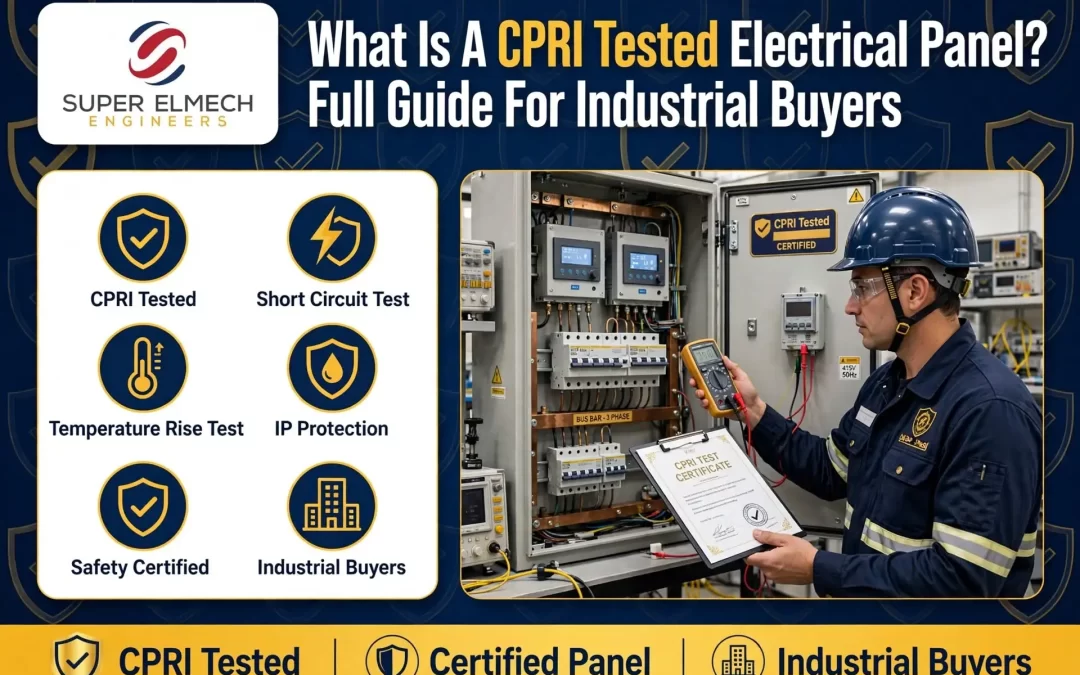
Electrical panels play a key role in your power distribution and control within industries, commercial buildings, infrastructure and industrial sites. They provide electrical power distribution, protection for the connected equipment and assist in ensuring the safe operation of the installation. When looking to buy electrical panels, you will often come across mention of CPRI Tested Electrical Panels.
What does CPRI tested actually mean? Is it an individual test per panel? What is the difference between a test report and a CPRI certification? What tests should I be checking before ordering?
These questions are important to electrical consultants, EPC contractors, project managers, procurement, plant engineers and industrial buyers. Simply choosing a cheaper option or one that mentions it is CPRI tested may miss vital information.
A CPRI tested electrical panel generally means that the panel assembly or design has been tested according to the test requirements at the Central Power Research Institute (CPRI). The exact definition will depend on the equipment, its rating and the tests carried out.
This guide explains what CPRI tested means, what tests are typically carried out on electrical panels, and what documentation you should expect. We will also show you how to verify a CPRI test report. Finally we will give you some tips on what to look for when choosing an electrical panel manufacturer in India.
Contents
- What Is A CPRI Tested Electrical Panel?
- What Is CPRI?
- Why CPRI Testing Is Important
- CPRI Test Report Or Type Test Certificate?
- Key Tests For Electrical Panels
- What Type Of Electrical Panel May Require CPRI Testing?
- How To Verify A CPRI Test Report
- What Should I Be Looking For?
- CPRI Tested Electrical Panels From Super Elmech Engineers
- Common Mistakes
- FAQs
- Conclusion
What Is A CPRI Tested Electrical Panel?
A CPRI tested electrical panel means that one or more tests have been carried out at the CPRI laboratories. These tests ensure that certain performance features have been tested.
CPRI stands for Central Power Research Institute. This is an Indian organisation that offers testing, research and certification services.
As an electrical panel buyer, you can gain insight into the design of the equipment through CPRI testing. This could include short circuit withstand, temperature rise, dielectric, switching or other tests according to the test programme.
However, you shouldn’t assume that everything has been tested on all panels produced by the company.
The type of test carried out will impact what is tested.
If a specific assembly has been tested at a particular rating for short circuit withstand then it isn’t assumed that it will be tested at a different rating or configuration. Ensure that the panel design offered is the same.
In simple terms,
Your factory wants to buy a Low Voltage Power Control Centre (PCC) panel. Your procurement team require evidence that the panel design meets the required electrical and performance criteria.
The manufacturer may provide you with a relevant test report or certificate.
Within the report you should check:
- What the name of the product tested is.
- Who is the manufacturer or applicant.
- What type of panel.
- The rated voltage and current.
- Short circuit withstand.
- What standard has been tested to.
- What tests were carried out.
- What exactly has been tested.
This will allow you to ensure that the test evidence is suitable for your project.
What Is CPRI?
CPRI stands for Central Power Research Institute. This is an Indian organisation that provides testing services.
They offer testing for various electrical products and equipment. This includes low voltage switchgear and control gear, panel assemblies, distribution boards, feeder pillars, cables, transformers and other power system equipment.
Their Short Circuit Laboratory provides testing for electrical equipment including panel assemblies. They also provide information on their short time current and short circuit testing capabilities.
This is important for industrial buyers as electrical distribution panels may need to withstand harsh operating and fault conditions. A good testing programme will provide evidence that the equipment will perform to the required criteria.
CPRI offer various testing and certification options so ensure you know exactly what the manufacturer is referring to.
CPRI Website
CPRI Short Circuit Laboratory
CPRI Certification Scheme
Why Is CPRI Testing Important?
Electrical panels should operate reliably to the required electrical criteria. Poorly designed or assembled panels can cause issues like overheating, insulation failure, equipment damage and electrical faults.
CPRI testing can provide evidence that the design meets certain performance criteria.
1. Evidence Of Electrical Performance
Testing ensures that the equipment meets certain electrical criteria. This could include insulation, current withstand, temperature rise or switching capabilities.
2. Better Technical Information
Industrial procurement teams often get multiple quotes. Having a relevant test report or certificate will allow the technical team to have more information about the panel.
This should be taken into consideration along with drawings, component details, ratings, inspection and project criteria.
3. Project Requirements
Some industrial, infrastructure and commercial projects have specific requirements relating to standards, testing and documentation.
If the project requires a type or CPRI tested panel, ensure you confirm with your electrical consultant, project or client what exact requirement they have.
4. Evidence Of Design Criteria
Having a valid test document will provide evidence of the criteria that have been tested. This can help the engineering team decide if the design is suitable.
5. Better Documentation
Having a structured testing and documentation process will allow you to see what has been tested on the panel. This can help with your project documentation by having test reports, approved drawings, component details and routine inspection.
Testing doesn’t guarantee there aren’t any risks with the operation. Ensuring the equipment is installed correctly, protected, maintained, suitable for the environment and operated within the correct limits is still very important.
CPRI Test Report Or Type Test Certificate?
One of the most important things to understand is the difference between a CPRI test report and a CPRI type test certificate.
Sometimes these can be used interchangeably in marketing but they may not mean the same thing.
CPRI provide information that a test report provides details about what was tested on the product/testing sample. A type test certificate is provided once the type testing has been successfully completed according to the relevant certification process.
| Document | Generally Indicates | Ensure You Check |
|---|---|---|
| CPRI Test Report | Details what was tested on the product/testing sample | Product, ratings, what was tested and results. |
| Type Test Certificate | Evidence that type tests have been successfully completed | Scope of certificate, standard, type of product and validity/status. |
| Routine Test Report | Details what checks have been carried out on the manufactured panel | Serial number, results and inspection date. |
| Acceptance Test Reports | Details what checks or tests have been carried out according to agreement. | Contract requirements, approved inspection plan and acceptance criteria. |
What Is A Type Test?
A Type Test is carried out to ensure that the design/product meets certain criteria according to the relevant standards.
This isn’t carried out on every individual panel.
Type test results can only be relied on for the criteria within the documented scope. Ensure that the design offered has the same relevant criteria, ratings and configuration.
What Is A Routine Test?
Routine tests are generally carried out on manufactured equipment to ensure it meets certain criteria. The routine test plan for an electrical panel should be in line with the relevant standard, project criteria and approved quality procedure from the manufacturer.
What Is An Acceptance Test?
Acceptance testing is carried out according to the agreed project/purchase criteria to ensure that the supplied equipment meets the required criteria.
This can include document checks, visual inspection, electrical checks and other agreed tests.
Do not assume that CPRI approved means you have the relevant documentation. Ensure you ask the manufacturer what type of documentation they are providing; a test report, type test certificate or other evidence.
Key Tests For Electrical Panels
The type of tests carried out will depend on what type of panel you’re looking at, the relevant standard, ratings, design and project criteria. Below are examples of tests that you may come across.
Short Circuit Withstand Test
This test ensures that the electrical assembly can withstand the relevant short circuit current for a certain period of time without causing any unacceptable damage.
This is particularly important for power distribution assemblies.
Ensure you check:
- Rated short time withstand current.
- How long was it tested for.
- Voltage and assembly.
- Busbar layout.
- Test report details and standard.
Temperature Rise Test
Electrical components and conductors produce heat when current is flowing through them.
This test ensures that the equipment doesn’t exceed the relevant temperature rise criteria according to the standard and ratings.
This is important for panels that will be operating continuously.
Dielectric Test
This test ensures that the insulation of the electrical equipment meets the relevant criteria according to the test.
High Voltage Test
This test is carried out to ensure that the insulation can withstand a certain voltage for a certain period of time.
The test and acceptance criteria will depend on the relevant standard and equipment.
Primary & Secondary Current Injection Test
Current injection tests are used to verify certain protection and measurement criteria.
Primary current injection – Test current is passed through the primary current circuit to ensure the relevant circuit and protection is in place.
Secondary current injection – Test current is applied to the secondary circuits such as relay inputs. This ensures that the protection devices are working and set up correctly.
This can be useful to verify the protection.
Switchgear & Functional Checks
Switchgear checks can include circuit breakers, contactors, isolators and other mechanisms.
Functional tests can also be carried out to ensure that the control wiring, interlocks, lamps, alarms and operation is correct.
Insulation Resistance Test
This test ensures that the resistance between certain conductors and earth or between electrical circuits meets the relevant criteria using the appropriate testing equipment and method.
This is usually carried out as part of the panel inspection/testing.
Paint Thickness & Visual Inspection
Paint thickness, surface finish, enclosure, door alignment, glands, labelling and general quality can be checked.
This isn’t a replacement for type tests but can be part of the quality control process.
What Type Of Electrical Panel May Require CPRI Testing?
The type of testing will depend on the project, relevant standards, panel and what you require.
CPRI provide information on their Short Circuit Laboratory. This includes testing for associated panel assemblies such as LT panels, PCC panels, MCC panels, distribution boards and feeder pillars.
Below are some common panel types.
Power Control Centre (PCC) Panel
A PCC panel is used for power distribution and control within industrial and commercial electrical installations.
Power may be supplied from a transformer, generator or other source, and distributed from outgoing feeders.
Ensure you check the rated current, short circuit withstand, busbar design, circuit breaker choice, protection and panel separation (if required).
Find out more about PCC Panels.
Motor Control Centre (MCC) Panel
An MCC panel is used to control and protect multiple electric motors.
It is commonly used in manufacturing plants, pumping and industrial process facilities.
Important considerations include motor ratings, starter type, protection, feeder layout and control.
Find out more about MCC Panels.
Automatic Power Factor Control (APFC) Panel
An APFC panel is used to control power factor correction with capacitor switching. This includes control equipment.
Ensure you check the load, rated capacitor bank, switching method, harmonics and protection.
Find out more about APFC Panels.
Automatic Mains Failure (AMF) Panel
An AMF panel is used with generators to control the transfer from mains to generator according to the design operation. This will depend on the generator ratings, transfer requirements, control logic, interlocks and protection.
Find out more about AMF Panels.
Water Treatment Plant (WTP) Panel
A WTP panel is used to control equipment within a water treatment system.
Depending on the project it can control pumps, motors, process equipment, alarms and automatic operation.
Find out more about WTP Panels.
How To Verify A CPRI Test Report
When looking to purchase an electrical panel you should ensure you ask for the relevant documentation. Just because it has a CPRI reference or is shown in a brochure doesn’t mean it is valid.
Step 1 – Product Details
Ensure you know what the product name, panel type, manufacturer/applicant and sample are.
Step 2 – Ratings
Ensure the ratings match what is being offered.
Check the following:
- Rated voltage.
- Rated current.
- Short circuit withstand.
- Frequency.
- Busbar layout.
- Relevant assembly.
Exact details will depend on the equipment and testing.
Step 3 – Test Details
Ensure you know what tests have actually been carried out. Just because one test has been carried out doesn’t mean all performance criteria have been verified.
Step 4 – Standard
Ensure that the standard and edition are mentioned. Check that it is relevant to your project.
Step 5 – Results
Ensure that the results, observations and conclusions are mentioned. If claiming it is a certificate ask for the certificate and what it covers.
Step 6 – Validity Of Document (If Required)
For important projects ensure you check with the organisation who issued the report/certificate.
CPRI provide information on their test reports and certification.
CPRI About Test Reports
CPRI Certification Scheme
What Should I Be Looking For?
CPRI testing documentation is just one aspect to consider when looking at a supplier. You should also consider;
Engineering Capabilities
Can the manufacturer provide the required General Arrangement (GA), Single Line Diagrams (SLD), control drawings and relevant documentation?
The design should be tailored to the project requirements.
Component Selection
Check that the circuit breakers, contactors, relays, meters, busbars, terminals and other components are the correct make, ratings and suitable.
Ask for the bill of materials and ensure it meets the approved specification.
Manufacturing
Check how the panel is fabricated, enclosure made, busbars processed, wiring, assembly and finishing.
A structured manufacturing process will help with consistency and traceability.
Testing & Inspection
Ask what testing is carried out during and after manufacture.
Ask for examples of routine test formats, inspection plan and relevant reports.
Project Experience
Has the manufacturer experience with similar panel types, environments and requirements?
Rather than general statements it is better to have experience with relevant projects.
Documentation & After Sales
Ensure you know what documentation will be provided. This should include approved drawings, test results, component details and operation/maintenance documentation if required.
Discuss installation coordination, commissioning and service.
CPRI Tested Electrical Panels From Super Elmech Engineers
Super Elmech Engineers Pvt. Ltd provide electrical control and distribution panels. They are based in Gurugram, Haryana.
On their website they provide information about their electrical panels. They mention that they offer CPRI tested panels. Their panel types include Power Control Centre (PCC), Motor Control Centre (MCC), Automatic Power Factor Control (APFC), Water Treatment Plant (WTP) and Control Desks.
They provide information on their testing and support process.
- Customised designs using AutoCAD.
- GA, SLD and control drawings.
- Planning and sourcing of electrical components.
- Cutting, bending, welding and fabrication.
- Painting, powder coating and assembly.
- Electrical testing and inspection.
- Documentation and post installation support.
Their testing and support page mentions the following tests:
- High voltage testing.
- Megger testing.
- Switchgear testing.
- Primary & Secondary Current Injection.
- Paint Thickness.
This can help you understand how they manufacture and test their panels. However, ensure you ask for the relevant test documentation for the panel you require. Ensure that the ratings and configuration match your project.
View their panels:
- PCC Panels
- MCC Panels
- APFC Panels
- AMF Panels
- WTP Panels
- Testing & Support
- About Super Elmech
If you need technical specifications, panel requirements or a quote for your project visit their Contact Page.
Common Mistakes
Even experienced procurement teams can miss out on some important information.
Assume All Panels Are Individually Tested
Type tests and routine tests are different. Ensure you know whether the document refers to a design, sample or individual panel.
Don’t Check The Brochure
A brochure won’t replace the test report/certificate.
Ignore The Ratings
Just because a report is available for a certain rating and design doesn’t mean it is suitable for other configurations. Ensure the equipment matches the test evidence.
Only Compare On Price
The quality of components, design, protection, enclosures, testing, documentation and after sales will affect how suitable the electrical panel is.
Don’t Check Project Requirements
Always ensure the offer matches the approved SLD, technical specification, load requirements and standards.
Frequently Asked Questions
1. What does CPRI tested electrical panel mean?
It means that an electrical panel assembly or relevant product design has undergone specified testing at CPRI laboratories. The exact test scope, ratings and results should be checked in the relevant report or certificate.
2. What is the full form of CPRI?
CPRI stands for Central Power Research Institute, an Indian organisation involved in electrical power research, testing and certification.
3. Is a CPRI test report the same as a CPRI certificate?
No. A test report records the product or sample tested and the test results. A type-test certificate is issued through the applicable certification process after successful completion of the specified type tests and conformity assessment.
4. Which tests are performed on electrical panels?
Depending on the product and applicable requirements, testing may include short-circuit withstand, temperature rise, dielectric, high-voltage, insulation resistance, current injection, switchgear and functional checks.
Not all tests apply to every panel.
5. Are all PCC panels required to be CPRI tested?
The requirement depends on the applicable standards, project specification, purchaser requirements and equipment design. Buyers should confirm the exact testing requirement with the project consultant or authority.
6. Are MCC panels also tested at CPRI?
CPRI’s Short Circuit Laboratory lists LT panel assemblies, including PCC and MCC panels, within its testing scope. The specific test and applicable rating must be confirmed for the proposed MCC design.
7. How can I verify a CPRI test certificate?
Review the document’s issuing authority, product identity, manufacturer or applicant, ratings, applicable standard, tests covered and certificate scope. For critical procurement, verify the document with the issuing organisation.
8. Does CPRI testing guarantee that a panel will never fail?
No. Testing verifies specified characteristics under defined conditions. Correct design, installation, protection coordination, operation and maintenance are also necessary for reliable performance.
9. What documents should I request from an electrical panel manufacturer?
Depending on the project, request approved drawings, technical specifications, component details, relevant type-test evidence, routine test reports, inspection records and other agreed documentation.
10. Where can I find a CPRI tested electrical panel manufacturer in India?
Start by shortlisting manufacturers that offer the required panel type and can provide relevant technical documentation. Compare their design capability, manufacturing process, test evidence, project experience and support arrangements. Super Elmech Engineers publishes its electrical panel range and testing process on its official website.
Conclusion
Understanding what CPRI tested electrical panel means is important for anyone purchasing electrical distribution or control panels for industrial and commercial applications.
CPRI testing provides technical evidence for the characteristics covered by the particular test programme. However, buyers should not assume that every product from a manufacturer has identical testing coverage or that a test report and a type-test certificate mean the same thing.
Before selecting an electrical panel manufacturer, verify the actual document, ratings, test scope, applicable standards, panel design and project specifications. Also evaluate manufacturing capability, component selection, routine testing, documentation and after-sales support.
For factories, infrastructure projects, commercial buildings and industrial facilities, a well-specified panel backed by appropriate technical documentation can support safer and more reliable electrical distribution.
If you are planning to purchase a PCC, MCC, APFC, AMF or WTP panel, discuss your application, electrical ratings and project requirements with the manufacturer before finalising the order.
Looking for electrical panel solutions for your next project?
Visit Super Elmech Engineers Pvt. Ltd. to explore its panel range and contact the team for project-related enquiries.