




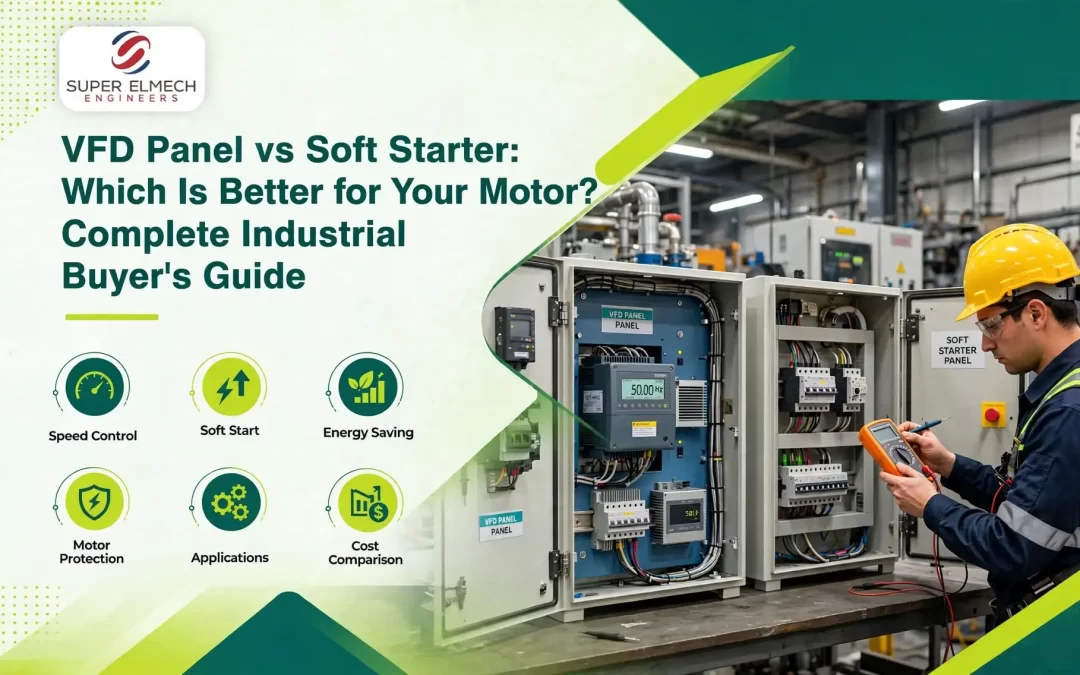
Introduction: VFD Panel vs Soft Starter
Electric motors are an important part of industrial environments. These can be found on pumps, compressors, conveyors, blowers, mixers and crushers as well as a variety of manufacturing machinery.
Using the wrong control system to start and run your electric motor can cause electrical and mechanical issues. Starting currents can be large and torque can cause vibration. This can cause issues with motor performance.
Choosing the right motor starter is vital.
Two common options used in industrial motor applications are Variable Frequency Drives (VFDs) and Soft Starters. These help provide a smooth start to your motor but have differences.
Which is better for your motor? VFD Panel or Soft Starter?
It depends on whether you require a smooth start to your motor, or if you need to run at different speeds.
A soft starter would be suitable for running the motor at a smooth speed whereas a VFD would be more suitable for varying speeds.
Having knowledge of this can help reduce unnecessary expenditure and improve your performance in industries looking to install new electrical systems or upgrade their existing motor starter.
Super Elmech Engineers Pvt. Ltd provide electrical panel engineering and manufacturing services for industrial applications including Variable Frequency Drive panels.
Table of Contents
-
What Is a VFD Panel?
-
What Is a Soft Starter Panel?
-
How Does a VFD Panel Work?
-
How Does a Soft Starter Work?
-
VFD Panel vs Soft Starter: Key Differences
-
VFD vs Soft Starter: Which Is More Energy Efficient?
-
Industrial Applications of VFD Panels
-
Applications of Soft Starter Panels
-
Advantages and Limitations of Both Technologies
-
Factors to Consider Before Selecting a Motor Control Panel
-
VFD Panel Cost vs Soft Starter Cost
-
Why Choose a Professional Motor Control Panel Manufacturer?
-
Frequently Asked Questions
-
Conclusion
What is a VFD Panel?
A Variable Frequency Drive panel is an electrical control panel used to control the speed of an AC motor. This is done by varying the frequency and voltage to the motor.
Instead of having a fixed speed motor, a VFD provides different speeds depending on the machinery it is connected to.
For example, an industrial water pump may not require the motor to run at full speed all day. A VFD can be used to slow down the motor speed depending on how much water is needed.
This can help reduce the energy being used unnecessarily in suitable variable torque applications such as-centrifugal pumps and fans.
A typical VFD panel can contain:
Variable Frequency Drive
MCCB or suitable incoming protection
Switching devices for input and output
Relays and terminal blocks
Fans for cooling
PLC or Automation Controller (if applicable)
HMI or Local Interface
Motor Protection and Fault Indicators
Bypass (if required)
This will depend on the motor ratings, load and the electrical specification of your project.
Primary Functions
Variable Speed
Provides a smooth acceleration/deceleration of the motor.
Automation
Help automate your process using external commands, PLC and sensors.
Monitoring
Provides data on how your motor is performing.
Reduced Power Usage
Can help save power in the correct applications.
What is a Soft Starter Panel?
A Soft Starter panel is an electrical control system that provides a smooth start to an AC motor. This is done by varying the voltage supplied.
Starting an AC motor using a direct online start can cause high starting currents and sudden torque. This can put strain on the motor, coupling, gearbox and machinery.
A soft starter will increase the voltage gradually to allow a smooth start to normal operating speed.
Most soft starters use Thyristors or Silicon Controlled Rectifiers (SCRs) to provide the correct voltage to the motor.
Depending on the design of the soft starter, once the motor is operating at the correct speed, a bypass contactor may be used.
Main Components
Main switch
Electronic soft starter
Bypass contactor (if applicable)
Overload protection
Relays
Terminal blocks
Local Start/Stop
Indicators
Emergency Stop/Safety interlock (if applicable)
Main Functions
Smooth Motor Start
Reduces strain on belts, couplings, gearboxes etc.
Smooth Stop
Some models provide smooth stopping.
Reduced starting current
Helps reduce the electrical and mechanical issues caused by starting the motor using a DOL start.
Soft starters are generally used for applications with a fixed speed.
How do VFD Panels Work?
A VFD converts the incoming AC to DC and then back to AC. This allows the speed of the motor to be controlled.
The process works as follows:
Rectifier – Converts AC to DC.
DC Bus – Stores and smooths the power.
Inverter – Converts the DC back into AC. This will be at the required frequency and voltage.
For example, a ventilation system in an industrial environment may require varying speeds of airflow.
A control signal can be sent to the VFD from a pressure sensor or automation controller and the speed of the fan motor will be changed.
This makes them a great option for applications requiring continuous speed control.
How do Soft Starters Work?
A soft starter varies the voltage to the motor.
Once the start signal is activated by the operator, the electronic control circuit will increase the voltage to the motor.
The motor will start up gradually.
The process works as follows:
The supply is used to power the soft starter. This will pass through the protection circuitry of the panel.
Start signal activated.
SCRs control the voltage.
The motor will gradually speed up.
Once the motor is running at the right speed a bypass may be used.
The motor will continue to run at normal speed.
This is a great option if your main requirement is to reduce the strain on the motor but you don’t require continuous speed control.
Key Differences Between a VFD Panel and Soft Starter
It is important to know about the differences between these technologies.
Difference
VFD Panel
Soft Starter Panel
Purpose
Start and Continuous Speed Control
Smooth Start and Optional Smooth Stop
Speed Control
Yes
No
Acceleration Control
Yes
Voltage Ramp
Energy Saving
Yes – Can save energy in correct variable speed applications.
No – No energy saving from varying speeds.
Cost
Typically higher
Typically lower
Flexibility
High
Low
Applications
Pumps, Fans, Conveyors, Process Machinery
Pumps, Compressors, Fixed Speed Machinery
Design
Drive considerations
Starter considerations
Automation
Advanced Speed and Process Control
Start/Stop Control
Space
May take up more space and require cooling.
Often take up less space.
The main difference is that a VFD provides speed control throughout whereas a soft starter just provides acceleration. This can be viewed in detail in technical guidelines produced by Eaton and Schneider Electric.
Which is more energy efficient? VFD or Soft Starter?
One of the biggest reasons industries will look at VFD technology is due to the energy saving benefits.
However, you need to understand that a VFD will not always save you energy.
Whether you save energy will depend on:
The load you are connecting.
How long the motor will be running for.
Speed required.
Energy Saving of VFD Panels
VFDs can provide huge energy saving opportunities in variable torque applications.
An example would be a centrifugal pump that doesn’t require to run at full speed. Using the correct VFD the motor can be slowed down depending on the process requirements.
In ideal conditions of an affinity law centrifugal pump/fan:
The flow will be approximately proportional to the speed.
Pressure will be approximately proportional to the speed squared.
Power will be approximately proportional to the speed cubed.
For example, a 80% reduction in speed can theoretically reduce the power of the fan/pump shaft to 51.2%.
However, this will depend on the characteristics of your system, losses, static pressure, control strategy and operating conditions.
Energy Saving of Soft Starter Panels
A soft starter is useful for controlling the start of the motor. However, it is not typically used to vary the speed.
Once the motor reaches full speed, a bypass may be used to allow the motor to run directly off the supply.
Therefore, generally a soft starter will not provide the same energy saving opportunities by varying speed like a VFD.
If you always need to run at full speed, then a soft starter may be a more economic option.
Which should I choose?
If you require the motor to run at a slower speed during normal operation, then a VFD would be best. If you just require a smooth start but don’t need to vary the speed, then a soft starter would be best.
VFD Panel Applications
VFD panels are widely used in industries requiring motor speed control.
Water Treatment Plants
Pumps within water treatment plants often require varying flow and pressures.
A VFD panel can be used to control the speed of the pump.
HVAC Installations
Motors are used in air handling units, cooling towers, ventilation fans and pumps in an HVAC installation. Using a VFD to control can help vary the motor speed depending on temperature, airflow and pressure.
Manufacturing Industries
Equipment such as mixers, conveyors, rollers and processing machines may require speed control. This can be achieved using VFDs.
Textile Industries
Precise speed control may be required on textile machinery. A VFD panel can help provide smooth control of suitable motors.
Chemical and Pharmaceutical Industries
Pumps, agitators and process equipment may require variable speed control. Correct drive selection and electrical protection is vital.
Soft Starter Panel Applications
These can be useful in applications where you require a smooth start but don’t need continuous speed control.
Industrial Pumps
Soft starters can help reduce the sudden start/stop of a suitable pump. If your system is prone to pressure spikes, consideration should be given to the valve operation and hydraulic conditions of the whole pump and pipeline.
Conveyor Systems
The motor may require a smooth start to reduce sudden tension on belts, couplings and machinery.
Compressors
Some fixed speed compressors can benefit from smooth motor starts. This will depend on the compressor manufacturer requirements.
Crushers and Heavy Duty Machines
Some heavy duty machines can suffer from a lot of mechanical stress during start up. A correctly chosen soft starter can help control the acceleration.
Industrial Blowers
Fixed speed blowers can use a soft starter to reduce the sudden start.
The load torque, motor characteristics, start frequency and recommendation from the equipment manufacturer should be considered.
Pros and Cons
Pros of a VFD Panel
Speed control.
Flexible automation and process control.
Potential energy savings in variable speed applications.
Smooth start/stop.
Useful monitoring and diagnostic functions.
Suitable for varying process requirements.
Cons of a VFD Panel
Higher cost in many applications.
Requires good ventilation.
Harmonics and EMC may need to be considered.
Motor cable length and insulation must be considered.
Correct programming is important.
Pros of a Soft Starter Panel
Lower cost.
Smooth start.
Reduced mechanical stress.
Good for fixed speed.
Often compact.
Some models have smooth stop.
Cons of a Soft Starter Panel
No speed control.
Less flexible for processes.
Start Frequency and Thermal limitations.
No energy management for variable speed.
Considerations for Choosing a Motor Control Panel
Before purchasing a VFD or soft starter panel, consider all of your motor requirements.
Motor Rating
Check the power rating, voltage, full load current, frequency and start characteristics of the motor. Don’t just consider the horsepower/kilowatts of the motor.
Load Type
Different loads will require different starting torques. A centrifugal pump will have very different torque requirements to a loaded conveyor.
Start Frequency
If the motor is starting and stopping frequently, check the manufacturers start frequency and thermal duties.
Speed Requirements
If you require different speeds during operation, or automation and PID based control, then a VFD may be suitable. If you just require a smooth start, then a soft starter may be sufficient.
Supply
Consider the available supply, voltage fluctuations, short circuit levels and other site considerations.
Panel Enclosure
Ensure the enclosure, temperature, ventilation and cooling of the panel matches the installation.
Automation
Check if you require PLC integration, remote monitoring, BMS and communications such as Modbus or others.
Expansion
Consider if you may require extra motors, automation or speed control in the future.
VFD Panel Cost vs Soft Starter Panel Cost
One of the most common questions asked by industries is whether a VFD panel or a soft starter panel is cheaper.
Generally, soft starter panels will be cheaper than VFD panels in similar applications. As they don’t have the same level of functionality.
However, you should also consider the overall cost.
Overall Costs
Equipment costs.
Panel costs.
Installation and commissioning costs.
Electricity costs.
Maintenance costs.
Down time and loss of production.
Expansion costs.
Long Term Value
A VFD may provide better long term value if the motor is running under varying load conditions and the energy can be saved by using variable speeds. Whereas a soft starter may provide better value if the process requires full speed and just a smooth start.
Generally manufacturers will require the motor rating, application, supply voltage, control requirements and installation.
Why Choose a Professional Motor Control Panel Manufacturer?
A motor control panel isn’t just a box of components. It needs to be designed to suit the motor, load, protection and operating conditions.
Choosing an experienced electrical panel manufacturer can help ensure you get the correct specification.
Super Elmech Engineers Pvt. Ltd provide electrical panel engineering and manufacturing services.
When considering a VFD panel manufacturer, check they have:
Experience in industrial motor control panels.
Knowledge on motor ratings and load requirements.
Correct components used.
Drawings and panel documentation.
Wiring and inspection.
Enclosure and cooling.
Automation and control.
Technical support and project management.
The panel should be designed to the approved specification and electrical safety.
FAQ
1. What is the main difference between a VFD and Soft Starter?
A VFD provides speed control throughout the motor cycle, by varying the frequency and voltage. A soft starter provides voltage control during start up and on some models stop. It does not provide speed control during operation.
2. Which is better? VFD Panel or Soft Starter Panel?
A VFD panel will be better if you require continuous speed control. A Soft Starter panel is generally better if you have a fixed speed motor.
3. Can a Soft Starter save electricity?
A soft starter can help reduce the effects of starting the motor but generally won’t provide much energy saving during operation. A VFD is generally a better option for energy management using variable speeds.
4. Is a VFD more expensive?
In many similar motor applications, a VFD panel will be more expensive. As they provide extra speed control and automation capabilities. This will depend on the motor capacity, components, panel design and project specification.
5. Can a VFD be used instead of a Soft Starter?
A correctly chosen VFD can provide smooth motor start and continuous speed control. Whether it can be used will depend on the motor, application, protection and process requirements.
6. Which starter should I use on industrial pumps?
A VFD would be useful if you require continuous flow/pressure control. A soft starter may be suitable if you have a fixed speed pump.
7. Are VFDs suitable for conveyor motors?
Yes. A VFD would be suitable for conveyors requiring variable speed, smooth start or process synchronisation. A soft starter can be suitable for fixed speed conveyors.
8. What information do I need for a VFD panel quote?
Generally manufacturers will require the kW/HP of the motor, voltage rating, full load current, type of load, speed requirements, start frequency, control method, enclosure requirements and project specification.
9. Do I need to maintain a VFD panel?
Yes. Regular inspections should be carried out to check the fans, ventilation, connections, alarms on the drive, filters and other components. Refer to the manufacturers maintenance instructions.
10. Who manufacture VFD panels in India?
Super Elmech Engineers Pvt. Ltd are an electrical panel engineering and manufacturing company. We can provide VFD panel solutions for industrial applications. Contact us to discuss your motor ratings and project requirements.
Conclusion: Choosing the Right Motor Control
Choosing whether to use a VFD panel or a Soft Starter panel will depend on the actual requirements of your motor and machinery.
A Soft Starter will be a practical option if you require a smooth motor start and then a fixed speed. Whereas a VFD would be more suitable if you require continuous speed control, flexibility and energy management using variable speeds.
Consider the motor capacity, load, start frequency, energy usage, operating conditions and any future automation requirements.
Choosing the correct motor control can help improve equipment performance and give you more control over your costs in industries, manufacturers, EPC contractors and electrical consultants.
Looking for a VFD Panel Manufacturer in India?
Contact Super Elmech Engineers to discuss your industrial motor control requirements and request a customised VFD panel quotation.
Website: https://www.superelmech.com/
Explore VFD panel solutions: https://www.superelmech.com/variable-frequency-drive-vfd-panels/