




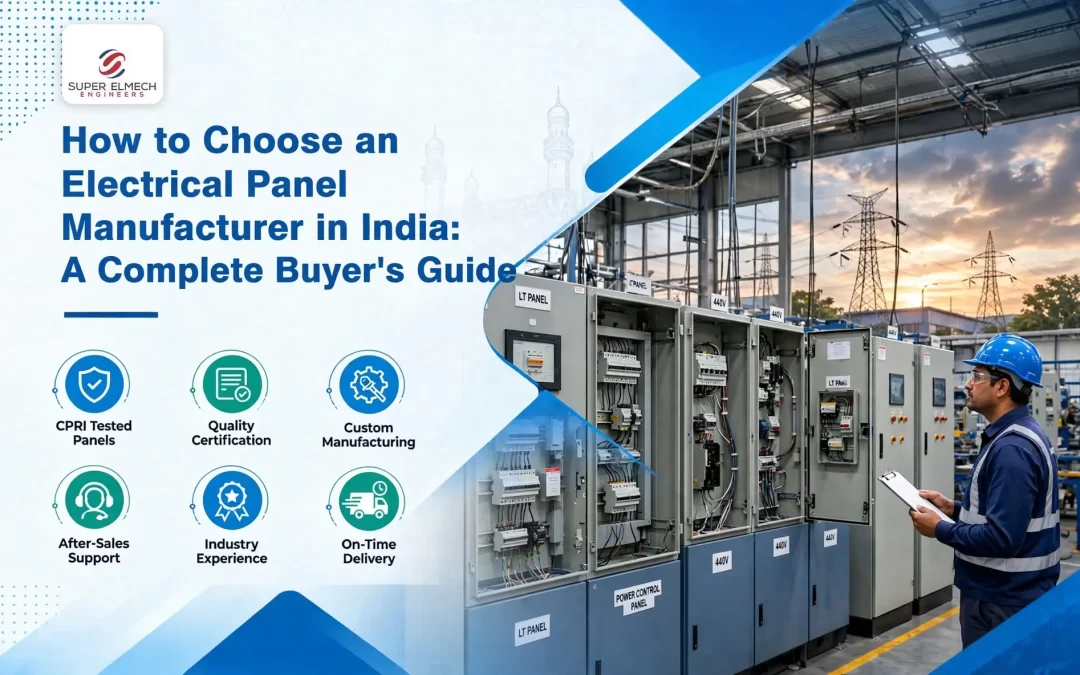
A practical guide to evaluating electrical panel manufacturers, technical capability, standards, components, drawings, quality, customisation and support in India.
Selecting the right electrical panel manufacturer will be an important element when completing any factory, commercial, infrastructure or industrial project. An electrical panel is not just a metal box with circuit breakers inside, it’s an integral part of the electrical distribution and control system.
Failure to choose the right electrical panel can lead to issues with tripping, overheating, maintenance and unexpected downtime. Whereas well engineered electrical panels can improve safety, power management and reliability.
There are many electrical panel manufacturers and suppliers available in India. Whilst the cheapest quote may tempt you, it’s important to ensure that the manufacturer supplies the right engineering, components, standards, testing, documentation, delivery and after sales.
This article will show you how to select the right electrical panel manufacturer in India, the questions to ask, documentation to request and how to select the right manufacturer based on your project requirements.
Table of Contents
What Is An Electrical Panel Manufacturer?
Define Your Electrical Panel Requirements
Ensure They Have The Right Technical Experience
Ensure They Comply With Standards And Testing
Ensure They Have The Right Components
Ensure They Provide Engineering Drawings
Ensure They Have Quality Assurance & Testing
Ensure They Can Customise To Your Requirements
Ensure They Have Installation & After Sales
How To Compare Electrical Panel Quotes
Common Errors To Avoid
Why Choose Us?
Frequently Asked Questions
1. What Is An Electrical Panel Manufacturer?
An electrical panel manufacturer will design and assemble electrical control and distribution equipment. This can include things like electrical power distribution, motor control, power factor correction, automation and electrical coordination.
A professional electrical panel manufacturer will generally undertake the following steps:
- Understand the electrical load and requirements.
- Design electrical drawings.
- Select the correct switchgear/control equipment.
- Fabricate the panel box.
- Fit the busbars, breakers, cabling and accessories.
- Undertake inspections and electrical testing.
- Provide documentation and dispatch.
The exact elements will depend upon the purchase order. However some manufacturers will only supply standard panels whereas others with an engineering background can design bespoke panels.
Quick Answer: Ensure they can explain how the panel is designed to meet your actual electrical load, conditions, safety and maintenance requirements.
2. Define Your Panel Requirements
Before contacting an electrical panel manufacturer ensure you have a clear understanding of your requirements. Without this key information the manufacturer will not be able to provide an accurate technical and commercial offer.
First define what type of panel you require.
Power Control Centre (PCC) Panels
A Power Control Centre panel is used to receive and distribute electrical power to multiple outgoing feeds. Often this type of panel is considered for factories, commercial buildings and high electrical distribution systems.
Ensure you know what incomer and outgoing feeds you require, what rating, what short circuit requirements, metering and protection you require.
Find Out More About PCC Panels
Motor Control Centre (MCC) Panels
An MCC panel is used to control and protect multiple electric motors. This may include motor starters, contactors, overload protection, circuit breakers and control.
If you require an MCC panel ensure you know what motor ratings you have, starting method, duty and control philosophy.
Find Out More About MCC Panels
Automatic Power Factor Control (APFC) Panels
APFC panels help ensure the correct power factor is achieved by using steps within the capacitor bank.
Before selecting an APFC panel manufacturer ensure you know what load profile, power factor, harmonic levels, capacitor bank layout and correction required.
Find Out More About APFC Panels
Variable Frequency Drive (VFD) Panels
VFD panels are used to control the speed of the motor. This can be useful for things like pumps, fans, conveyors etc.
Ask them what sizing they can do, motor compatibility, ventilation, harmonics, bypass requirements and control.
Find Out More About VFD Panels
Other Bespoke Panels
Depending on your project you may require AMF panels, PLC load sharing, synchronisation, HVAC, AHU, fire fighting, water treatment and other bespoke panels.
Ensure they have experience with the relevant panel types.
3. Ensure They Have The Correct Technical Experience
Ensure they have the right technical experience. Don’t just take their word for it that they are a leading manufacturer, ensure they can provide information to help your technical team decide.
Ask them:
Have they supplied similar panels?
Can they look at your electrical load schedule?
Can they produce or understand Single Line Diagrams?
Do they provide General Arrangement drawings?
Can they explain the protection and control philosophy?
Do they have a testing and inspection process?
Can they provide relevant references?
Ensure They Have Relevant Experience
Depending on your project the panel may be used within a manufacturing environment which will have different requirements compared to a commercial building or water treatment plant.
For example a factory MCC panel may need to have multiple motor feeds and process interlocks. Whereas a commercial power distribution panel would have a larger focus on separation of feeds.
Ask them about how they approach similar applications. It’s better if they have relevant experience.
4. Ensure They Comply With Standards & Testing
It’s important to ensure they comply with standards. Don’t just take their word for it that they comply with international standards. Ensure they are using the correct standards, edition, testing and documentation.
Low voltage switchgear and controlgear assemblies will often use the IEC 61439 series. Ensure they are using the correct Indian Standards, project specifications, statutory and client requirements.
What Is A Type Tested / Design Verified Panel?
Type testing / design verification provides evidence that the panel design or assembly has been tested to the correct requirements.
Depending on the standard and testing required the verification will include things like temperature rise, dielectric, short circuit and enclosure requirements.
Ask them for:
- The relevant test report/design verification.
- Name of testing laboratory.
- Assembly/design family.
- Rating and configuration.
- Any restrictions.
CPRI testing should be checked to ensure it actually covers the testing. Don’t assume all panels they will supply are individually tested to CPRI just because they have designs that are.
Type Testing & Routine Testing
Type testing / design verification refers to the design/assembly. Routine verification will be undertaken on the completed assembly. This will depend on the standard and project requirements.
Ask them for the routine inspection and testing. This should be based on the actual panel they will be supplying. The exact testing should be based on the approved design, standard and purchase specification.
5. Ensure They Have The Right Components
The panel will need to be reliable so ensure the full assembly will be using the correct components.
Key Components
Depending on the design the panel may include:
- Air Circuit Breakers (ACBs).
- Moulded Case Circuit Breakers (MCCBs).
- Miniature Circuit Breakers (MCBs).
- Contactors and overload protection.
- Protection and control relays.
- Current Transformers & Potential Transformers.
- Digital & Multifunction Meters.
Busbars.
- Control Transformers, Terminal Blocks & Indication.
The components should be chosen based on the rating, application, coordination, fault level and electrical system.
Busbars
The busbars will need to be suitable for the design. This includes the material, size, layout, fixing and clearance.
Ask them to confirm what the rated current and short circuit rating is for your project. This should be backed up with calculations, design verification or testing.
Panel Material
Ensure the panel has the correct material, thickness, finish, door layout, cable entries, gland plates, earthing and access.
Also ensure they have the correct IP rating. This will depend on the installation environment, ie dust, moisture and accidental touch.
A clean electrical room may have different requirements for the panel material compared to a harsh industrial environment.
6. Ensure They Have Good Engineering Drawings
Having good engineering drawings will avoid any confusion with the consultant, contractor and manufacturer.
Ask them what drawings they will provide for approval.
Single Line Diagram
This will show a simplified version of the electrical distribution. This will help the engineering team understand what incomers, bus sections, outgoing feeds and main protection devices there are.
General Arrangement
This will give an overview of the physical layout, size, sections and access to the panel.
Control Drawings
This will show the control wiring, interlocks, logic and connections.
Bill Of Materials
This will show the main components and their specifications. This will help you to ensure the correct make/model/rating is being used.
Tip: Ensure you have a stage in your purchase process where you will approve drawings. Don’t assume anything and let them start fabrication.
7. Ensure They Have Quality Assurance
A professional electrical panel manufacturer should have a quality process in place. This should include:
- Incoming component inspection.
- Sheet metal fabrication and panel checks.
- Busbar preparation.
- Component fitting and wiring.
- Cable identification and connection.
- Earthing and mechanical checks.
- Electrical routine verification.
- Final inspection and dispatch documentation.
Factory Acceptance Test (FAT)
A Factory Acceptance Test may be included in the inspection plan. This will allow you or your consultant to check the panel meets the requirements before dispatch.
The exact testing should be agreed upon. Depending on the panel and project requirements it may include visual checks, verification of drawings, wiring checks, functionality checks and electrical testing.
Ask them if they can provide signed inspection reports and if they can accommodate inspection by the client/third party.
8. Ensure They Can Customise
Not all projects will use a standard catalogue design. Industrial projects may require specific feeding arrangements, control logic, panel sizes, cable entries, metering, communication and integration.
A good manufacturer should be able to discuss your requirements.
Ask them if they can:
- Provide bespoke SLD and GA.
- Different incomer/outgoing feeds.
- Correct protection and metering.
- PLC/automation requirements.
- Communication requirements.
- Correct panel and segregation.
- Future feeds/expansion.
Don’t assume they will just add extra features. Ensure any changes will be technically suitable, safe, cost effective and can be delivered.
9. Ensure They Can Install & Provide After Sales
Depending on your contract they may just deliver the panel or offer further services. Ensure you know what they can provide.
Ask them if they can provide:
- Technical support during installation.
- Testing and commissioning support.
- Operation and maintenance documentation.
- Troubleshooting.
- Replacement components.
- Warranty and service.
Support can be very important for a critical industrial facility.
Ask if installation, cable termination, testing and commissioning are included within your quotation.
10. How To Compare Panel Manufacturers
When comparing panel manufacturers in India ensure you are using the same technical specification.
A cheap quote may not include all the necessary components, testing, documentation or on site support. A higher quote may include more engineering and support. Ensure you compare each element.
Rating
Voltage, current and fault.
Design
Approved SLD, GA and control.
Standards
Compliance with standards and verification.
Components
Make/model/rating and protection.
Panel
Material, size and IP.
Busbars
Material, size and short circuit.
Testing
Inspection, routine and agreed FAT.
Documentation
Drawings, BOM and test.
Delivery
Manufacturing timeline and dispatch.
Support
Warranty, commissioning and service.
Think About Overall Cost
A panel that is easy to maintain, has the correct protection and clear documentation may be a better option in the long run. Document any differences to the technical specification before issuing your purchase order. Ensure your final offer, drawings and commercial are referencing the same configuration.
11. Common Errors To Avoid
Avoid the following common errors:
Price Only – A cheap quote may not include all the necessary components/testing/documentation.
Fault Level – Ensure the panel has the correct short circuit rating for your electrical system.
Unclear Certifications – Ask them for the report and ensure it covers the design, rating and configuration.
No Approved Drawings – This could cause expensive changes during manufacture/installation.
No Component Details – Don’t just ask for the brand, ensure you know the exact rating/model.
No Support – Ensure they can support you if any issues occur during commissioning.
Generic Specification – Ensure the panel meets your actual load, conditions and project standards.
12. Why Choose Us?
Super Elmech Engineers Pvt Ltd are an electrical control and distribution panel manufacturer based in Gurugram, India. Their website states they offer power distribution, motor and drive control, building and infrastructure, water treatment and bespoke panels.
They offer a range of panels including PCC, MCC, APFC, VFD, AMF, HVAC, AHU, fire fighting, PLC load sharing and synchronisation.
Their website also states they offer an engineering and manufacturing process including GA drawings using AutoCAD, SLD and control drawings, planning components, manufacturing and assembly. You should discuss your technical requirements, relevant design verification, testing and delivery timescale with them before final approval.
About Super Elmech Engineers
PCC Panels
MCC Panels
APFC Panels
VFD Panels
Testing & Support
Contact Super Elmech
Request a Technical Discussion
If you are planning a new factory, upgrading an existing electrical distribution system or sourcing panels for an industrial or commercial project, share your SLD, load details, panel schedule and technical specification with the engineering team.
A clear technical discussion can help establish the appropriate panel configuration, documentation, testing scope and commercial requirements.
Contact Super Elmech Engineers Pvt Ltd
Website: https://www.superelmech.com/
https://www.superelmech.com/blog/electrical-panel-manufacturers-delhi-ncr/
Location: Gurugram, Haryana, India
Phone: +91 124 646 0877 / +91 9811129576
13. Frequently Asked Questions
1. How do I choose the best electrical panel manufacturer in India?
Compare the manufacturer’s relevant experience, engineering capability, applicable standards, design-verification documents, component quality, testing process, documentation, delivery commitments and after-sales support. Select a supplier that can demonstrate how its proposed panel meets your project specification.
2. What documents should I request from an electrical panel manufacturer?
Depending on the project, request the technical offer, SLD, GA drawing, control schematic, bill of materials, component datasheets, applicable design-verification or test documents, routine test records, inspection documents and warranty details.
3. What is the difference between PCC and MCC panels?
A PCC panel is primarily used for power distribution to different feeders or sections. An MCC panel is designed to control and protect multiple electric motors. The actual configuration depends on the electrical design and application.
4. Why is CPRI testing important for electrical panels?
CPRI testing can provide evidence that a particular design or assembly has been evaluated for specified performance requirements. Buyers should examine the report’s scope, ratings and configuration instead of relying only on a general claim that a manufacturer offers CPRI-tested panels.
5. What is the difference between type testing and routine testing?
Type testing or design verification evaluates a panel design or assembly system against specified requirements. Routine verification is carried out on completed assemblies as required by the applicable standard and project specification.
6. Can electrical panels be customised for industrial applications?
Yes. Depending on the manufacturer’s engineering and production capability, panels can be configured for project-specific feeder arrangements, ratings, protection, metering, control logic, enclosure requirements and communication interfaces. All changes should be reviewed and approved before fabrication.
7. What affects the price of an electrical control panel?
Price depends on panel type, current and voltage ratings, fault level, enclosure size, busbar design, component makes, protection features, automation requirements, testing scope, documentation, quantity and delivery conditions.
8. Should I inspect an electrical panel before dispatch?
For projects where inspection is required, arrange a defined inspection or Factory Acceptance Test before dispatch. Agree on the inspection scope, acceptance criteria, documentation and witness requirements in the purchase order.
9. Does the electrical panel manufacturer also provide installation and commissioning?
Some manufacturers offer installation, testing and commissioning support, while others supply panels only. Confirm the exact scope, site responsibilities, charges and service terms before placing the order.
10. Which electrical panel manufacturer should I contact for an industrial project?
Shortlist manufacturers that have relevant experience in your panel category and can provide technical documentation, appropriate testing evidence and support for your project. You can contact Super Elmech Engineers to discuss PCC, MCC, APFC, VFD and other listed panel requirements.
14. Conclusion
Choosing the right electrical panel manufacturer in India requires more than comparing prices. Buyers should evaluate engineering knowledge, panel design, applicable standards, component selection, busbar and enclosure construction, testing, documentation, customisation and after-sales support.
Start with a clear project specification and share the same requirements with every shortlisted manufacturer. Verify the technical offer, ask for relevant supporting documents and approve the drawings before fabrication. This approach can reduce procurement risks, avoid unnecessary changes and help ensure that the supplied panel is suitable for the intended electrical system.
For industrial and commercial panel requirements, Super Elmech Engineers offers a range of power distribution, motor control, drive control, building infrastructure and specialised panel solutions. Contact the team to discuss your project requirements and request a technical quotation.