




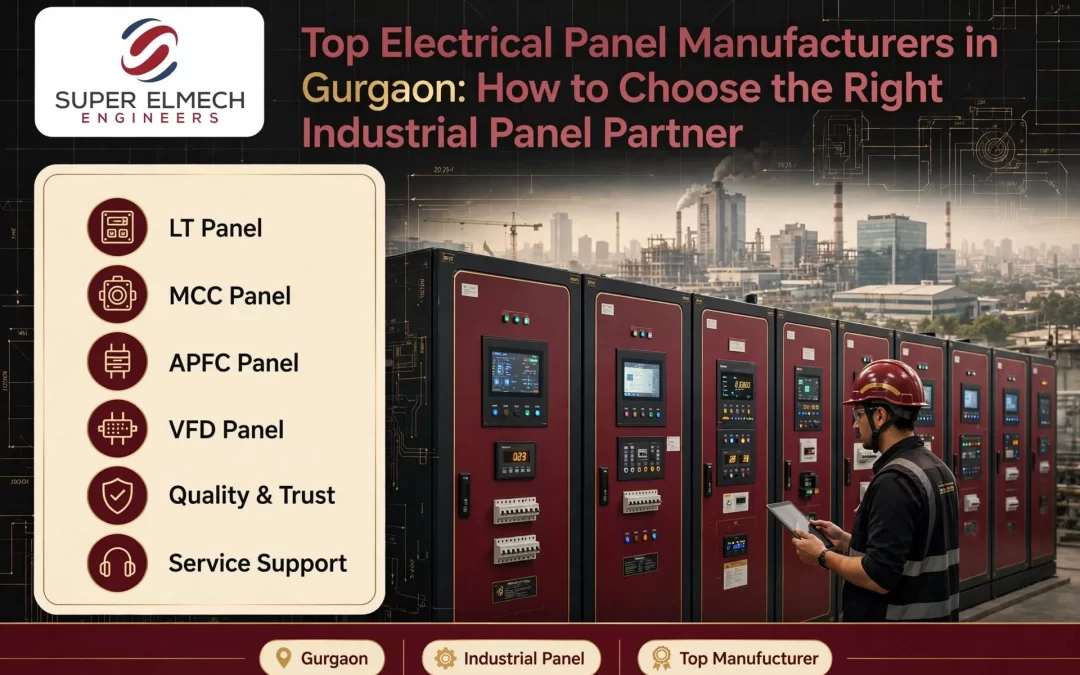
Gurgaon, officially known as Gurugram, has developed into an important industrial and commercial centre in the Delhi NCR region. With manufacturing units, IT parks, warehouses, commercial buildings, hospitals and infrastructure projects expanding across the region, the demand for dependable electrical power distribution and control systems continues to grow.
Choosing from the top electrical panel manufacturers in Gurgaon is therefore an important decision for businesses planning a new facility, upgrading an existing electrical system or installing machinery. The right manufacturer should understand the project’s electrical load, safety requirements, operating environment and future expansion plans—not simply supply a panel at the lowest price.
An electrical panel is the central point from which electrical power is distributed, controlled and protected. Its design and construction can influence equipment reliability, maintenance requirements, operational safety and long-term project costs.
This guide explains the major types of electrical panels, the technical checks buyers should perform, the questions to ask before placing an order and how to shortlist an electrical panel manufacturer in Gurugram.
Table of Contents
- Why Gurgaon Businesses Need Reliable Electrical Panels
- Types of Electrical Panels Used in Industrial Projects
- Top Electrical Panel Manufacturers in Gurgaon: How to Shortlist
- Important Technical Specifications to Check
- Manufacturing, Inspection and Testing Requirements
- How Much Does an Electrical Panel Cost in Gurgaon?
- Common Mistakes to Avoid When Selecting a Manufacturer
- Why Consider Super Elmech Engineers Pvt Ltd?
- Frequently Asked Questions
- Conclusion
Why Gurgaon Businesses Need Reliable Electrical Panels
Gurugram has a varied industrial and commercial environment. Manufacturing facilities, automotive suppliers, commercial complexes, hospitals, warehouses and infrastructure projects have different electrical requirements.
For example, a factory operating several motors needs suitable motor control and protection arrangements. A commercial building may require dependable power distribution across lighting, HVAC, lifts and other services. A warehouse may need a distribution system designed around material-handling equipment, ventilation and future electrical expansion.
A properly engineered electrical panel helps to:
- Distribute electrical power to different loads.
- Protect circuits against specified electrical faults.
- Control motors, pumps, fans and other equipment.
- Monitor operating parameters.
- Improve power factor when an appropriately designed APFC system is installed.
- Support safe operation and planned maintenance.
- Allow future modifications when the system is designed with suitable spare capacity.
The correct panel depends on the project’s load schedule, single-line diagram (SLD), fault level, operating conditions and applicable electrical requirements.
Why local manufacturing and project coordination matter
Working with a manufacturer in or around Gurugram can make technical discussions, factory visits, inspection coordination and project communication easier. However, location alone should not determine the purchase.
Buyers should verify the actual manufacturing address, engineering capability, product range, inspection arrangements, delivery commitments and after-sales support. A company may have a sales office in one location while manufacturing at another facility.
Types of Electrical Panels Used in Industrial Projects
Before contacting electrical panel manufacturers in Gurgaon, identify the type of panel your project requires. Different panels perform different functions, and selecting the wrong configuration can create operational and maintenance difficulties.
1. Power Control Centre (PCC) Panel
A Power Control Centre panel is generally used for receiving and distributing electrical power to downstream distribution boards, motor control centres and other electrical loads.
Typical PCC applications include:
- Manufacturing plants
- Industrial buildings
- Commercial complexes
- Infrastructure projects
- Large electrical distribution systems
A PCC panel may include incomer and outgoing circuit breakers, busbars, metering instruments, protection devices and control accessories.
The panel should be designed around the approved electrical drawings, rated current, fault withstand requirements and the project’s protection coordination philosophy.
2. Motor Control Centre (MCC) Panel
A Motor Control Centre panel is used to control and protect multiple electric motors from a central assembly.
Common applications include:
- Industrial production lines
- Water and wastewater treatment plants
- HVAC systems
- Pumping stations
- Process industries
- Material-handling systems
Depending on the application, an MCC may contain DOL starters, star-delta starters, soft starters, VFD feeders, contactors, overload protection and motor protection devices.
Fixed and draw-out MCC panels
Fixed-type MCC panels have components installed in fixed compartments. Draw-out configurations allow designated functional units to be withdrawn for maintenance or replacement, subject to the manufacturer’s design and safety provisions.
The choice depends on plant operating requirements, maintenance strategy, available space and budget.
3. Automatic Power Factor Control (APFC) Panel
An APFC panel automatically controls capacitor-bank switching to maintain the desired power factor under changing load conditions.
It is commonly considered in facilities with inductive loads such as motors, pumps, compressors and industrial machinery.
A typical APFC panel may include:
- Automatic power factor controller
- Capacitor banks
- Capacitor-duty switching devices
- Protection equipment
- Detuned reactors, where required by the harmonic assessment
- Metering and indication
The required kVAR capacity should be calculated from actual load and power-factor information. An oversized or poorly configured capacitor bank can create operational problems.
4. Automatic Mains Failure (AMF) Panel
An AMF panel manages the changeover between the normal mains supply and a standby generator according to the system’s configured operating sequence.
It can monitor mains conditions, initiate generator-start commands, manage transfer logic and support the return to the normal supply when conditions are restored.
AMF panels are commonly used in facilities where continuity of electrical supply is important, such as hospitals, commercial buildings, factories and essential services.
The generator, switching equipment, protection and interlocking arrangement must be compatible with the complete system design.
5. Variable Frequency Drive (VFD) Panel
A VFD panel controls motor speed by regulating the frequency and voltage supplied to a compatible AC motor.
Typical applications include:
- Pumps
- Fans and blowers
- Conveyors
- Compressors
- HVAC equipment
- Process machinery
VFD selection should consider motor ratings, load characteristics, starting requirements, harmonics, ventilation and the manufacturer’s installation recommendations.
6. PLC and Automation Control Panel
PLC panels are used for automatic control of industrial processes and machinery. They may integrate programmable logic controllers, input/output modules, relays, communication equipment, HMIs and other automation components.
These panels are useful when equipment needs coordinated operation, sequencing, monitoring or communication with a supervisory control system.
Top Electrical Panel Manufacturers in Gurgaon: How to Shortlist
A search for the top electrical panel manufacturers in Gurgaon may return large switchgear companies, specialist panel builders and smaller engineering firms. These businesses may serve different project sizes and technical requirements.
Instead of treating an online list as a quality ranking, prepare a shortlist and evaluate each manufacturer against the same technical and commercial criteria.
What to compare before selecting a manufacturer
| Selection factor | What the buyer should verify |
|---|---|
| Manufacturing facility | Actual factory address and manufacturing capability |
| Product range | PCC, MCC, APFC, AMF, VFD and other required panels |
| Engineering | SLD, GA drawings, control drawings and load calculations |
| Components | Approved makes and exact component models |
| Panel construction | Enclosure, segregation, busbar and cable arrangement |
| Testing | Inspection plan, routine test records and applicable test evidence |
| Customisation | Ability to meet project-specific requirements |
| Delivery | Production schedule and dispatch commitments |
| Support | Installation coordination, commissioning and service arrangements |
| Documentation | Drawings, BOM, manuals and test reports |
Examples of manufacturers and businesses to research
The following are examples of electrical panel and switchgear businesses with a Gurugram presence. This is an indicative research shortlist, not an independently verified ranking of the best manufacturers. Buyers should contact each business directly to confirm its current product range, manufacturing location, certifications, project suitability and availability.
- Super Elmech Engineers Pvt Ltd – Gurugram-based electrical control and distribution panel manufacturer. Its published product range includes PCC, MCC, APFC, VFD, AMF and other specialised panel solutions.
- Tricolite Electrical Industries Limited – Has a manufacturing presence in IMT Manesar, Gurugram. Buyers can check its current switchboard and panel offerings against project requirements.
- Milestones Switchgears Pvt. Ltd. – Listed at Udyog Vihar, Gurugram. Confirm the specific LT/HT panel categories and engineering scope relevant to your project.
- Indian Transformers and Electricals Pvt. Ltd. – Has a Gurugram presence and offers electrical equipment and power-distribution solutions. Confirm the exact panel scope required.
- Shivam Instruments & Controls Pvt Ltd – A Gurugram-based business listed for electrical control and power-distribution panel work. Verify its current manufacturing and project capabilities.
A manufacturer’s presence in Gurugram does not automatically establish that it is suitable for every project. Request technical documents, factory details and comparable project references before making a final decision.
Important Technical Specifications to Check
The electrical panel quotation should be evaluated against a technical specification—not just a product name or total price.
1. Rated voltage and current
Confirm the system voltage, frequency and rated current. The panel’s current rating should be appropriate for the calculated load and the project’s future requirements.
For LT systems, buyers commonly encounter 415 V, three-phase installations, but the actual project specification must always take priority.
2. Short-circuit withstand capacity
The panel’s short-circuit rating must be appropriate for the prospective fault level at the installation point.
Ask the manufacturer to explain the basis of the selected rating and provide relevant design or test documentation. Do not assume that every panel from a manufacturer has the same short-circuit withstand capability.
3. Busbar design
Busbars carry current between the incoming and outgoing sections. Their material, cross-section, arrangement, support system, temperature-rise performance and short-circuit withstand capability are important.
The design should be suitable for the specified current and operating conditions.
4. Enclosure and ingress protection
The enclosure protects internal components from external conditions and accidental contact.
Check:
- Indoor or outdoor installation
- Required IP rating
- Dust and moisture exposure
- Ventilation requirements
- Corrosion protection
- Ambient temperature
- Cable entry arrangement
The required protection level should be determined by the actual installation environment.
5. Protection and switchgear selection
Circuit breakers, contactors, overload relays, protection relays and other devices should be selected according to the load, fault level and coordination requirements.
Ask for exact makes and model numbers in the bill of materials (BOM). A quotation that simply says “standard components” does not provide enough technical detail.
6. Drawings and documentation
Before production, review the following documents where applicable:
- Single-line diagram (SLD)
- General arrangement (GA) drawing
- Control schematic
- Power schematic
- Bill of materials
- Cable and terminal details
- Inspection and testing plan
Why drawings should be approved before manufacturing
Approved drawings reduce the risk of incorrect feeder arrangements, insufficient cable space, unsuitable component placement and avoidable changes during production.
For a customised panel, the buyer and manufacturer should agree on the final drawings and scope before fabrication and assembly begin.
Manufacturing, Inspection and Testing Requirements
A professional electrical panel manufacturer should have a defined process for engineering, fabrication, assembly, inspection and documentation.
Typical manufacturing stages
- Review the project specification, SLD and load schedule.
- Prepare and review the GA and control drawings.
- Finalise the component selection and BOM.
- Fabricate and finish the enclosure.
- Install busbars, switchgear and control components.
- Complete wiring, ferruling and identification.
- Perform applicable inspections and electrical tests.
- Record test results and prepare dispatch documentation.
What should buyers check during inspection?
The inspection should be based on the approved drawings, technical specification and agreed inspection plan.
Typical checks may include:
- Enclosure dimensions and finish
- Component make and model
- Busbar dimensions and connections
- Wiring identification and ferruling
- Tightness and workmanship checks
- Earthing continuity
- Insulation resistance
- Functional operation of control circuits
- Interlocking and protection functions, as applicable
- Metering and indication checks
The exact tests depend on the panel design, applicable standards and project specification.
What does CPRI-tested mean?
CPRI testing generally refers to testing performed by the Central Power Research Institute for specified equipment or assemblies under defined test conditions.
Buyers should ask for the actual test certificate and verify the product configuration, ratings and scope covered by it. A certificate for one tested design should not be assumed to cover every panel manufactured by the same company.
Similarly, routine tests on an individual completed panel and type-test evidence for a design are not interchangeable.
How Much Does an Electrical Panel Cost in Gurgaon?
There is no single standard price for an industrial electrical panel. The cost depends on the electrical rating, component selection, enclosure design, busbar arrangement, fault level, control requirements, testing scope and quantity.
| Cost factor | How it affects the quotation |
|---|---|
| Panel type | PCC, MCC, APFC, AMF and VFD have different configurations |
| Current rating | Influences busbars, switchgear and construction |
| Fault level | Affects design and equipment selection |
| Component brand | Changes material cost and technical characteristics |
| Enclosure | Material, thickness, size and IP rating influence cost |
| Automation | PLC, HMI, communication and control features add scope |
| Testing | Inspection and test requirements affect project cost |
| Quantity | Multiple panels may change manufacturing economics |
| Installation | Site work, cabling and commissioning may be quoted separately |
How to compare quotations fairly
Do not compare two quotations only by their final amount. Check whether both include the same technical ratings, component brands, busbar material, enclosure specifications, protection devices, drawings, testing, packing and delivery terms.
A lower initial price may not represent better value if important components or services are excluded.
For an accurate quotation, share the SLD, load schedule, panel quantity, installation details and required delivery timeline with the manufacturer.
Common Mistakes to Avoid When Selecting a Manufacturer
Choosing only on the basis of price
A low-cost quotation may exclude essential protection, documentation or testing. Compare the complete technical and commercial scope.
Not checking the factory
If the project is significant, arrange a factory visit or inspection. Verify that the manufacturer has the required facilities, assembly capability and quality-control process.
Ignoring future expansion
If additional machinery or feeders are expected, discuss spare feeders, space and electrical capacity during the design stage.
Not confirming the component brands
Ask for the approved BOM with exact make and model details. Confirm whether substitutions require written approval.
Treating every certificate as universal
Check the scope, validity, ratings and configuration covered by each certificate. Avoid relying on a generic claim without supporting documentation.
Overlooking after-sales support
Confirm who will handle installation coordination, commissioning assistance, troubleshooting and warranty-related communication.
Why Consider Super Elmech Engineers Pvt Ltd?
Super Elmech Engineers Pvt Ltd is an electrical control and distribution panel manufacturer based in Gurugram, Haryana. The company serves industrial and commercial requirements through a range of electrical panel and power-management solutions.
Its published information describes an ISO-certified organisation with a manufacturing facility in Gurugram and engineering processes that include AutoCAD-based GA sketches, single-line diagrams and control drawings. The company states that its facility is equipped to deliver electrical panels up to 6000A. Buyers should confirm the exact rating, configuration and project-specific capability for their application.
Electrical panel solutions
Super Elmech’s published product range includes:
- Power Control Centre (PCC) Panels: For electrical power distribution.
- Motor Control Centre (MCC) Panels: For motor control and protection.
- APFC Panels: For automatic power-factor correction.
- Thyristor-Based APFC Panels: For applications requiring faster capacitor-bank switching.
- AMF Panels: For mains and generator changeover control.
- VFD Panels: For variable-speed motor applications.
- HVAC and AHU Panels: For building and air-handling system control.
- Water and ETP-related Panels: For treatment plant equipment control.
Explore the relevant product pages:
- Power Control Centre (PCC) Panels
- Motor Control Centre (MCC) Panels
- Automatic Power Factor Control (APFC) Panels
- Thyristor-Based APFC Panels
- Variable Frequency Drive (VFD) Panels
- Fire Fighting Panels
- HVAC Panels
- Testing and Support
What information should you share for a quotation?
To help the engineering team understand your requirement, prepare:
- Project location and industry.
- Required panel type and quantity.
- Electrical load schedule and SLD.
- Voltage, current and fault-level details.
- Preferred switchgear brands, if specified.
- Indoor/outdoor installation and IP requirements.
- Automation, PLC or communication requirements.
- Inspection, testing and documentation requirements.
- Expected delivery and commissioning schedule.
Discuss your electrical panel requirement with Super Elmech Engineers Pvt Ltd.
Website: https://www.superelmech.com/
Address: A-1/11, Sheetla Colony, Sayyad Marg, Gurugram, Haryana
Phone: +91 (124) 646 0877
Mobile: +91 9811129576
Email: [email protected]
For project enquiries, visit the Super Elmech Contact Page.
Frequently Asked Questions
1. Who are the top electrical panel manufacturers in Gurgaon?
Gurugram has several electrical panel and switchgear businesses, including Super Elmech Engineers Pvt Ltd, Tricolite Electrical Industries Limited and other specialist manufacturers. The right choice depends on the required panel type, ratings, engineering capability, testing evidence, delivery and service support. Buyers should independently verify each company’s current capabilities.
2. How do I choose an electrical panel manufacturer in Gurugram?
Check the manufacturer’s actual factory, engineering drawings, product range, component brands, panel construction, inspection process, test documentation, delivery schedule and after-sales support. Compare quotations against the same technical specification.
3. Which types of electrical panels are used in factories?
Common industrial panels include PCC, MCC, APFC, AMF, VFD, PLC and distribution panels. The selection depends on the plant’s power distribution, motor control, automation and backup-power requirements.
4. What is the difference between a PCC panel and an MCC panel?
A PCC panel primarily receives and distributes electrical power to downstream systems. An MCC panel is designed to control and protect multiple motors through individual motor feeders and starter arrangements.
5. What is an APFC panel used for?
An APFC panel automatically switches capacitor banks to maintain a target power factor as electrical loads change. Its capacity and configuration should be based on actual load and power-factor data.
6. What is an AMF panel?
An Automatic Mains Failure panel monitors the normal mains supply and manages the configured generator-start and source-transfer sequence when mains conditions become unacceptable. The complete system requires compatible generator, switching and protection arrangements.
7. Are CPRI-tested electrical panels always required?
Not every project has the same testing and certification requirements. Buyers should follow the project specification, applicable standards and consultant or authority requirements. Where CPRI test evidence is specified, verify the certificate’s scope and the tested configuration.
8. Can electrical panels be customised for a factory?
Yes. Industrial panels can be designed around the approved SLD, load schedule, protection requirements, enclosure conditions, automation needs and future expansion plans. The final design should be approved before manufacturing.
9. What documents should I request from a panel manufacturer?
Depending on the project, request GA drawings, SLDs, control schematics, BOM, relevant certificates, inspection and test records, operating documents and warranty details.
10. Does Super Elmech Engineers manufacture electrical panels in Gurugram?
Super Elmech’s published company information identifies its manufacturing facility in Gurugram, Haryana. The company lists multiple electrical control and distribution panel categories. Confirm the required panel configuration, rating, manufacturing schedule and project scope directly with its engineering team.
Conclusion
Selecting from the top electrical panel manufacturers in Gurgaon requires more than comparing company names or quotations. Industrial buyers should evaluate engineering capability, panel ratings, component quality, manufacturing processes, inspection and testing documentation, delivery commitments and after-sales support.
A well-designed electrical panel should match the actual application and approved project specifications. Whether the requirement is a PCC, MCC, APFC, AMF, VFD or automation panel, clear technical communication before manufacturing can reduce avoidable changes and improve project coordination.
Super Elmech Engineers Pvt Ltd, with its Gurugram manufacturing facility and published range of electrical control and distribution panels, is one option industrial buyers can evaluate for their project requirements. Share your SLD, load schedule and technical specifications with the engineering team to discuss a suitable panel solution.