




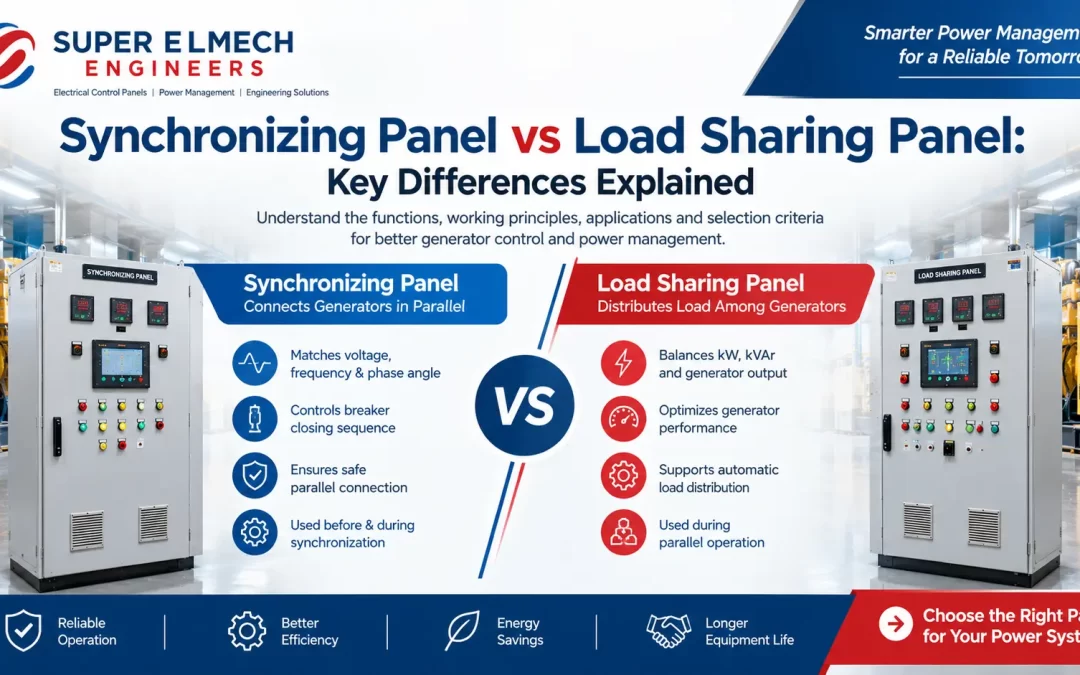
Synchronising Panel vs Load Sharing Panel
When an industrial site has multiple DG sets, there needs to be a safe way to link them together to ensure a reliable power solution.Using a synchronising panel and load sharing panel can help!
A synchronising panel links an incoming generator to a live bus bar and ensures the conditions for the generator match. A load sharing panel ensures a shared load between parallel generators.
Understanding this difference will help with technical specification of the generator sets and when comparing quotes with electrical panel manufacturers.
Table of Contents
What is a synchronising panel?
How does it work?
What is a load sharing panel?
How does it work?
Synchronising Panel vs Load Sharing Panel: Comparison Table
How they work together
Industrial applications
Technical specifications
Choosing the right panel
Common mistakes.
Choosing the right electrical panel manufacture.
FAQs
Conclusion
1.Synchronising Panel vs Load Sharing Panel?
A synchronising panel is an electrical panel that helps with linking two or more compatible AC supplies together in parallel.
If a site has two diesel generators and the first generator is already supplying power to the bus bar. When the second generator starts, it will need to be linked to the live busbar but only once certain electrical conditions are met.
The synchronising system will compare the incoming generator to the live busbar and will ensure the breakers close when the set conditions are met.
Key functions of a synchronising panel include;
Monitor generator and busbar voltages.
Compare generator and busbar frequencies.
Check phase angle & sequence.
Ensure a synchronising process happens either manually or automatically.
Control or allow the generator circuit breaker to close.
Link to generator controllers, protection relays and other controls.
Allow monitoring of the status and alarm.
Conditions checked during synchronising;
Voltage
Ensure the incoming voltage matches the busbar within certain limits.
Frequency
Ensure the incoming voltage frequency matches the busbar.
Phase Sequence
Correct phase sequence.
Phase Angle
Ensure phase angle is correct within the range for the breaker operation.
Limits will depend on the generator, synchronising controller, protection and approved engineering settings.
2. How Does a Synchronising Panel Work?
The synchronising panel can be fully automatic, manual or have a mixture of both.
Start
Generator engine starts up and speeds up. Alternator creates AC voltage.
Measurements
Controller measures incoming generator and busbar voltages, frequencies and phase.
Adjust
If the design allows automatic adjustments, the controller will link to the engine governor and AVR to get the generator up to the correct operating conditions.
Check Synchronising Conditions
Controller will ensure the incoming generator meets the set synchronising conditions.
Breaker Closes
If conditions are met, the breaker will be instructed/allowed to close via the approved control and interlocking.
Working in Parallel
Once linked, the generator will work in parallel with the existing source. It may have load sharing functionality either separately or built into the panel to ensure the generator shares the load.
A synchronising panel will not replace any generator protection. Breaker interlocking, fault protection and full sequence of operations will need to be engineered for the specific installation.
3. What Is a Load Sharing Panel?
A load sharing panel is a control system that allows a shared load between parallel generators.
When multiple generators are supplying a common busbar, it is important that each generator is within suitable operating limits. The load sharing system will ensure that each generator shares its load correctly according to the chosen control strategy.
For example, a manufacturing site may have 2 generators supplying their production equipment. The load sharing system will ensure that each generator works in line with the load changes within the plant and doesn’t put an unsuitable load on either generator.
Key functions of a load sharing panel include;
Ensures active power (kW) is shared.
Supports reactive power (kVAr) if set.
Monitor generator loading and status.
Link to compatible engine governor and AVR.
Supports sequencing depending on load if included.
Provides alarms and status information.
Links to overall power management system.
Understanding kW, kVA & kVAr.
Active Power (kW)
Used by equipment such as motors, pumps, lights etc.
Reactive Power (kVAr)
This relates to the magnetic and electric fields in AC equipment. This is generally controlled via the excitation of the generator and AVR.
Apparent Power (kVA)
This is the overall load in kVA. When choosing a generator, you should consider the kW, kVA, power factor and ratings of the equipment.
Load sharing should be compatible with the generators and their controls. It may not be correct to have equal kW sharing between generators if they have different ratings.
4. How Does a Load Sharing Panel Work?
This depends on the generator controller and overall power management system however generally;
Link
Generators will be linked using the approved synchronising and breaker control.
Measure Load
Controllers will measure the generator output and correct parameters such as kW, kVAr, voltage, frequency and breaker status.
Calculate Load Requirement
Controller will calculate how much the generator should contribute depending on the sharing method and available capacity.
Communicate
System will communicate with compatible governor and AVR controls or other controls to ensure the generators share the load.
Manage Load Changes
As load changes, the system will monitor the generators.
Alarms & Sequencing
Depending on the design, the system may ask for another generator to start, perform load shedding or raise an alarm if approaching operating limits.
For example, if a production line starts and the factory load increases, an integrated power management system may start another generator. Once the demand has reduced, the system may stop an unnecessary generator using the set operating conditions.
The sequences should be designed and commissioned for the actual load profile and generator.
5. Synchronising Panel vs Load Sharing Panel: Comparison Table
Item
Synchronising Panel
Load Sharing Panel
Main Function
Ensures a synchronised connection to an incoming source.
Ensures load is shared between parallel generators.
Key Function
Ensures correct electrical conditions prior to and during connection.
Ensures generators share load correctly when working in parallel.
Key Measurements
Voltage, frequency, phase angle and phase sequence.
kW, kVAr and other relevant electrical and status measurements.
Main Function
Ensures synchronisation and breaker closure.
Ensures governor/AVR and load sharing.
Typical Equipment
Synchronising controller, measuring circuits, breaker controls & interlocking.
Load sharing controller, generator controls and measuring interfaces.
When Used
When a controlled connection to parallel generators is required.
When parallel generators need to share the load.
Generator Start/Stop
May be part of an integrated automated sequence.
May have sequencing based on demand if included.
Overloading
May have alarms and interlocking but not a load management solution.
May have load management to prevent overloading.
Typical Application
To link an incoming generator to an energised busbar.
To ensure multiple generators share the load.
Physical Design
Can be a stand-alone panel or integrated.
Can be a stand-alone panel or integrated.
Which panel to choose?
There is no ‘better’ panel to choose. It depends on what functionality is required.
Synchronising – Ensure you specify a correct synchronising function.
Load Sharing – Ensure you specify a load sharing function compatible with your generators.
Both – Consider an integrated solution or a coordinated multi-controller solution.
In many modern installations, these functions will be integrated into the generator controllers or power management system.
6. How Do They Work Together?
The synchronising and load sharing functions complement each other.
The synchronising function will help ensure the conditions are met to connect an incoming generator to a live bus bar. The load sharing will help ensure the generators share the load.
Example;
A manufacturing plant has 3 generators in total. The load will change throughout the day.
Generator 1 will start and supply the load.
As the load increases, Generator 2 will start.
The synchronising controller will check Generator 2.
The breaker will close once the approved conditions are met.
The load sharing will ensure the generators share the load.
If the load increases further, Generator 3 may start depending on the power management sequence.
This can help with flexibility and ensure the maximum amount of generation is used.
Generator Start > Synchronising > Breaker Close > Load Sharing > Monitoring.
Depending on the site, the sequence may also include paralleling with utility, bus tie logic, automatic switching, load shedding, redundancy and fault recovery.
7. Industrial Applications
Manufacturing Plants
Generators are used to support motors, compressors, pumps, production lines and essential services. Synchronising and load sharing can help ensure multiple generator sets share the power.
Hospitals & Healthcare Facilities
Hospitals may have a highly engineered back-up power system for certain essential loads. Paralleling generators may be part of the overall emergency power system, however transfer times and redundancy should be specified.
Data Centres
Multiple generators may be used as part of the power resilience. The control should be considered with load steps, redundancy, protection, testing and recovery.
Commercial Buildings
Large commercial buildings or high rise buildings may have multiple generators to help supply essential or operational loads. The control panel should be specified based on the approved electrical design and load.
Industrial Utilities & Infrastructure
Water treatment, industrial utilities and infrastructure may require some coordination of generators to support pumps, ventilation and essential equipment.
Remote & Captive Power Plants
Remote sites may rely on multiple generators to provide the varying load. A good power management system can help ensure that the generators are shared correctly.
8. Technical Specifications
Before requesting a quote, ensure you have a technical specification with the following information;
Generator Ratings
Number of generators, kW and kVA ratings, voltage, frequency, power factor, generator make and interface.
Synchronising Controller
Ensure it can be set to automatic/manual, has voltage and frequency monitoring, synchronising functionality, breaker control, alarms and is compatible with your intended generator controls.
Load Sharing
Will you require load sharing based on %, set loads, base load, load dependent sequencing or other.
Governor & AVR
Ensure it is compatible with the engine governor and AVR. Incorrect settings or incompatible interface can cause poor load sharing.
Protection & Breakers
Speak to your responsible electrical engineer to ensure you have the correct generator protection, breaker interlocking, over current, reverse power and voltage/frequency protection.
Monitoring
Does the installation require PLC/HMI, remote monitoring, event logging or integration with building management or power management system.
Enclosure
Consider the enclosure, IP rating, ventilation, ambient temperature, dust, humidity, cable entries and ease of maintenance.
Drawings & Testing
Ask for drawings, controller settings, sequencing, protection settings, testing and commissioning. Ensure the testing plan covers the required synchronising, breaker interlocking, load sharing and fault scenarios.
9. Choosing the Right Panel
Follow this checklist when looking at generator control panels.
Application
Do you have multiple diesel/gas generators, utility or a mix?
Load Requirements
Create a load sheet with the demand, motor starting requirements, essential loads and future expansions.
Operation
Do you require manual/automatic synchronising, load sharing, automatic sequencing, paralleling with utility or other?
Control System
Ask them to explain how the controllers, measuring circuits, breaker interlocking, governor/AVR and communications work.
Fault Conditions
What will happen if a generator fails, loses communication, fails to synchronise, overloads or the controller fails.
Full Quotes
Ensure you are comparing the full technical scope, components, drawings, testing, commissioning, warranty and service.
Commissioning
Who will set up the controllers, test onsite, train staff and provide handover documents.
10. Common Mistakes
Don’t make the following mistakes when specifying;
Assuming synchronising and load sharing are the same.
Not ensuring compatibility with the generator controllers.
Confusing kW, kVA & kVAr requirements.
Not considering breaker interlocking and protection.
Not specifying what will happen if a generator fails or loses communication.
Not defining testing and commissioning requirements.
Not considering future expansion.
Only comparing on price.
Having a clear technical specification will help the manufacturers suggest a system that fits your application.
11. Choosing an Electrical Panel Manufacturer
Ensure they understand the relationship between the electrical design, generator controls, protection, installation and commissioning.
Ensure they have;
Experience with generator control and power management systems.
Technical drawings and clear scope of supply.
Compatible with your chosen generators and controllers.
Protection & Interlocking.
Documentation & Testing.
Installation & Commissioning.
Access for maintenance & after-sales.
Super Elmech Engineers Pvt. Ltd offer electrical panel manufacturing and engineering solutions. Industrial customers can contact us to discuss your application and ensure we can provide the correct generator synchronising/load sharing scope.
Useful links;
Note – VFD panels relate to motor control and aren’t a replacement for synchronising or load sharing panels. Please confirm with the manufacturer what the exact product will do.
12. Frequently Asked Questions (FAQs)
Q1. What is the main difference between a synchronising panel and load sharing panel?
A synchronising panel ensures an incoming generator is connected to the system with the correct electrical conditions. A load sharing panel ensures the load is shared between the parallel generators.
Q2. Can a synchronising panel work without a load sharing panel?
Yes, in some instances. The load sharing can be performed via separate generator controllers or integrated system. The full design will ensure the generators are loaded correctly.
Q3. Can a load sharing panel work without a separate synchronising panel?
If the generator controllers have the correct synchronising functionality, a separate panel may not be required. However, the system must provide the synchronising functionality.
Q4. Can they be combined into one panel?
Yes, they can be combined or coordinated across the generator controllers, switchgear and power management system.
Q5. Can a load sharing panel be used with 2 generators?
Yes, a load sharing system can be designed for 2 or more generators.
Q6. Will a synchronising panel help reduce fuel consumption?
No, it won’t directly. This depends on the generator efficiency, loading, strategy and maintenance. A good power management system may help improve the efficiency of the operation in some cases.
Q7. What does the governor do in a load sharing system?
The governor controls the speed of the engine and generally takes part in the active power (kW). This will depend on the generator and controller.
Q8. What does the AVR do in a load sharing system?
The AVR controls the excitation and voltage of the generator. With the correct controls, it can take part in the reactive power/power factor sharing.
Q9. What information do I need to provide when requesting a panel quote?
Quantity of generators, ratings, voltage, frequency, generator/controller details, load sheet, operation, protection, communication & commissioning.
Q10. How do I choose a synchronising panel manufacturer in India?
Ensure they have technical experience, compatible with your generators, good control design, protection, documentation, testing, commissioning and service. Ask for a proposal based on the actual project specification.
13. Conclusion
The main difference between a synchronising panel and load sharing panel is their function within a multi-generator system. The synchronising panel ensures an incoming generator can be connected to a common busbar with the correct electrical conditions. The load sharing panel ensures the generators share the load.
Many industrial sites will require both a synchronising and load sharing panel either as separate panels, integrated into the generator controllers or as part of an overall power management system.
Ensure you know the generator ratings, load profile, operation, protection, controls and commissioning requirements. A technical complete proposal will be more helpful than just a quote for the panel name/price.
Contact Super Elmech Engineers for any electrical panel enquiries and discuss your technical requirements.