




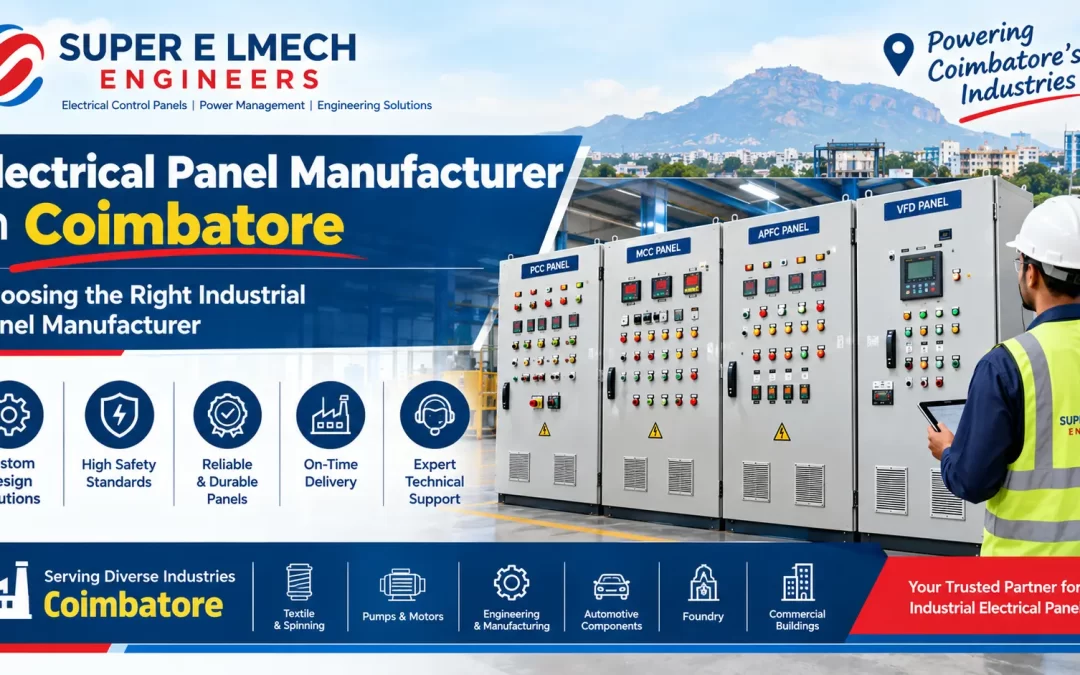
Introduction: Choosing the Right Electrical Panel Manufacturer in Coimbatore
Coimbatore is an important industrial and manufacturing centre in South India.
As most companies operate within this industry, it’s important that you have reliable electrical distribution and control systems. This is required for any machinery, motors, production lines, pumps, compressors and utilities. All of this will rely on correct electrical panel designs.
Therefore, it’s important to choose the correct Electrical Panel Manufacturer in Coimbatore. Factory owners, electrical contractors, EPC Companies, Consultants, Project Managers and Industrial Procurement will find this useful.
An electrical panel contains several components, protection devices, wiring and the enclosure. The design will depend upon the electrical requirements of the project.
The right electrical panel will depend on the load connected, voltage, fault level, environmental conditions, control scheme, future expansion and any standards.
This article will cover the main types of industrial electrical panels, the applications they can be used for, important factors to consider, key specifications and what to ask.
Table of Contents
- Why Reliable Electrical Panels Are Important for Coimbatore Industries
- What Is an Industrial Electrical Panel?
- Types of Electrical Panels Used in Coimbatore Industries
- Applications of Electrical Panels in Coimbatore Industries
- Key Components Used Within an Industrial Electrical Panel
- How to Choose the Right Electrical Panel Manufacturer in Coimbatore
- Electrical Panel Manufacturing and Quality
- Why Engineering and Technical Support Matters
- What to Ask Before Ordering an Electrical Panel
- Frequently Asked Questions
- Conclusion: Find the Right Electrical Panel Solution for Your Industrial Project
Why Reliable Electrical Panels Are Important for Coimbatore Industries
Having a stable electrical supply is important in any industry. Poor protection, wiring, components or incorrect panel design can cause issues.
There are various industries within Coimbatore’s manufacturing industry.
Textiles and Spinning Mills
Various motors, drives, pumps, blowers and compressors will be required. This could include Motor Control Panels, VFD Panels, MCC Panels and Distribution Panels.
Pumps and Motors
Testing, machinery, assembly lines and utilities will require electrical systems. Motor starters, overload protection and speed control will be a factor.
Foundries and Metal Processing
Various machinery will be used, including furnaces, motors, dust collection, compressors and material handling. The panel must be designed with the load, environment and protection in mind.
Engineering and Automotive Components
Various machinery will be used in manufacturing plants, including CNC, hydraulic, conveyor, robotics and manufacturing utilities. This could include machine control, distribution, automation and motor protection.
Ensure that exactly what electrical panel you require is determined by the electrical drawings and requirements.
What Is an Industrial Electrical Panel?
An industrial electrical panel consists of various electrical and control components which are housed within an enclosure. They are used for distributing electrical power, providing protection, controlling machinery and monitoring or automation.
Depending on the application, they can include:
- Circuit Breakers and Protection Devices
- Contactors and Control Relays
- Motor Starters and Overload Relays
- Busbars and Distribution Points
- Variable Frequency Drives
- Programmable Logic Controllers (PLC)
- Metering and Indication
- Control Wiring and Terminals
- Enclosures, Cable Glands and Accessories
A good engineer will ensure that the panel is designed with electrical ratings, component compatibility, temperature rise, short circuit, wiring, accessibility and maintenance.
Types of Electrical Panels Used in Coimbatore Industries
Depending on the application, there are various types of panels.
1. PCC Panel (Power Control Centre)
Used for distributing and controlling electric power.
It can take a supply from a transformer, generator or upstream source and distribute it to downstream feeds.
Common applications are:
- Manufacturing
- Industrial Utilities
- Commercial
- Large Distribution Systems
Consider what incomer and feeders are needed, along with busbar size, fault level, protection and metering.
2. MCC Panel (Motor Control Centre)
Used to control and protect multiple motors.
They can include motor starters, contactors, overload protection, circuit breakers, control relays and accessories.
Common applications:
- Textile Machinery
- Pumps
- Compressors
- Conveyors
- Industrial Processes
The design will depend on motor ratings, starting methods, duty cycle, operation sequence and maintenance.
3. APFC Panel (Automatic Power Factor Control)
This panel helps control the power factor by automatically switching capacitor steps depending on the reactive power required.
They will commonly include capacitor banks, switching devices, a power factor controller, protection and other components.
Can offer:
- Improved power factor
- Improved reactive power management
- Avoid unnecessary power factor penalties
- Improved distribution utilisation
Capacitor banks must be chosen based on the load profile, harmonics, switching and utility requirements. Detuned reactors may be required.
4. VFD Panel (Variable Frequency Drive)
A VFD panel will control the speed of a motor by changing the frequency and voltage supplied.
These can be useful where the process varies and you need to control the speed of the motor.
Common applications:
- Pumps
- Fans and Blowers
- Textile Machinery
- Conveyors
- Industrial Processes
Ensure you select the right VFD by considering motor details, load, starting and stopping requirements, ambient temperature, enclosure and harmonics.
Find out more about our VFD panel solutions here.
5. AMF Panel (Automatic Mains Failure)
This panel will manage the change between mains supply and standby generator based on the control setup.
Common applications:
- Factory
- Commercial
- Hospital
- Warehouse
- Any building that requires standby power
Consider generator ratings, interlocking, sequence of operation, protection and operation.
6. Synchronising Panel
Used for synchronising two or more generators or sources, using an approved method of control and protection.
Can be used to help synchronise, control breakers, share load and monitor.
Common applications are industrial plants and multiple generator sets. The design will depend on generator details, protection and operation.
7. PLC and Automation Control Panel
Used for automating machinery.
They can include PLC, power supplies, I/O, relays, communications, terminals and a human-machine interface.
Common applications:
- Production Lines
- Pump Automation
- Material Handling
- Process Control
- Machine Sequencing
Ensure you select the correct hardware and software based on the number of signals, process sequence, communications and future expansion.
8. LT Distribution Panel
Low Tension panels are used for distributing electricity.
They can include incomers, busbars, feeders, metering and protection.
Consider what voltage and current ratings, fault level, installation and distribution are required.
Applications of Electrical Panels in Coimbatore Industries
Any experienced electrical panel engineer should know that each industry will have different requirements.
Electrical Panel Requirements by Industry
| Industry | Typical Panel Requirements |
|---|---|
| Textiles and Spinning | MCC, VFD, PCC and Machine Control Panels |
| Pumps and Motors | Motor Control, Testing and Distribution Panels |
| Foundries | PCC, MCC and Equipment Control Panels |
| Engineering Units | Machine Control, PLC and Distribution Panels |
| Automotive Components | MCC, Automation and Machine Control Panels |
| Commercial | LT Distribution and APFC Panels |
| Water and Utilities | Pump Control and Automation Panels |
These are just examples of typical applications. The final panel design must be based on the actual equipment and project drawings.
Key Components Used Within an Industrial Electrical Panel
Correct component selection and coordination will be important.
Circuit Breakers
Provide protection from overload and short circuit. Consider voltage, current, interrupting capacity, tripping characteristics and coordination.
Contactors
Contactors are electromechanical switches commonly used to control motors, capacitor banks and other loads. Ensure the utilisation category and duty are suitable.
Overload Relays
Provide motor protection from overload. Settings should match the motor data and protection requirements.
Busbars
Provide distribution of power within the panel. Ensure correct current ratings, temperature rise, short circuit, material, supports and enclosure.
VFDs and Soft Starters
Control motor speed. Soft starters help reduce stress on the motor when starting. Ensure the correct choice based on load and process.
PLC and Control Relays
Help with automation, interlocking, sequencing and alarms.
Metering and Indication
Provide indication of electrical parameters.
Enclosures, Cable Glands and Terminals
Ensure enclosures, glands, terminals and wiring are suitable for the installation.
How to Choose the Right Electrical Panel Manufacturer in Coimbatore
When choosing an electrical panel manufacturer, it’s important to not only look at quotes but also ensure the panel is an engineered product designed for the application.
1. Determine Your Electrical Requirements
Ensure you have the following details ready to request your quote:
- Single Line Diagram (SLD)
- Load Details
- List of Motors and Ratings
- Incoming Supply Details
- Outgoing Feeders Required
- Voltage and Frequency
- Fault Level Available, if known
- Control Scheme
- Location and Environmental Conditions
If drawings are not available, speak to a qualified electrical consultant or engineering team.
2. Can They Review Your Electrical Drawings?
Ask if they can review your electrical drawings, component selection, control wiring, panel layout and operation sequence.
They should also clarify any technical details that aren’t available.
3. Component Details
Ensure you know what make, model and ratings of breakers, contactors, relays, drives, busbars, metering and other components are being used.
Don’t assume that two quotes with similar prices will be the same technically.
4. Fabrication
Ensure the enclosure will be fabricated as per the drawings, mounted correctly, wired well, components identified, cables routed correctly and the panel made accessible.
5. Inspection and Testing
Ask what inspection and testing will be carried out. This can include:
- Visual Inspection
- Wiring and Connections
- Earth Continuity
- Insulation Resistance, if applicable
- Functionality
- Interlocking
- Other routine testing requirements, depending on the panel type, design and requirements
6. Documentation
Ensure you will receive the following documentation:
- Approved Drawings
- General Arrangement
- SLD
- Control Wiring
- Bill of Materials
- Component Data Sheets
- Test Documentation
- Operation and Maintenance Information, if required
7. After-Sales Support
Ensure you know how technical queries, commissioning, updating of documentation and service requirements will be handled.
Having this information will make future maintenance easier.
Electrical Panel Manufacturing and Quality
Electrical panels will be engineered, components sourced, fabricated, wired, inspected and tested.
Engineering
The design will determine the electrical ratings, control, protection, component layout and enclosures.
Fabrication
The enclosure will be manufactured as per the approved sizes, material, mounting and environmental requirements.
Mounting
Components will be fitted as per the approved layout, with adequate spacing, accessibility and identification.
Wiring
Power and control wiring will be completed as per the approved drawings.
Inspection and Testing
The panel will be reviewed as per the agreed inspection and testing. Any variations should be noted and resolved prior to dispatch.
Documentation
Documentation will be provided as per the purchase order. This would include component details and test documentation.
Super Elmech can provide information on testing and support. Ensure you know what testing will be carried out.
Why Engineering and Technical Support Matters
Having the correct panel design can help you organise your electrical equipment better.
For example, a textile unit may require motor speed control on selected machines. A pump manufacturing unit may require motor control and testing. A foundry will have different operation and environmental conditions compared with a commercial building.
Therefore, it’s important to design the panel for the actual process.
Super Elmech Engineers Pvt. Ltd. specialise in electrical panel engineering and manufacturing. If you are looking to create electrical panels for your industrial project, visit their website. Let them know your technical requirements.
View More from Super Elmech
- Electrical Engineering and Panels
- VFD Panels
- Testing and Support
- Get in Touch
What to Ask Before Ordering an Electrical Panel
Before placing your purchase order, ensure you know:
- Is the quote based on the latest approved SLD and technical requirements?
- Are the components clearly listed with make and ratings?
- Is the panel suitable for the fault level at the installation?
- Are the enclosure sizes and IP requirements known?
- Will spare feeders be required for future expansion?
- What testing and inspection will be carried out?
- What drawings will be provided?
- Are installation and commissioning included or excluded?
- What are the delivery, warranty and support terms?
- Who will approve any variations?
Having this information written down will help avoid any confusion during manufacturing.
Frequently Asked Questions
1. What Is an Electrical Panel Manufacturer in Coimbatore?
An electrical panel manufacturer will design and assemble electrical distribution and control panels. When choosing a manufacturer, ensure you compare their technical ability, component selection, quality of manufacture, testing and documentation.
2. What Types of Electrical Panels Are Commonly Used in Coimbatore Industries?
Common electrical panel types include PCC, MCC, APFC, VFD, AMF, Synchronising, PLC Automation and LT Distribution Panels. The correct type will depend on the electrical loads and requirements.
3. What Is the Difference Between a PCC Panel and MCC Panel?
A PCC panel is mainly used for distribution. An MCC panel is used to control and protect multiple motors. Some installations will use both.
4. What Is an APFC Panel Used For?
An APFC panel is used to automatically switch capacitor steps to help manage reactive power and improve power factor. The design should consider load profile, harmonics and utility requirements.
5. What Is a VFD Panel Used For in Textile Industries?
A VFD panel controls the speed of compatible motors by varying the frequency and voltage. This could be used on selected textile machinery, pumps, fans and other equipment.
6. What Information Do I Need to Get a Quote for an Electrical Panel?
You should provide SLD, load details, list of motors, voltage, current, fault level, control requirements, enclosure details and installation conditions.
7. How Do I Choose the Right LT Panel?
Consider voltage, current, fault level, busbars, protection, enclosure, metering, cable connections and standards.
8. Why Is Testing Important for Electrical Panels?
Testing and inspection help ensure that the panel is built to the agreed design. The testing will depend on the panel type, project requirements and standards.
9. Can Electrical Panels Be Customised for Industrial Applications?
Yes. The panel can be designed to suit your load, control sequence, protection, components and installation.
10. Does Super Elmech Manufacture Industrial Electrical Panels?
Super Elmech Engineers Pvt. Ltd. show their electrical panel engineering and manufacturing capabilities on their website. Visit their site and get in touch.
Conclusion: Find the Right Electrical Panel Solution for Your Industrial Project
Choosing the right electrical panel manufacturer is an important step in creating a safe and reliable electrical system. With many industries within Coimbatore, including textiles, pumps, motors, foundries, engineering and manufacturing, there are many different requirements.
Depending on your project, whether you need a PCC Panel, MCC Panel, APFC Panel, VFD Panel, AMF Panel, Synchronising Panel or LT Distribution Panel, you should choose the right panel based on the load, technical requirements, installation and operation.
Ensure you review the engineering drawings, component ratings, quality of fabrication, testing and inspection, documentation and after-sales support.
Planning an Industrial Electrical Panel Project in Coimbatore?
Get in touch with Super Elmech Engineers Pvt. Ltd. and let them know your electrical panel requirements.
Website: https://superelmech.com/
Contact: https://superelmech.com/contact-us/