




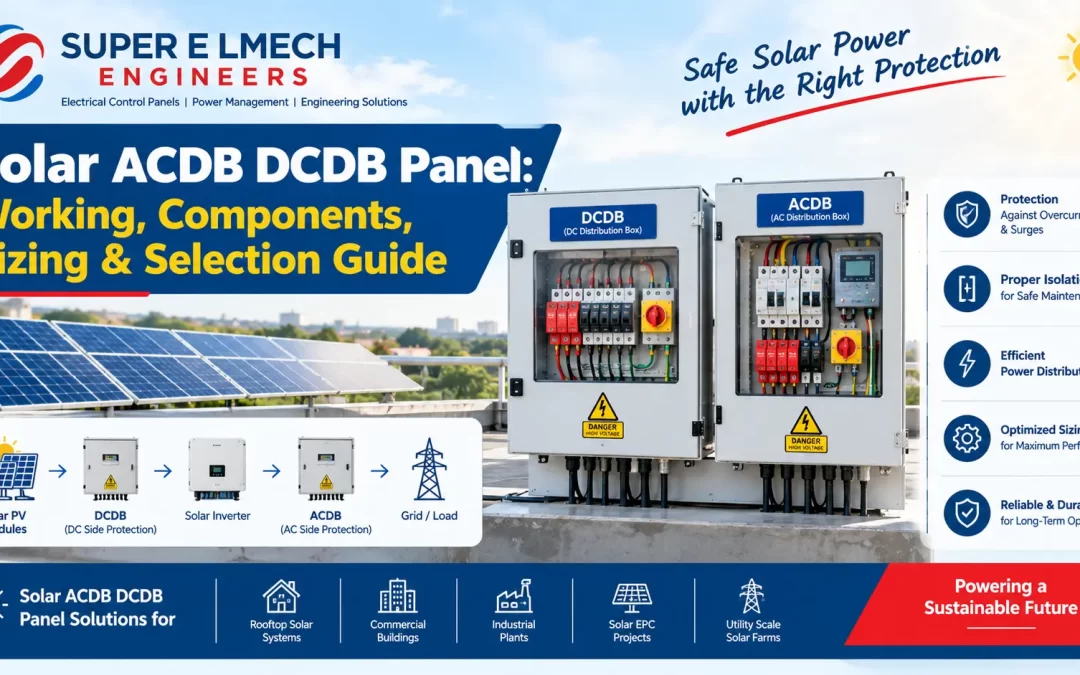
Solar ACDB and DCDB Panels: Components, Sizing, Selection and Applications
Solar power systems are becoming more important in factories, commercial buildings, warehouses, housing societies and industries. Companies are looking to reduce their electricity costs, increase energy efficiency and make the most out of their roof and/or ground mounted spaces.
However, just having solar modules and an inverter is not enough to create a safe and reliable solar power system. Protection, isolation and distribution are also important.
This is where Solar ACDB and DCDB panels come in.
A DC Distribution Box (DCDB) is typically used between the solar PV strings and the inverter. Providing protection, isolation and string monitoring or combining depending on the system design.
An AC Distribution Box (ACDB) is typically used on the AC side of the inverter. Providing the appropriate protection and isolation before connecting the power to the electrical distribution system.
Both panels will need to be sized correctly for the voltage, current, inverter, fault level, environment and electrical requirements.
This article will explain how Solar ACDB and DCDB panels work, the components involved, sizing, selection and common mistakes.
Table of Contents
- What Is a Solar DCDB Panel?
- What Is a Solar ACDB Panel?
- What Is the Difference Between ACDB and DCDB?
- Main Components of a Solar DCDB Panel
- Main Components of a Solar ACDB Panel
- How to Size a Solar DCDB Panel
- How to Size a Solar ACDB Panel
- Example Solar ACDB and DCDB Sizing
- Things to Consider When Choosing ACDB and DCDB Panels
- Common Mistakes in Solar ACDB and DCDB Panel Selection
- Applications of Solar ACDB and DCDB Panels
- How to Choose the Right Solar ACDB and DCDB Panel Manufacturer
- Frequently Asked Questions
- Conclusion
What Is a Solar DCDB Panel?
A Solar DCDB (Direct Current Distribution Box) is a protection and distribution box for the DC side of a solar photovoltaic system.
Solar modules produce DC electricity. These are connected in series to form strings and multiple strings are often connected to the inverter.
The DCDB will protect and isolate between the PV array and inverter.
Functions of DCDB
Protect against over current and faults in DC
Provide safe isolation of PV circuit
Combine strings (if required)
Provide surge protection (as required)
Organise DC cables
String monitoring (if required)
Depending on the inverter design some string inverters will have protection, isolation and surge protection built into them so an external DCDB may not be necessary or will be different.
What Is a Solar ACDB Panel?
A Solar ACDB (Alternating Current Distribution Box) is used on the AC side of an inverter.
The inverter changes the DC electricity produced by the solar modules to AC electricity. An ACDB will protect and isolate the electricity before connecting to the building distribution system.
Functions of ACDB
Protection against over current
Isolation
Protection against transient over voltages (using suitable surge protection)
Organise connections between the inverter and downstream electrical system.
Improves safety and ease of maintenance.
The ACDB needs to be sized to be appropriate for the inverter rating, electrical design and protection requirements.
What Is the Difference Between ACDB and DCDB?
Whilst both panels are used in solar designs, they have different functions.
Parameter
DCDB
ACDB
Full Form
DC Distribution Box
AC Distribution Box
Side of Panel
Solar DC Side
Inverter AC Side
Typical Location
PV Array to Inverter
Inverter to AC Distribution
Supply
DC
AC
Purpose
Protection and Isolation of DC
Protection and Isolation of AC
Protection
DC rated fuse, DC isolator and DC SPD
AC rated breaker, AC isolator and AC SPD
Inputs
Module Voltage, String Current and Number of Strings.
Inverter Output Voltage, Current and Fault Level.
In simple terms the DCDB will protect and organise the DC side connections of the solar panel. The ACDB will protect and organise the AC side of the inverter.
Main Components of a Solar DCDB Panel
Components inside the DCDB will depend on the PV array design and inverter manufacturers requirements.
DC Fuse/String Fuse
Protects PV strings from over currents. Fuses will be important in parallel string designs as there is a risk of reverse current from other strings.
The fuse needs to be rated for:
Max PV String Current
Max Series Fuse Rating (modules)
Max Voltage
Fault Current
DC Fusing Rating of Manufacturer
Current Only Should not be Used
DC Surge Protection Device
Protects the DC part of the solar installation from transient over voltages.
The SPD will be chosen based on:
Max PV System Voltage
Earthing Configuration
Lightning Protection Design
Type and Protection Level of SPD
Manufacturer Coordination Requirements
DC Isolator
Provides isolation of the relevant DC circuit.
Must be rated for DC voltage, current and switching.
Terminals
Provides organised connections for PV strings and inverter.
Must be rated for the cable size, current, temperature and enclosure.
Enclosure
Protects electrical components.
Should be rated for:
Appropriate IP rating
UV and Corrosion Resistant (if required)
Temperature
Cable Entries
Ventilation
Good electrical clearances and creepage.
Main Components of a Solar ACDB Panel
Components inside the ACDB will be AC rated switches and protection devices.
AC Circuit Breaker
Protects the circuit. Must be chosen based on:
Inverter Rated Output Current
Cable Current Rating
Derating Factors
Fault Current
Breaking Capacity
Coordination with Upstream and Downstream Protection.
AC Surge Protection Device
Protects the electrical system from transient over voltages.
SPD will be chosen based on the earthing system, lightning assessment and design requirements.
AC Isolator
Provides isolation of the inverter. Must be rated for voltage, current and switching.
Bus Bars and Terminals
Used for distributing the power. Must be rated for:
Current
Temperature
Short Circuit Rating
Thermal Conditions of Enclosure.
Enclosure
Protects the assembly. Optional metering, indicators and monitoring can be added but should only be added if required.
How to Size a Solar DCDB Panel
Correctly sizing your DCDB is very important to ensure safe operation. Designing the panel should start with reviewing the PV module datasheet, string design and inverter.
Check Max PV String Voltage
The Open Circuit Voltage (Voc) of a PV module will change depending on the temperature. As the modules voltage will usually increase with lower temperatures, it will be important to calculate the max voltage corrected for the minimum design temperature for the site.
A basic calculation would be:
String Voc= Module Voc x Number of Modules
This is just a basic calculation that does not take into consideration temperature and should not be considered as your final design voltage. You will need to apply a temperature correction factor using the module manufacturers temperature coefficient.
Ensure all components are rated for the max corrected voltage (Inverter, DC Isolator, Fuses, SPD, Connectors etc.)
Check String Current
You will find the short circuit current (Isc) and max power current (Imp) from the PV module datasheet.
If you have parallel strings:
Total Current= String Current x Number of Parallel Strings
Ensure the design current is taking into consideration any correction factors and safety requirements from the relevant standards and design.
Do not use current only to size your fuses and cables.
Check Number of Strings
Check:
Number of PV Modules
Modules in Series per String
Number of Parallel Strings
Inverter MPPT Inputs
Max Input Current
Whether or not the inverter has built in string protection.
This will decide whether you need an external string combiner DCDB.
Choose DC Fuses
Must be rated for max series fuse rating of module and protection requirements.
Voltage must be rated for max corrected voltage of the DC system.
Choose DC SPD
Must be rated for max PV voltage, earthing, surge exposure and coordination.
Choose DC Isolator
Must be rated for the DC voltage, current and approved for switching.
Check Enclosure
IP Rating
Temperature Rise
Cable Bends
Terminal Compatibility
Clearance and Creepage
Environmental Conditions and Corrosion.
How to Size a Solar ACDB Panel
Start off by looking at the inverter rated output current and electrical characteristics.
Calculate Inverter Output Current
Three Phase
I = P ÷ (1.732 x V x PF)
Where:
I = AC = Current in Amps
P= Active Output Power in Watts
V= Line to Line Voltage
PF= Power Factor
Single Phase
I = P ÷ (V x PF)
The main design consideration will be using the inverter manufacturers rated output current and operating parameters. This is just a calculation.
Choose AC Circuit Breaker
Must be:
Rated for inverter manufacturers requirements
Protect the chosen cable
Appropriate voltage and current rating
Appropriate breaking capacity for fault current available.
Coordination with Upstream and Downstream Protection.
Choose AC SPD
Must be rated for system voltage, earthing and surge protection requirements.
Choose Bus Bars and Terminals
Must be rated for design current, temperature, enclosure and short circuit.
Check Cable
Cable should be sized for:
Continuous Current
Installation Method
Temperature
Derating due to grouping.
Voltage Drop
Short Circuit
Insulation and Environmental.
Finalise Enclosure
Ensure the enclosure has the correct size, IP rating, internal spacing, cable entries, ventilation and ease of maintenance.
Example Solar ACDB and DCDB Sizing
Assume we have the following design:
Solar Inverter Rating- 50kW
Three Phase Voltage- 415V
PF- 1.0
PV Strings- 4 Parallel Strings
Modules in Series- 18 Modules
Module Voc- 49V
Module Isc- 13A
Example AC Current
Three Phase:
I = 50,000 ÷ (1.732 x 415 x 1.0)
Approx. 69.6A
This is just an example. You should ensure the inverter has the correct rated output current and operating voltage range. You should also check manufacturer instructions, cable design and protection coordination before choosing an ACDB breaker.
Example DC Voltage
Uncorrected String Voltage:
49 V × 18 = 882 V
You should apply a correction factor for the minimum design temperature for the site.
Example DC Current
Uncorrected Combined Short Circuit Current:
13 A × 4 = 52 A
This is just an example and you should ensure that your design takes into consideration any correction factors, reverse current, module max fuse ratings, inverter input limitations and protection requirements.
Please note these are just examples to show how to calculate the values. This is not a design ready for construction and should not be assumed that you should choose these breaker, fuse, cable or SPD ratings. This should be confirmed by a qualified electrical engineer using the full project data.
Things to Consider When Choosing ACDB and DCDB Panels
Solar System Rating
A 10kW system will have different requirements compared to a large industrial installation. The panel should be designed based on the actual PV and inverter setup.
Inverter Requirements
Check:
Max DC Input Voltage
Max Input Current
MPPTs
Max Short Circuit Input Current
Rated AC Output Current
External Protection Required.
Site Conditions
Outdoor installations could have dust, rain, heat, humidity and direct sunlight. Ensure the enclosure and components are appropriate.
Protection Coordination
Ensure all protection is coordinated. Incorrect coordination can cause unnecessary tripping and poor protection.
Standards
Ensure you are using the latest applicable Indian electrical standards, relevant IEC standards, project requirements and utility requirements. The design engineer should check applicable standards for PV arrays, electrical installations, surge protection and switchgear assemblies.
Expansion
If there is a possibility of expansion, consider future capacity, extra ways and additional connections to the inverters.
Common Mistakes in Solar ACDB and DCDB Panel Selection
Even a high quality panel can become unsafe and unreliable if not specified or installed correctly.
Don’t:
Specify DC components based on the nominal voltage.
Ignore temperature correction of PV string Voc.
Use AC components in DC circuits without appropriate DC ratings.
Ignore max series fuse rating of module.
Don’t specify AC breaker without checking cable protection and fault levels.
Don’t specify SPD without checking earthing and system voltage.
Ignore temperature rise of enclosure.
Don’t consider cable routing, glands and terminal compatibility.
Don’t provide appropriate labelling.
Don’t check inspection, testing and commissioning.
A well designed solar distribution panel should be safe, easy to maintain and compatible with the whole solar installation.
Applications of Solar ACDB and DCDB Panels
Solar ACDB and DCDB panels can be used in various PV installations.
Industrial Solar Power Plants
Factories and industrial units will use solar to assist with their electricity requirements. An appropriate ACDB and DCDB can help provide organised protection and isolation.
Commercial Buildings
Offices, shopping centres, hospitals and warehouses can use rooftop solar. The panel will depend on the inverter design and electrical system.
Domestic Rooftop
Domestic installations will also require appropriate protection. The design should be appropriate for the inverter and installation requirements.
Education and Housing Societies
Schools, Colleges and Housing Societies can use solar for common area loads.
Ground Mounted Installations
Large solar plants may require multiple string combiners, inverter connections and distribution. The protection design should be developed for the electrical design of the plant.
How to Choose the Right Solar ACDB and DCDB Panel Manufacturer
Choosing the right panel manufacturer should not just be based on cost. The panel should be appropriate for your project requirements.
Ensure the manufacturer can:
Review Inverter Datasheet, PV String Design, Single Line Diagram, Protection Requirements and Site Conditions.
Check Component Ratings
Breaker, Fuses, Isolator, SPD, Terminals and Bus Bars are rated and from an appropriate manufacturer.
Quality of Manufacturing
Quality of wiring, mounting, cable routing, terminal labelling, enclosure and assembly documentation.
Testing
Ask if they can provide inspection and test documentation for the agreed scope. Testing could include insulation resistance, continuity, function and other tests.
After Sales
Ensure they can provide technical support, documentation and assistance.
Super Elmech Engineers Pvt. Ltd specialise in electrical panel engineering and manufacturing. Customers can review our capabilities and provide their electrical requirements.
Useful Pages:
Home Page: https://superelmech.com/
Testing & Support: https://superelmech.com/testing-and-support/
VFD Panels: https://superelmech.com/variable-frequency-drive-vfd-panels/
Contact Us: https://superelmech.com/contact-us/
Frequently Asked Questions
What is a Solar ACDB Panel?
A Solar ACDB is an AC Distribution Box used on the output of a solar inverter. This will provide appropriate protection, isolation and distribution for the solar connection.
What is a Solar DCDB Panel?
A Solar DCDB is a DC Distribution Box used on the PV side of a solar system. Depending on the design it can provide string protection, DC isolation, surge protection and string combining.
What is the difference between an ACDB and DCDB?
A DCDB is used on the DC side between the PV array and inverter. An ACDB is used on the AC side of the inverter. Components will need to be appropriate for the application.
Do I always need a DCDB?
Not always. Some inverters will have built in protection and isolation. If the inverter has built in string protection, the number of strings and project requirements will determine if an external DCDB is required.
How do I calculate the current rating of an ACDB?
A basic calculation for a three phase system is I = P ÷ (1.732 x V x PF). However, breaker and cable selection should take into consideration inverter specifications, installation conditions, fault levels and protection coordination.
How do I calculate the voltage of a DCDB?
A basic calculation would be Module Open Circuit Voltage x Number of Modules in Series. This should be corrected for the minimum design temperature.
Conclusion
Solar ACDB and DCDB panels are important parts of a properly engineered solar PV electrical system. The DCDB supports protection and isolation on the PV side, while the ACDB provides protection and isolation on the inverter’s AC output side.
Correct sizing requires more than selecting a breaker or fuse based on the solar plant’s kW capacity. Engineers must review PV string voltage, temperature correction, current ratings, inverter limits, cable selection, fault levels, surge protection, enclosure conditions and applicable electrical requirements.
For industrial, commercial and rooftop solar projects, selecting a suitable panel configuration and verifying the complete design can improve electrical safety, reliability and maintainability.
If you are planning an electrical panel project, visit Super Elmech Engineers Pvt. Ltd. and share your project requirements for a technical discussion.
Website: https://superelmech.com/
Contact: https://superelmech.com/contact-us/