




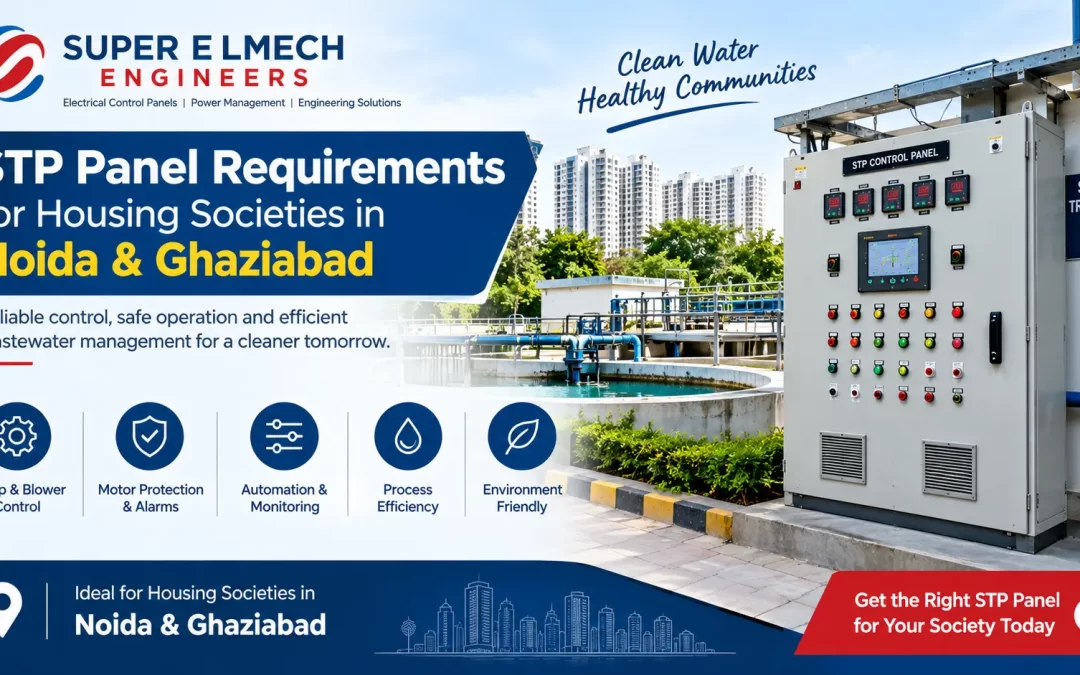
STP Panel Requirements for Housing Societies in Noida & Ghaziabad
Sewage treatment plants (STPs) provide an effective way to manage wastewater from apartment blocks, communal areas and other uses for housing societies in Noida and Ghaziabad. An STP can be designed to ensure the facility operates effectively with the required treatment process.
However, to ensure the STP equipment works correctly, the pumps, blowers, mixers, valves, sensors and other equipment must be controlled in the correct order. An STP electrical control panel can be used.
An optimum control panel can be used within residential societies to help monitor, control and identify fault issues with STP equipment. This will depend on the STP capacity, treatment process, number of motors & level of automation.
This guide will explain the key requirements, important components, safety aspects and questions you should ask your panel manufacturer when designing a new STP, upgrading an existing plant or replacing an old STP electrical panel.
Table of Contents
- STP Control Panel
- Why you need a reliable STP Panel
- Key STP Panel Requirements
- Important STP Panel Components
- Manual vs Automated STP Panel Control
- Choosing the right STP Panel Capacity
- Electrical Safety & Protection
- STP Panel Requirements for Noida & Ghaziabad
- Installation, Testing & Commissioning
- Maintenance Checklist
- Choosing the right STP Panel Manufacturer
- Frequently Asked Questions (FAQs)
- Conclusion
1. What is an STP control panel?
An electrical panel used to control and monitor STP equipment.
Depending on design, the panel can control pumps, blowers, mixers, dosing pumps, sludge handling and other equipment.
The panel can also monitor float switches, level transmitters, pressure switches, flow meters and other field devices to give control signals, telling the equipment when to come on/off or raise an alarm.
Key features of an STP Panel
Control the STP motors to turn on/off.
Ensure correct sequence of equipment working with the treatment process.
Include motor overload and short circuit protection.
Monitor water levels and equipment status.
Include alarms for chosen faults.
Automatically alternate pumps between duty/standby (if required).
Have manual switches for authorised maintenance/testing.
Indicators, meters & HMI to show status.
It is worth noting that this is not the treatment process itself but simply the electrical control and protection to allow the chosen equipment to operate as intended.
2. Why you need a reliable STP Panel
An STP in a residential society can run for long periods, meaning there can be high volumes of wastewater throughout the day. With an incorrectly specified panel this can cause issues.
2.1 Varying Wastewater Flow
Depending on how many people are in the property, what time of day & how much the facility is being used, there can be varying wastewater flows. Ensuring the control of equipment is suitable for the process design.
2.2 Pumps & Blowers
Different types of pumps & blowers (transfer, aeration etc.) will have different requirements. Ensure the panel includes correct start methods, control and protection.
2.3 Fault Identification
Overloads, phase loss, low water level and tripping can affect the normal running of equipment. Correct alarms can be included so staff are aware of the issue and can intervene quickly.
2.4 Duty/Standby
If there are pumps/blowers in standby, the control system can be set up to automatically alternate between pumps or go into standby if there is an issue. This will depend on the process design and equipment available.
2.5 Equipment Status
Having clear indicators and fault messages means the facility manager can clearly see if equipment is running, not running, in standby or having issues.
A well designed panel will ensure reliable running of the equipment. However, if the treatment equipment is undersized, incorrect design or poor maintenance then this will not overcome this issue.
3. Key STP Panel Requirements
Before purchasing your STP panel, your society management committee, facility manager and STP contractor should decide what functionality is required.
3.1 Motor Control
Ensure the panel is sized for the correct motor rating, start current, duty and process requirements.
Some common ways to start motors include:
Direct On Line – May be suitable for smaller motors.
Star Delta – May be suitable for some compatible motors.
Soft Starter – Can reduce start current and stress.
Variable Frequency Drive – If the motor and process can be designed to allow this.
Do not choose the start method based purely on motor size. This should be decided based on the supply, load type, how frequently motors are started and manufacturer recommendations.
3.2 Pumps
Depending on the plant design, the panel may be used to control inlet, transfer, recirculation, sludge or treated water pumps.
Ensure you note what pumps are being used, motor rating, duty, sequence and interlocks.
3.3 Blowers
Aeration blowers may be required for the process. Ensure the control of blowers is based on the treatment process.
If variable speed is needed, ensure the VFD and control signals are suitable for the blower and process.
3.4 Level Monitoring
Level switches/transmitters can be used to monitor high/low levels.
Depending on the application, this can be used to turn pumps on, stop equipment or raise high level alarms.
3.5 Alarms & Indicators
Useful indicators can include:
Power available.
Motor running/not running.
Motor Tripped/overloaded.
High Level.
Low Level.
Pump/Blower fault.
Auto/Manual.
Common fault.
Only include alarms that are possible with the correct sensors, signals and control.
3.6 Auto & Manual
Ensure the panel clearly includes what will happen in auto mode. Manual functions should be designed so only authorised people can use them. This should not override any key safety features.
4. Important STP Panel Components
This will depend on how many motors, power rating, level of automation and site conditions.
Component
Purpose
Notes
Incomer Protection
Protection & isolation for supply.
Correct rating, fault level & coordination.
Motor Protection
Protection for individual motors.
Ensure correct settings & compatible with motor information.
Contactors/Motor Starters
To control motors.
Ensure motor duty & electrical rating.
Overload
Protection for motor overload.
Ensure correct selection & settings.
Control Relays
Used for control & interlocking.
Ensure correct function & wiring.
PLC/controller
Used for any auto sequences.
Ensure I/O, logic & maintainable.
HMI/indicators
Shows equipment status & alarms.
Ensure clear messages & accessible to operator.
Level Switch/Transmitter
Monitors tank/sump level.
Ensure compatible with process.
VFD/Soft Starter
Used for start/speed.
Ensure compatible with motor, cooling & settings.
Panel & Terminals
Protection & organisation of electrical equipment.
Ensure suitable for site, & can be maintained.
STP Automation with PLC
Larger or more complex plants may require a PLC to control the pumps, blowers, level signals & alarms.
An HMI can be used to show equipment status, fault messages & selected process information. Remote monitoring can also be included.
Not all housing societies will require a PLC, a simple relay panel may be sufficient for a small & simple installation. This will depend on your treatment process & level of monitoring required.
5. Manual vs Automated STP Panel
The level of automation will depend on the size, complexity, running times and maintenance available.
Feature
Manual/Basic Panel
Automated STP Panel
Equipment Control
Manual start/stop.
Equipment controlled with pre-set/configured logic.
Level Control
May not be available or can be done separately.
Can use level signals for automated control.
Duty/Standby
May require manual.
Can be automated if designed.
Alarms
Depends on indicators & relays chosen.
Can use configured alarms & fault messages.
Process Sequencing
Mainly manually controlled or hard wired.
Can automatically sequence multiple items.
Monitoring
Simple indicators.
Can have PLC/HMI or remote monitoring.
Generally simpler.
More control & configuration.
An automated panel may not always be the best option. Ensure it is compatible with your treatment process and the team understand how to deal with alarms & faults.
6. Choosing the Right STP Panel Size
There is no one-size-fits-all size for residential societies. The panel should be designed based on the equipment schedule & electrical supply.
Step 1: STP Design Capacity
Ensure you know the design capacity of your STP and process. Do not assume panel size based on the number of apartments.
Step 2: Motor Schedule
Ensure you have a list of all motors including their ratings, voltage, phase, full load current, start method, duty & standby.
Step 3: Simultaneous Motors
Ensure you know which motors can run at the same time and if any are interlocked or sequenced.
Step 4: Start Current
Consider the start current & frequency of pumps & blowers. Ensure the supply & switching equipment are suitable.
Step 5: Control
Ensure you know if level control, duty/standby, automated sequencing, VFD & local indicators are needed.
Step 6: Site Conditions
Consider humidity, dust, temperature, water, ventilation & location of electrical room.
Step 7: Quotation
Ask the manufacturer to provide you with a single line diagram, control schematic, equipment schedule & clear scope of supply.
7. Electrical Safety & Protection
Often STP panels will be installed in utility rooms or areas that will have moisture & wastewater. Ensuring electrical safety is considered at design stage.
7.1 Short Circuit & Overload
Ensure the protection devices are correct for the circuit rating, fault current available, motor and coordination.
7.2 Phase & Voltage
If applicable, phase loss, phase sequence, under/over voltage can be included.
7.3 Earthing
Ensure the installation is designed to meet the correct electrical design & earthing standards. The panel enclosure, equipment & exposed parts should be included in the approved design.
7.4 Ingress Protection
Ensure the ingress protection is correct for the actual conditions. If the panel is in a dry electrical room this will be different to a wet or splashing area.
7.5 Safe Maintenance
Ensure there is correct isolation, labelling, accessibility & maintenance. Work should be performed by qualified personnel with the site electrical safety procedures.
7.6 Fault Response
Ensure there is a plan for any faults. For example if equipment overloads, low/high tank level or a critical pump fails. This should be documented & tested.
Ensure the correct electrical standards, local authority & project requirements are known to the responsible engineer. Do not assume one panel design will fit all housing societies.
8. STP Panel Requirements for Noida & Ghaziabad
Ensure the panel is suitable for your housing society in Noida or Ghaziabad. This should take into consideration the design of your plant, utility, environmental conditions & local requirements.
8.1 Approved STP Design
If you are replacing/upgrading your panel, ensure you have the process flow diagram, equipment schedule & control drawings.
8.2 Actual Site Conditions
Ensure the electrical room has good ventilation, no moisture or dust, accessibility, cable runs and safe maintenance area. The panel should be designed to match the actual installation.
8.3 Monitoring
Ensure you know if the team need just local indicators, HMI, alarms or integration with the building management system.
8.4 Serviceability
If you use maintenance contractors to maintain your equipment, you may want to ensure the circuitry is clearly labelled, equipment is easily accessible & fault messages are easy to understand. Having clear documentation can help with troubleshooting.
8.5 Compliance
Ensure you know the requirements by speaking to your STP Consultant, electrical engineer & local authority. This can vary depending on the site, project approvals & current regulations.
8.6 Future Changes
If you expect to add more equipment or upgrade your process, speak to your designer to ensure there is extra I/O, space in the panel & control system can be upgraded. Plan for future capacity.
9. Installation, Testing & Commissioning
Even if the panel is manufactured correctly, it should be installed, wiring checked & commissioned.
Pre-installation
Ensure you have the approved electrical & control drawings.
Ensure the components are correct for the motor schedule.
Ensure the panel is the correct size, cable entries & installation location.
Ensure earthing is correct & site connections are correct.
Ensure all documentation is supplied.
Testing
Depending on the approved inspection & test plan, this could include:
Visual inspection & component check.
Continuity & insulation testing of wiring.
Earthing & protection.
Motor rotation & control signals.
Manual & auto testing.
Level switches & alarms.
Interlocking & duty/standby.
Fault indications & recovery.
Commissioning
The commissioning team should ensure the actual sequence of the plant matches the approved control philosophy. Testing should be recorded with settings, drawings & any changes. This should be passed onto the facility manager.
Super Elmech describe how they design, manufacture, test & support their panels. Buyers can review the process to see what testing will be carried out for their project.
10. Maintenance Checklist
Regular checks can help identify any issues. Follow the manufacturer guidelines & site maintenance plan.
Daily/regular checks
Ensure critical pumps & blowers are running as expected.
Check alarms, & investigate any faults.
Listen for any unusual noise, vibrations, heat or smell.
Ensure no visible leaks or water damage is affecting electrical equipment.
Periodic Checks
Ensure panel is clean, no moisture & no signs of overheating.
Terminal tightness & connections, following approved safe method.
Ensure ventilation & cooling.
Test alarms, sensors & automated sequences.
Investigate motor tripping & recurring faults.
Ensure control drawings & equipment settings are up to date.
Electrical work should be carried out by competent personnel following correct isolation & safety. Do not open or service any live equipment unless it is specifically authorised & under the correct safety requirements.
11. Choosing the Right STP Panel Manufacturer
Choosing the right STP panel manufacturer should not be based purely on price. Ensure they understand the electrical loads, control & conditions.
Questions to ask before ordering
Can the panel be designed to fit the approved STP equipment schedule?
Are the motor starters & protection correct for the motors?
Is there duty/standby auto?
What sensors, wiring & process instrumentation are included?
Will there be a PLC/HMI? Who will programme/control the system?
What testing & commissioning is included?
Will they provide you with approved drawings, settings & testing?
What warranty, troubleshooting & after sales support is provided?
Why Choose Super Elmech Engineers Pvt. Ltd?
Super Elmech Engineers Pvt. Ltd manufacture electrical panels. They describe how they design, manufacture & test their panels. Housing societies & STP contractors can speak to them about your equipment schedule & project requirements to ensure the panel scope is suitable.
Useful Links
Super Elmech Engineers Home Page
About Super Elmech
Testing & Support
Contact Super Elmech
Provide them with information about your STP capacity, process, motor schedule, control sequence, automation level & site conditions for an accurate quotation.
12. Frequently Asked Questions (FAQs)
Q1: What is an STP control panel?
An electrical assembly used to control, monitor & protect equipment such as pumps, blowers, mixers & other equipment.
Q2: What components will I need in my STP panel for a housing society?
This will depend on the design of the plant, however can include incomer protection, motor starters, overload, control relays, PLC/controller, indicators, level sensors & alarms.
Q3: Will an automated STP panel be better?
An automated panel can reduce regular operator intervention & ensure equipment is sequenced. However it should be designed to match your treatment process & maintenance availability. For some installations a simple panel may be sufficient.
Q4: Can pumps be automated?
Yes, if there are suitable level sensors, control & motor circuits the panel can start/stop pumps as per the approved sequence.
Q5: Do I need a VFD on all my STP pumps & blowers?
No, a VFD can be useful if you require variable speed. However not all motors will need a VFD if they can be started using conventional starters.
Q6: What should I check before replacing my old STP panel?
Ensure you have reviewed the existing motor schedule, control drawings, equipment condition, protection ratings, sensors, sequence & recurring faults. Ensure the new panel is based on the actual installation.
Q7: How do I choose an STP panel manufacturer in Noida/Ghaziabad?
Ensure they can design for your STP equipment, choose the correct components, provide protection, automation, documentation, testing, commissioning & support.
Q8: Will an STP panel ensure the treated wastewater meets discharge requirements?
No, the panel is used to control the electrical equipment. The treatment will depend on the overall design, running of the plant, maintenance & quality of the wastewater. Compliance should be ensured through the correct requirements & testing.
Q9: What information do I need to get a quotation for an STP panel?
Provide information about your STP capacity, process flow diagram, motor ratings, supply, control sequence, automation level, field instrumentation, site conditions & commissioning.
Q10: How often should I maintain my STP panel?
Follow the instructions from the panel & equipment manufacturers, site maintenance & correct safety requirements. This should depend on the conditions, criticality & faults observed.
Conclusion
Selecting the right STP panel for a housing society in Noida or Ghaziabad starts with understanding the actual treatment plant and its operating requirements. Motor ratings, starter selection, duty/standby arrangements, automation, protective devices, enclosure suitability and commissioning procedures should all be considered before finalising the design.
A well-specified panel can help operators manage equipment more effectively, identify faults and maintain a clearer record of plant operation. The final result still depends on correct engineering, quality installation, proper commissioning and regular maintenance.
Super Elmech Engineers Pvt. Ltd. provides electrical panel-related engineering, fabrication, testing and support services described on its website. Housing societies, builders, STP contractors and facility managers can contact the company to discuss project requirements and confirm the scope suitable for their installation.